.svg)
SIGN UP FOR JUICEBOX (IT’S FREE!)

Who are you looking for?
Thank you! Your submission has been received!
Oops! Something went wrong while submitting the form.

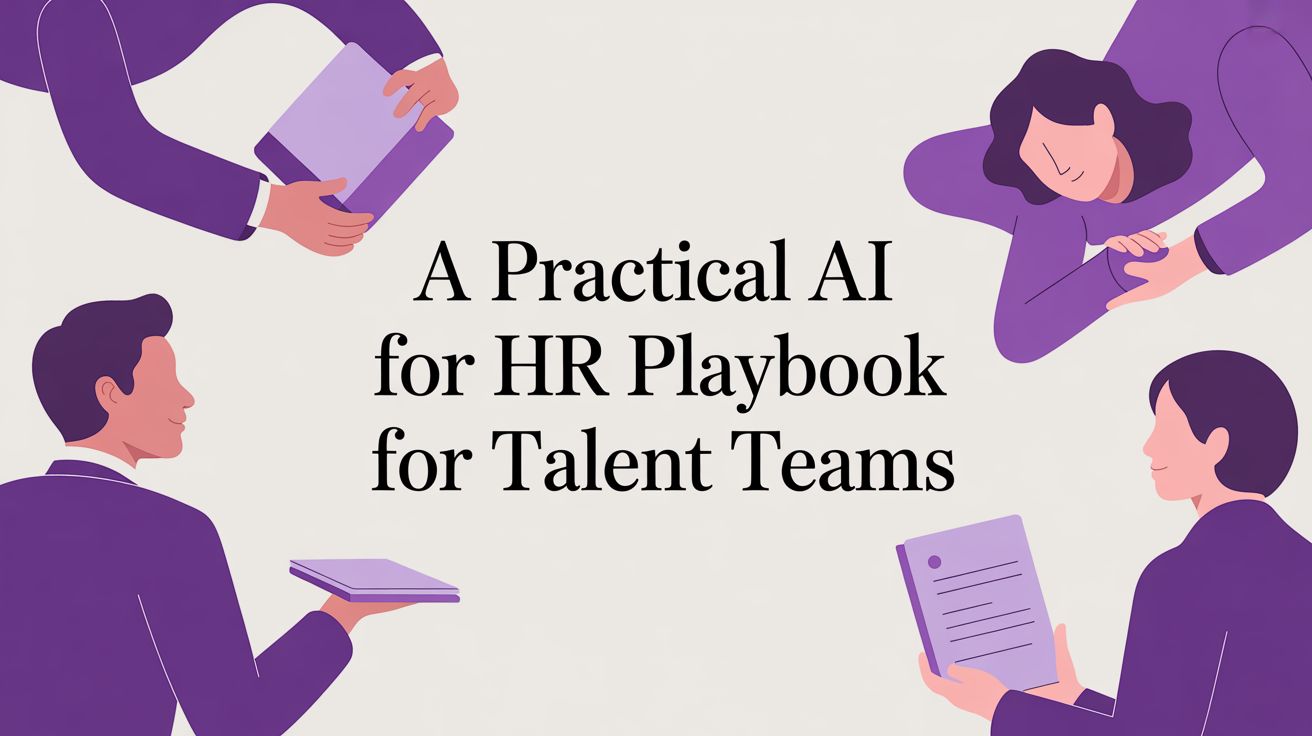
The strategic value of AI for HR is not replacing recruiters, but augmenting them to shift from tactical execution to strategic business partnership.
By automating top-of-funnel tasks with AI, talent teams can reallocate their expertise to high-impact activities like candidate engagement and market intelligence, directly driving business outcomes like reduced time-to-hire and improved quality-of-hire.
TL;DR
The real value of AI for HR isn't about replacing recruiters—it's about unleashing their strategic potential. It’s the shift that turns talent acquisition from a reactive, manual chore into a proactive, data-driven function that directly shapes business outcomes.
This playbook outlines how to move beyond hype and integrate AI to solve real business problems.
For years, the chatter around AI in HR felt stuck in a loop of chatbots and resume parsers—tools that felt more like experiments than indispensable parts of a recruiter's workflow. This left many talent leaders skeptical, seeing AI as a solution searching for a problem.
That era is over. We're now moving from isolated AI gadgets toward integrated platforms that solve real-world business challenges. The new wave of AI for HR fundamentally rewires how talent teams operate, replacing broken manual processes with efficient, intelligent workflows. Instead of just slapping a turbocharger on an old engine, it builds a new one.
Historically, a staggering 80% of a recruiter's time was burned on manual, top-of-funnel tasks—building complex Boolean strings, sifting through irrelevant profiles, and hunting for contact info. This left a mere 20% for high-value work: building candidate relationships and advising hiring managers.
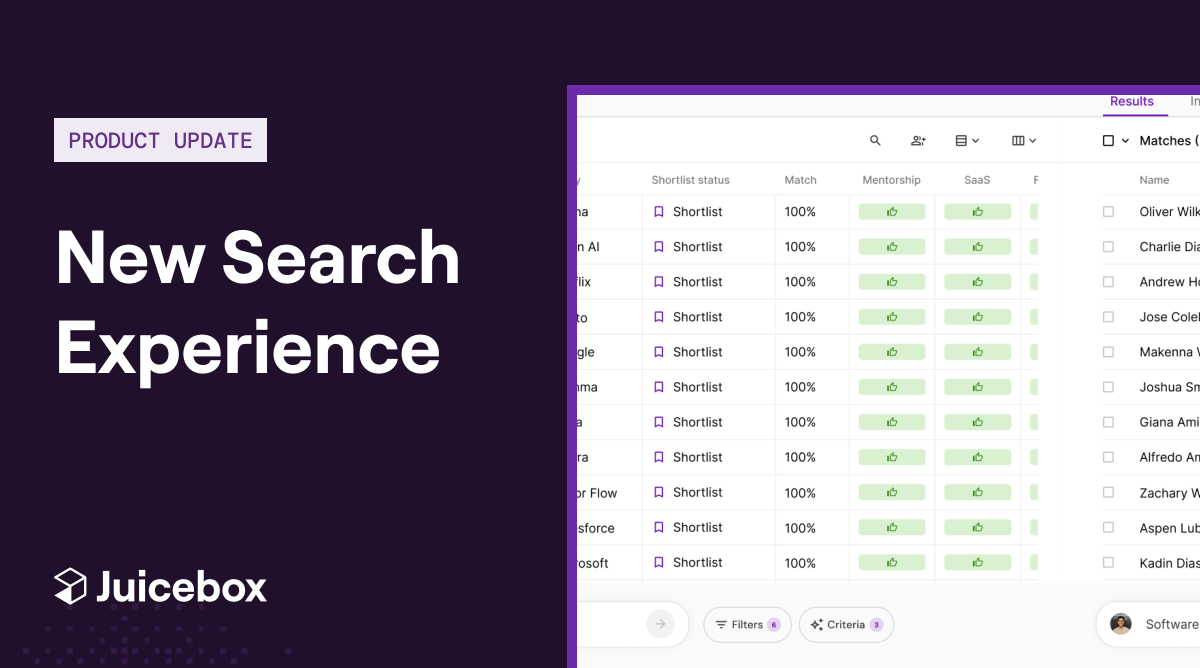
This is exactly where modern AI flips the script. By automating the tactical grunt work, it frees up human expertise. For example, PeopleGPT, a sourcing feature inside the Juicebox platform, uses natural language prompts to scan over 800 million profiles and deliver a qualified shortlist in seconds. The need for manual boolean search for recruiters and painful data validation vanishes, turning hours of tedious work into minutes.
This isn't just about efficiency. It's about connecting talent acquisition directly to the company's bottom line. When your team can build pipelines faster and engage higher-quality candidates, the business sees tangible results:
The core benefit of AI isn't automation for its own sake. It's about reallocating your team's most valuable resource—human judgment—to activities that drive revenue and innovation.
Making this shift requires asking, "What business problems can AI solve?" instead of "What tasks can AI do?" When you focus on outcomes like beating talent scarcity and gaining a competitive edge, AI for HR becomes a powerful engine for growth. As you build your strategy, it is also important to learn how to prevent adverse impact in hiring practices.
To grasp how AI for HR works, you must look past buzzwords and see where it plugs into the talent lifecycle. The biggest wins happen where manual work creates the most painful bottlenecks—and for most talent teams, that’s right at the top of the funnel.
AI platforms bridge the gap between messy, manual tasks and clean, measurable business outcomes.
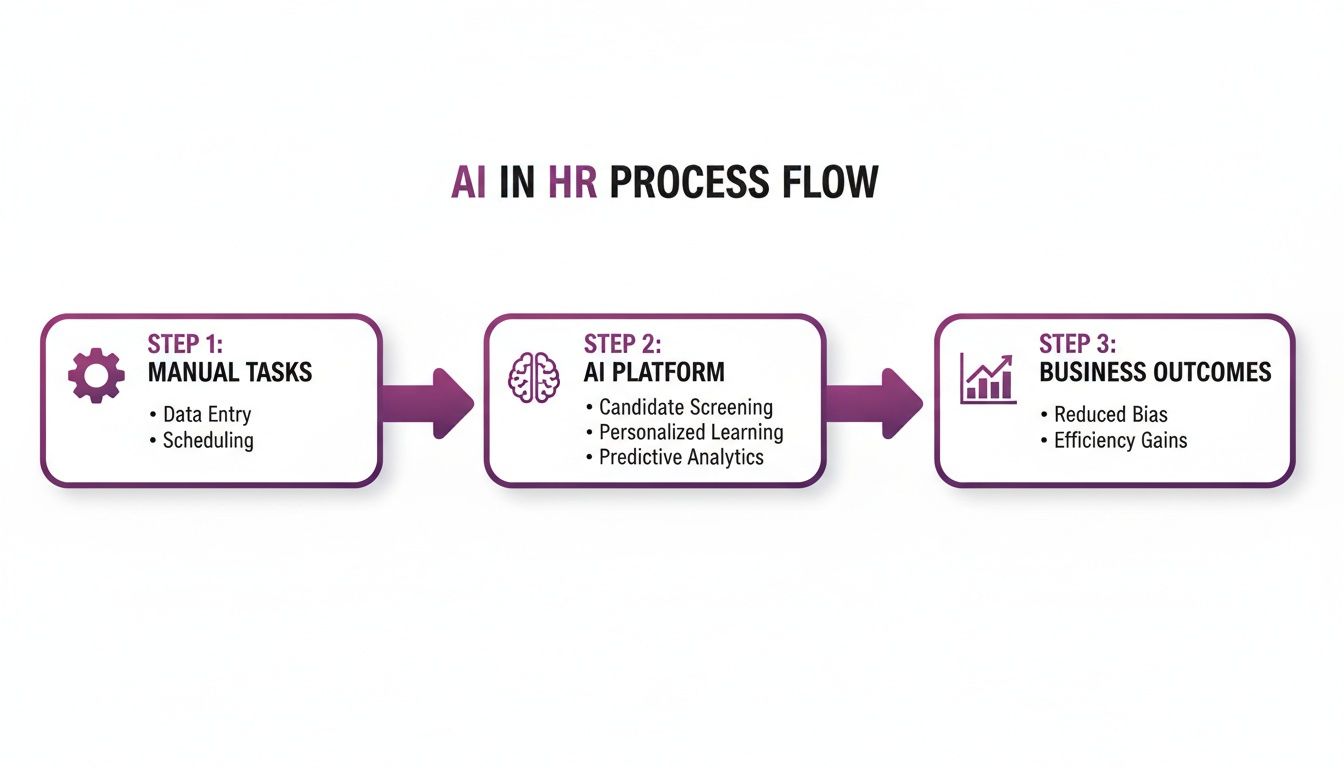
The flow is simple: AI ingests the chaos and produces strategic results that directly move the needle on core business metrics.
Ask any recruiter what eats up their day, and they'll say it's finding great passive candidates. It’s a grind of wrestling with complex Boolean searches and manually sifting through profiles on siloed platforms.
AI-native sourcing flips this script.
Recruiters can describe their ideal candidate in plain English. For example, "Find senior backend engineers in San Francisco who have worked at a YC-backed fintech startup and have experience with Go and AWS" can instantly scan millions of profiles. The AI understands context and career paths, not just keywords.
Platforms like Juicebox pull data from over 60 sources, finding talent that 80% of competitors miss because they're stuck in the crowded LinkedIn pond.
The next bottleneck? Screening. Manually comparing hundreds of resumes to a job description is slow and riddled with unconscious bias. AI intelligently parses and ranks candidates based on what actually matters for the role. It can score candidates against hard requirements, surface "silver medalists" from past searches, and flag hidden strengths a human might miss. This transforms screening from a gut-feel pass into a data-driven process, ensuring hiring managers only see the most qualified people.
Top candidates are spammed with generic messages. To cut through the noise, you need personalization at scale.
AI for HR generates hyper-personalized messages based on a candidate's unique background, mentioning specific projects or shared connections. This simple touch can triple reply rates.
Advanced platforms even run multi-step email sequences, intelligently scheduling follow-ups and stopping the campaign when a candidate replies.
Beyond individual candidates, AI offers a strategic view of the talent market. It crunches millions of data points to give you real-time insights that used to require expensive consultants. For any business trying to stay competitive, this is a must-have, and you can learn what goes into great talent intelligence software in our deep-dive guide.
With an AI platform, leaders get instant answers to critical questions:
This shift is accelerating as companies move from basic GenAI to sophisticated Agentic AI. In fact, 93% of IT leaders plan to deploy AI agents that can manage entire workflows, fueled by the need for real productivity gains after early experiments proved lackluster—only 19% of core HR processes saw improvement among European firms using GenAI.
The conversation around AI for HR often gets stuck in a false choice: human intuition versus machine efficiency. The future isn't about replacement; it’s about creating a hybrid team where AI acts as a force multiplier for human expertise.
This collaborative model redefines the recruiter's role, breaking them free from manual grunt work to become the architects of an intelligent, automated system.

A recruiter's value was once measured by their mastery of tactical skills like crafting the perfect Boolean search string. That era is fading. AI-native platforms have made that manual work obsolete. A recruiter can now use a simple prompt to achieve in seconds what used to take hours.
This frees up the recruiter to focus on the distinctly human, high-impact activities AI can't touch:
The core responsibility of a recruiter is no longer about finding needles in a haystack. It’s about knowing which needles are worth finding and convincing them to join your team.
This shift allows smaller teams to punch above their weight. With AI handling top-of-funnel volume, a single strategic recruiter can deliver the output of a much larger team, solving a key pain point for growing companies: scaling hiring without scaling headcount. This is the foundation of an effort to streamline the recruitment process.
The hybrid team is evolving faster with the arrival of autonomous AI agents. These aren't passive search tools; they are digital partners working 24/7 to build talent pipelines. We're seeing the rise of hybrid teams, where 52% of talent leaders plan to add autonomous AI agents to their sourcing rosters.
Some futurists predict that by 2036, AI agents could outnumber humans 10 to 1 in management roles, amplifying each hire's value 100 times.
In this model, the recruiter manages a team of AI agents. Their job is to refine prompts, give feedback, and analyze market data. This symbiotic relationship—where AI handles scale and the human provides strategic direction—is the new blueprint for high-performance recruiting.
For practical applications, check our guide on how to use AI in recruiting.
Getting leadership to invest in new tech requires cold, hard numbers. If you want a budget for AI in HR, you must speak the C-suite's language. Ditch vague promises of “efficiency” and present a clear return on investment.
Your business case must connect the dots between what an AI platform does and the core financial and operational metrics that matter. This isn't just another expense—it's a strategic move to slash costs, drive revenue, and build a resilient talent pipeline.
Before showing how much better things can be, establish an honest baseline of your current recruiting engine.
Gather data on three main areas:
Once you have these numbers, you can paint a clear financial picture. If your average time-to-hire is 50 days, what’s the real cost of a key engineering role sitting vacant? Framing the problem in terms of lost revenue gets leadership’s attention. For more, see our guide on how to drastically reduce time to hire.
With your baseline established, project the specific, measurable improvements an AI platform will deliver.
A strong business case doesn't sell features; it sells outcomes. Frame your argument around replacing high-cost, low-yield activities with a more efficient, AI-driven alternative that delivers a clear and predictable ROI.
Model the savings from tool consolidation. Teams often pay upwards of $10,000 per seat, per year for legacy tools that access a single talent pool. Put that number side-by-side with a multi-source AI platform. Here’s an example of how Juicebox's transparent pricing helps build a powerful cost-benefit analysis.
This clear pricing makes it easy to model costs against the opaque contracts of older systems.
From here, build a simple model:
Bringing AI into your HR workflow isn't flipping a switch. It’s a strategic shift from scattered experiments to a fully integrated AI strategy. The real wins are unlocked when AI becomes a core part of how your talent team operates.
To get there, you must push past the usual hurdles: building trust, upskilling your team, and proving a clear ROI. Right now, there’s a massive gap between teams testing the waters and those redesigning their entire process around AI. This puts HR leaders in a new role—driving fundamental business change.
The first phase of AI adoption often looks like a random collection of tools—a chatbot here, a resume parser there. These point solutions offer small efficiency bumps but don't fix systemic bottlenecks.
A cohesive strategy weaves AI into the entire talent lifecycle, starting with the biggest pain point: top-of-funnel sourcing. Instead of a tiny pilot on a non-critical role, unleash a powerful AI sourcing platform on your hardest-to-fill positions. This proves value fast and builds momentum for broader adoption.
The goal is to stop asking, "What can this tool do?" and start defining, "What business problem are we solving?" That mental shift is the foundation of any successful AI rollout.
The adoption curve for AI in HR is still in its infancy. While nearly 8 in 10 organizations use AI in at least one HR function, a mere 1 in 5 has actually rebuilt processes to see game-changing results. Even more telling, a staggering 61.6% of HR professionals say they have minimal involvement with AI, and only 35% feel prepared to integrate it. This data from AIHR's industry research (2024) shows just how critical a deliberate strategy is.
A successful AI rollout hangs on high-quality data and outcome-based metrics. AI is only as smart as its data. Relying on a single, often-stale source like LinkedIn sets you up for biased, incomplete results. True AI-native platforms pull data from dozens of sources to create a rich, real-time picture of the talent market.
Just as important is defining success from day one. Ditch old activity metrics and focus on outcomes the business cares about.
By focusing on diverse data and outcome-driven KPIs, your AI strategy becomes a powerful, ethical engine for business growth.
The real win with AI for HR isn't just shaving hours off old tasks. It’s about completely changing the game. By taking over the manual work that eats up a recruiter's day, AI frees them up to make strategic moves that impact the bottom line.
This shift turns HR from a reactive support desk into a proactive talent engine. Instead of drowning in Boolean strings, recruiters can finally focus on what matters: analyzing the talent market, nurturing silver-medalist candidates, and advising hiring managers on future workforce needs.
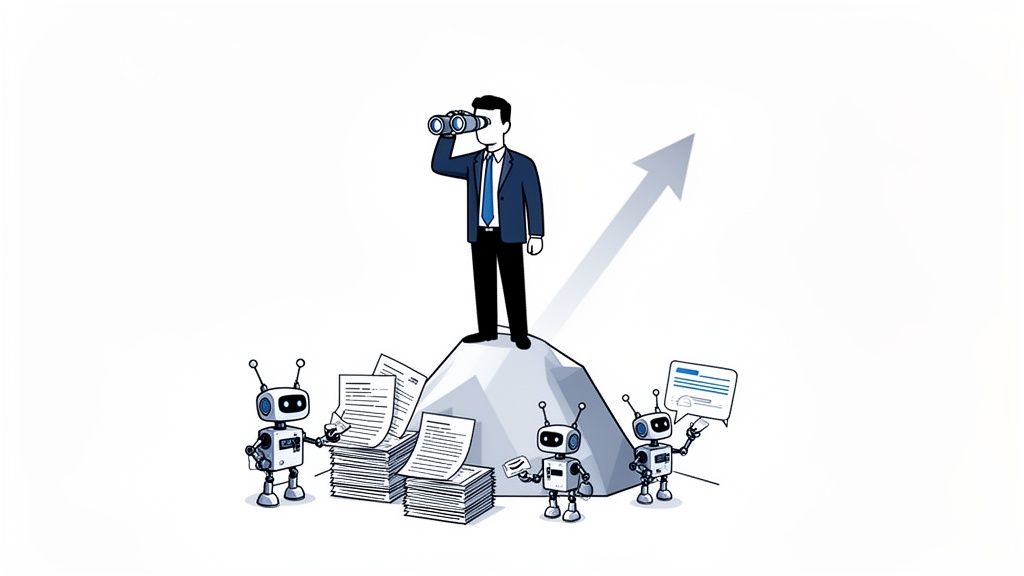
The secret to this transformation is the jump from simple automation to agentic AI. Think of traditional AI tools as smart calculators. You punch in a command, and they execute it.
Agentic AI is like a junior sourcer who can think for themselves. You give it a high-level goal—"find me three qualified senior software engineers"—and the AI agent figures out all the steps. It can search across platforms, verify contact details, and even kick off personalized outreach without constant supervision.
This autonomy is what truly sets recruiters free. They can hand off the entire top-of-funnel grind to an AI agent, trusting it to build a solid pipeline of candidates, even while they're offline.
When AI takes over the grunt work, the human touch is re-focused on judgment, relationships, and strategy. A recruiter's value is no longer measured by how many candidates they can find, but by their skill in engaging and closing the right ones.
This shift elevates the HR function from a cost center, measured by efficiency, into a strategic driver of growth, measured by the quality of talent it brings into the business and its impact on revenue.
Take IBM, for instance. Their AI agent already handles 94% of common HR questions, allowing them to shift budget from administrative overhead into revenue-generating roles. This isn't about replacing HR; it's about making it more valuable.
This new model lets HR move past old-school metrics like "time-to-hire" and focus on "time-to-productivity." The question is no longer how fast you filled the seat, but how quickly that new hire started making an impact. As tech gets smarter, so does the potential for strategic influence. You can read more about how AI agents are evolving to take on more complex, autonomous work.
Adopting AI for HR is more than a technological upgrade; it's a fundamental re-architecture of the talent function.
By automating manual, top-of-funnel processes, AI doesn't replace human expertise—it elevates it. This strategic shift unlocks the true potential of your talent team, transforming them from tactical executors into proactive business partners who drive measurable growth and secure a competitive advantage in the war for talent.
No. AI is an augmentative tool, not a replacement. It automates high-volume, repetitive work like sourcing and initial screening, freeing recruiters for high-value tasks like building relationships, engaging candidates, and strategic advising.
Measure ROI by tracking core recruiting metrics. Look for tangible gains like a reduced time-to-hire, lower cost-per-hire, and increased quality-of-hire. Compare the dollar value of these improvements against the cost of the AI platform.
Start by pinpointing your single biggest bottleneck. For most teams, it’s top-of-funnel sourcing. Run a focused pilot with an AI sourcing tool on a hard-to-fill role to solve that specific problem, prove value, and then strategically expand its use.
Juicebox delivers the platform you need to find, verify, and engage top-tier candidates faster.
See how recruiters use PeopleGPT inside Juicebox.
{{large_cta}}
Run your first search for free. Find and engage top talent across 800M+ profiles. Trusted by 5,000+ customers.
.png)