.svg)
SIGN UP FOR JUICEBOX (IT’S FREE!)

Who are you looking for?
Thank you! Your submission has been received!
Oops! Something went wrong while submitting the form.

AI hiring software is a category of tools that uses artificial intelligence to automate and improve parts of the recruiting process. It acts as a strategic co-pilot, handling repetitive tasks like candidate sourcing, data verification, and initial outreach. This core benefit—automating the manual work—allows recruiters to focus on building relationships and making final hiring decisions. For talent teams still relying on manual processes, adopting ai hiring software is no longer a luxury; it's a necessity for survival in a hyper-competitive market.
Imagine trying to win a Formula 1 race while your competitors have high-performance cars and you're stuck on foot. That's what modern recruiting feels like without the right tech. The race for top talent is faster and more competitive than ever, and clinging to manual processes is a surefire way to fall behind. AI hiring software is the engine that elite talent acquisition teams now rely on to win.
But there’s a problem: most tools claiming to use "AI" are just legacy systems with a new coat of paint. True ai hiring software is built differently. Think of it as a co-pilot. The human recruiter is still in the driver's seat, but the AI handles navigation, system checks, and routine communications. This frees you up to focus on the most critical part of the journey—actually connecting with the right people. This shift from manual command to intelligent conversation is why Juicebox was founded; we saw that the old way of sourcing was fundamentally broken, trapping recruiters in endless administrative work.

TL;DR The Core Benefits
- Accelerated Sourcing: Find qualified candidates in minutes, not days, by searching across millions of profiles with simple, natural language.
- Lower Cost-per-Hire: Consolidate expensive, single-function tools like LinkedIn Recruiter into one platform for sourcing, verification, and outreach.
- Data-Driven Decisions: Gain real-time insights into talent markets, salary benchmarks, and diversity metrics to build a smarter hiring strategy.
The biggest difference between modern AI platforms and legacy tools is how you interact with them. For decades, recruiters had to master Boolean search—a rigid, command-based language of "AND," "OR," and "NOT." It's powerful, but it's also slow, unforgiving, and completely unintuitive.
A new generation of ai hiring software ditches that outdated model. Instead of wrestling with complex strings, you just ask for what you need: "Find me a senior product manager in San Francisco who has previously worked at a Series B fintech startup."
This natural language approach does more than save time; it changes who can source effectively. Hiring managers, founders, and junior recruiters can now find top-tier candidates without needing weeks of specialized training. This is a huge reason the market is expanding so quickly.
The growth is undeniable. The global AI hiring software market, valued at USD 1.8 billion in 2024, is projected to hit USD 5.4 billion by 2034, according to a recent analysis by Future Market Insights. It's moving from a niche add-on to a core part of the modern talent stack.
Ultimately, this technology isn't just another piece of human resources software. It's a new strategic layer that reallocates a recruiter's most valuable asset: their time. By automating the most time-consuming parts of the top-of-funnel process, it gives teams the freedom to be more strategic.
Instead of spending 80% of their time just searching for candidates, recruiters can now invest that energy in what really matters:
This simple reallocation of time is what gives companies a real, sustainable edge in the war for talent.
To really understand ai hiring software, you have to look past the hype and check under the hood. Modern platforms aren't just a single feature; they're integrated systems designed to own the entire top-of-funnel recruiting workflow. It all boils down to four critical capabilities: intelligent sourcing, data verification, automated outreach, and predictive analytics.
Each piece of the puzzle works together, transforming a slow, choppy process into one fluid motion. Think of it like swapping a disjointed assembly line for a single, unified robotic arm that can find, inspect, assemble, and report on the final product. The bottom line? This integration delivers speed and efficiency that older tools just can't touch.
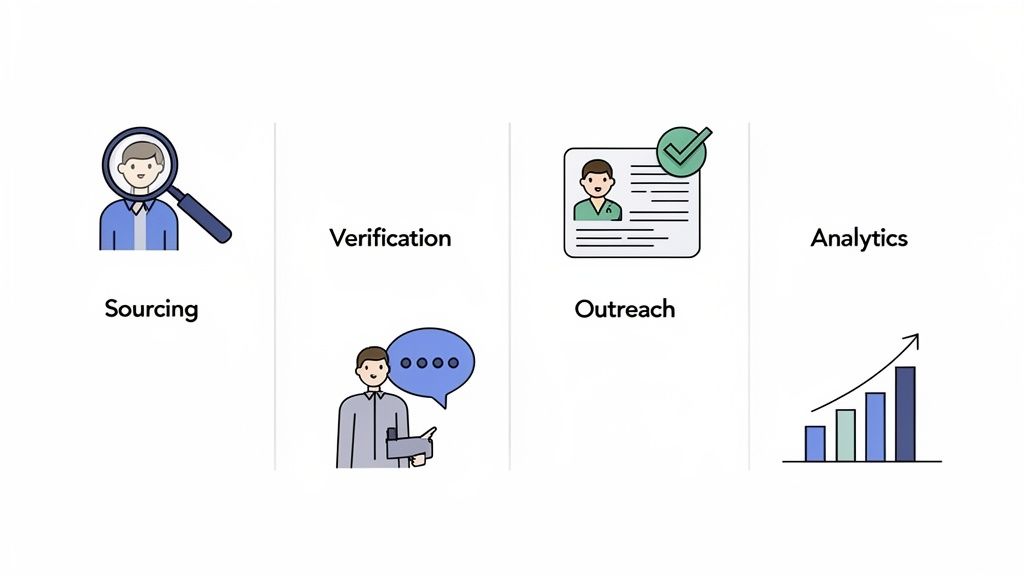
First, and arguably the most important function, is AI-powered sourcing. Traditional sourcing means you're stuck manually crafting complex Boolean strings on siloed platforms. Modern ai hiring software changes the game by letting you use natural language.
Instead of typing ("software engineer" OR "developer") AND "fintech" AND ("Austin" OR "ATX"), you just ask: "Find me a software engineer in Austin with fintech experience." The AI understands and instantly scans hundreds of millions of profiles across dozens of public platforms to surface the best matches. Dive deeper into the mechanics with our guide to top 10 AI recruiting tools for 2026.
This unlocks a wider and more diverse talent pool. After all, an estimated 80% of qualified candidates exist outside of any single professional network. By searching everywhere, you find the hidden gems your competitors miss.
What’s the point of finding the perfect candidate if you can't reach them? This brings us to the second core capability: AI-driven data verification. The best platforms automatically find and validate contact info, especially email addresses, to ensure your outreach lands in the right inbox.
You might think your current database is clean, but contact data decays at a staggering rate of over 22% per year, according to a 2022 study by Gartner. Relying on old info leads to high bounce rates, which hurts your domain reputation and wastes time.
It’s not just about finding an email; it’s about finding the right email. AI systems cross-reference multiple data points to confirm deliverability, often hitting 95%+ accuracy and slashing bounce rates to below 5%.
And in the age of remote work, these platforms are also adding layers of robust identity verification to ensure secure and trustworthy candidate screening.
Once you have a verified contact, it's time for outreach. This is where AI moves beyond simple mail-merge automation. Instead, it powers smart, multi-step sequences that adapt to how a candidate behaves.
For instance, the system can:
This level of automation doesn't replace the human touch; it amplifies it, ensuring every candidate gets timely, relevant communication.
Finally, the best ai hiring software provides predictive analytics that go far beyond basic activity reports. Instead of just telling you how many emails your team sent, AI analytics give you strategic insights into the talent market itself. For example, a global consulting firm like PwC recently used AI to analyze its workforce data, saving thousands of hours and sharpening its strategic planning.
You can get instant answers to critical questions like:
This flips recruiting from a reactive function to a proactive, data-driven strategy.
Picking the right ai hiring software feels like choosing a co-pilot for a critical mission. The wrong one can leave you stranded, but the right one gets you where you need to go faster and safer than you could alone.
Here’s the catch: not all platforms are built the same. Some are just old systems with a shiny "AI" sticker, while others represent a fundamentally new way to think about talent acquisition.
To cut through the noise, you need a solid evaluation framework. This isn't about chasing flashy features; it's about understanding the core mechanics that actually drive results.
Most people believe the best talent search comes from the biggest database. In reality, the opposite is true: what matters is the diversity of the data. Most traditional recruiting platforms operate like walled gardens, locking you into a single network like LinkedIn. Strategically, this is a huge mistake.
Why? The best talent isn't on just one website. They’re on GitHub, Behance, academic sites, and dozens of niche professional communities. To truly streamline your recruitment process, you must look beyond the obvious places.
A platform that pulls data from 30+ sources instead of one gives you an instant edge. It’s the difference between fishing in a small, overcrowded pond and having the entire ocean. Juicebox customers, for example, find that 80% of their hires come from talent pools completely invisible on LinkedIn.
A multi-source approach isn't a "nice-to-have"—it's non-negotiable for building diverse, high-quality pipelines.
The next big test is how you actually find people. Does the platform force you to speak its language, or does it understand yours? For decades, recruiters were forced to master complex Boolean commands, creating a barrier for hiring managers and junior team members.
Modern ai hiring software throws that old model out with natural language search.
Instead of fighting with parentheses and operators, you just describe the person you need. This shift from command-based queries to conversational prompts is what finally unlocks speed and accessibility for your entire hiring team.
To see the difference, let’s compare the old way with the new. The table below breaks down the fundamental shift in how these tools approach core recruiting tasks.
What this shows is a move away from manual work toward a strategic, automated approach where technology does the heavy lifting.
"Automation" is a word thrown around a lot, but what does it really mean? You have to ask: does this tool just send alerts, or can it actually act on my behalf? Basic automation might handle simple follow-up emails, which is helpful, but it’s not world-changing.
True, next-generation automation involves AI agents that can take over entire workflows. Imagine giving an AI agent a job description and having it work for you 24/7 to:
This is the difference between a tool that helps you do your job and one that does the most repetitive parts of your job for you.
An AI tool that doesn’t play nicely with your existing tech stack is more of a problem than a solution. Manually copying and pasting data between your sourcing tool and your Applicant Tracking System (ATS) or CRM isn't just a time-suck—it's a recipe for costly errors. Some of the best sourcing tools, like PeopleGPT, solve this with deep integrations.
Look for a platform with native integrations into systems you already rely on, like Greenhouse, Lever, or Ashby. The goal should be a seamless, one-click sync that pushes candidate profiles and communication history directly into your system of record.
You might think a tool with mysterious pricing must be more powerful, but the opposite is usually true. Opaque, "contact us for a demo" pricing is a classic enterprise sales tactic designed to hide the real cost and lock you into long contracts.
Instead, look for platforms with clear, transparent, and scalable pricing. A product-led growth (PLG) model with monthly subscriptions lets you start small, prove value, and scale up as needs grow. This transparency is a good sign a company is confident in its product. You can find a detailed breakdown in this comprehensive recruiting software comparison.
In an age of ever-increasing data privacy regulations, compliance can't be an afterthought. Any ai hiring software you consider must be built from the ground up with frameworks like GDPR and CCPA in mind.
This means the platform should source data from publicly available information and give you the tools you need to manage candidate data responsibly. Make sure the vendor has clear policies on data processing and honors removal requests to protect both your company and the candidates.
Adopting new technology isn't just about cool features; it's about the bottom line. The real value of ai hiring software shows up in three core recruiting metrics: speed, cost, and diversity. These aren't just small improvements. They represent a fundamental shift in how well a company builds its most important asset—its people.
The operational impact is impossible to ignore. A 2023 report from SHRM found that up to 75% of candidate communications can be automated. This isn't just a theory. Chipotle, for example, used an AI chatbot to slash its time-to-hire by 67%, dropping it from 12 days to just 4. These examples, pulled from recent analyses of AI in recruitment, all point to the same thing: massive, measurable gains in efficiency.
In the race for talent, speed is everything. The best candidates are off the market in just 10 days, which means slow, manual processes are costing you the very people you need. AI hiring software collapses the top of the funnel, taking the time required to go from a job description to a full pipeline of qualified, interested candidates from weeks down to minutes.
Here’s the proof: one tech startup using Juicebox built a pipeline of 50 qualified software engineers in under an hour for a role that had been open for three months. That's a task that previously would have tied up a full-time sourcer for weeks.
The financial impact of AI goes beyond saving time. By bringing sourcing, data verification, and outreach together, companies can consolidate their tech stack and get rid of redundant tools. It's common for teams to pay for a LinkedIn Recruiter seat, a separate email verification tool like some of these Indeed alternatives, and an outreach sequencer. Those costs add up fast.
A modern ai hiring software platform can replace three or four of these single-function tools at a fraction of the cost. More importantly, it directly lowers your cost-per-hire by reducing recruiter hours and improving the quality of hire through better, more accurate matching.
The chart below breaks down the key decision points—data, search, and price—to consider when figuring out which software will give you the best return.
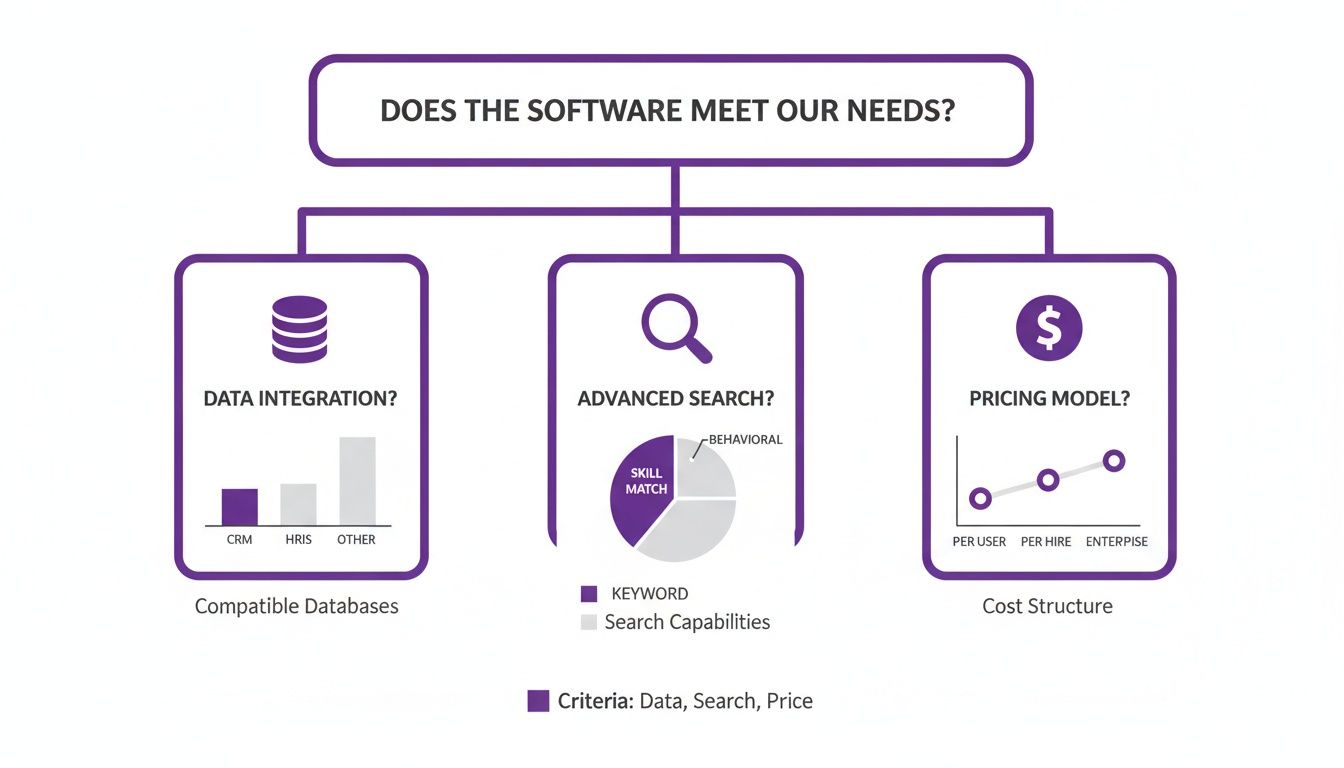
As the decision tree shows, the right software choice comes down to finding the sweet spot between comprehensive data access, an intuitive search experience, and a pricing model that makes sense for your business.
You might think that bringing AI into hiring would introduce more bias, but when designed right, the opposite is true. Well-built ai hiring software can be an incredibly powerful tool for reducing human bias and improving diversity.
How? By casting a much wider net.
Human recruiters, even with the best intentions, often unconsciously fall back on familiar networks. An AI, on the other hand, can objectively scan millions of profiles across 30+ platforms, uncovering incredible candidates from underrepresented groups who are invisible on traditional networks like LinkedIn.
One Juicebox customer, for instance, needed to hire a diverse engineering team. By sourcing from platforms like GitHub and academic sites, they increased their pipeline of candidates from underrepresented backgrounds by 40% in just two months. The AI was simply programmed to find the best people based on skills, ignoring the proxies for bias that humans often rely on.
Bringing new tech into your workflow has its bumps, but the gap between a smooth rollout and a frustrating false start usually comes down to avoiding a few common mistakes.
First, let's bust the biggest myth: AI is not here to replace recruiters.
Most companies think of AI as a replacement, but the reality is the opposite. The goal isn't to remove humans. It's to supercharge their abilities by automating the soul-crushing tasks like manual sourcing and data entry. This frees up your team to focus on what they do best: building relationships and closing deals.
This workflow shows how training is the critical bridge connecting your team, your ATS, and the new ai hiring software. Without it, even the slickest tool will fall flat.
You can buy the most powerful platform, but if your team doesn’t know how to use it, you've bought expensive shelfware. It's a classic mistake to assume an intuitive interface means zero training is needed. Modern tools are easier to learn, but you still need an onboarding plan.
This plan should cover:
Remember, technology is just a tool. A skilled human armed with a powerful LLM can do incredible things, but the emphasis there is on "skilled."
Another pitfall is trying to jam a new AI tool into a rigid, outdated process. This happens all the time with integrations. If your ai hiring software doesn't sync flawlessly with your Applicant Tracking System (ATS), you're creating an administrative nightmare.
You might think you can work around a clunky integration. Here’s why that fails: friction. Any process that adds extra steps will eventually be abandoned. Before you commit, make sure the platform has deep, native integrations with the systems you already use. The goal is a one-click data sync.
AI is powerful, but it isn't magic. Expecting the software to instantly fill every open role in the first week is a recipe for disappointment. Like any strategic tool, it takes time to dial in your approach and see the full ROI.
Start with a clear, measurable goal for the first 30 days. Maybe the goal is to slash the time it takes to build a qualified pipeline for one or two key roles. Celebrate that initial win, then expand. This approach builds momentum and proves value without putting unrealistic pressure on your team or the tech, and it's key to tracking important recruiting metrics effectively.
Does AI hiring software replace human recruiters?
No, it empowers them. AI handles the grunt work—sourcing, data entry—so your team can focus on building relationships and closing candidates.
How does AI sourcing ensure GDPR compliance?
Reputable platforms build compliance in from the start. They rely on public data and provide tools for data management compliant with GDPR and CCPA.
Is AI hiring software only for large enterprise companies?
Not anymore. Modern platforms use flexible, transparent pricing that scales with you, making powerful AI accessible to startups and growing businesses.
How long does it take to implement and see results?
With cloud-based platforms and seamless integrations, your team can be up and running in minutes, often seeing a jump in sourcing speed within the first week.
Adopting ai hiring software isn't just about tweaking your workflow. It’s about creating a massive, long-term competitive advantage.
The core benefit is speed. This technology gives you the power to find, connect with, and hire world-class talent faster and more effectively than anyone else.
This is what unlocks a true strategic advantage. Suddenly, any company can tap into a global talent pool that felt out of reach. The days of slow, disconnected recruiting are over. The future belongs to teams that are fast, intelligent, and strategic.
{{large_cta}}
Run your first search for free. Find and engage top talent across 800M+ profiles. Trusted by 5,000+ customers.