
Think of reimbursement as more than just paying someone back. It’s the promise a company makes to its people: if you spend your own money for a legitimate business reason, we’ll make you whole. It’s a core financial function that covers everyone from employees and job candidates to vendors who’ve fronted costs on your behalf.
But here’s the problem most tools ignore: a slow, clunky reimbursement process isn’t just an administrative headache; it’s a direct tax on employee morale. Getting this system right is non-negotiable—it’s fundamental for building trust, moving fast, and staying on the right side of financial regulations. Unlike generic platforms, we see reimbursement as a strategic lever for operational excellence, not just a line item in a spreadsheet.
What is the reimbursement process?
Let’s be real. Reimbursement isn’t just about cutting checks. It’s a direct reflection of your company’s operational health and how much you respect your team’s time and money. Think of it like your company’s financial nervous system. When it’s running smoothly, information and cash flow without a hitch.
But when it’s slow or broken, it creates real friction. A clunky, manual process doesn’t just waste time; it frustrates your team and exposes the business to serious compliance risks. According to the IRS, sloppy expense reporting can trigger major tax penalties, turning what should be a simple payback into a huge liability.
The key players in the workflow
A solid reimbursement workflow hinges on seamless teamwork between three groups. Each has a specific job to do, and if communication breaks down anywhere along the line, you get delays and errors that mess things up for everyone. Nailing down these roles is the first step to building a system that actually works.
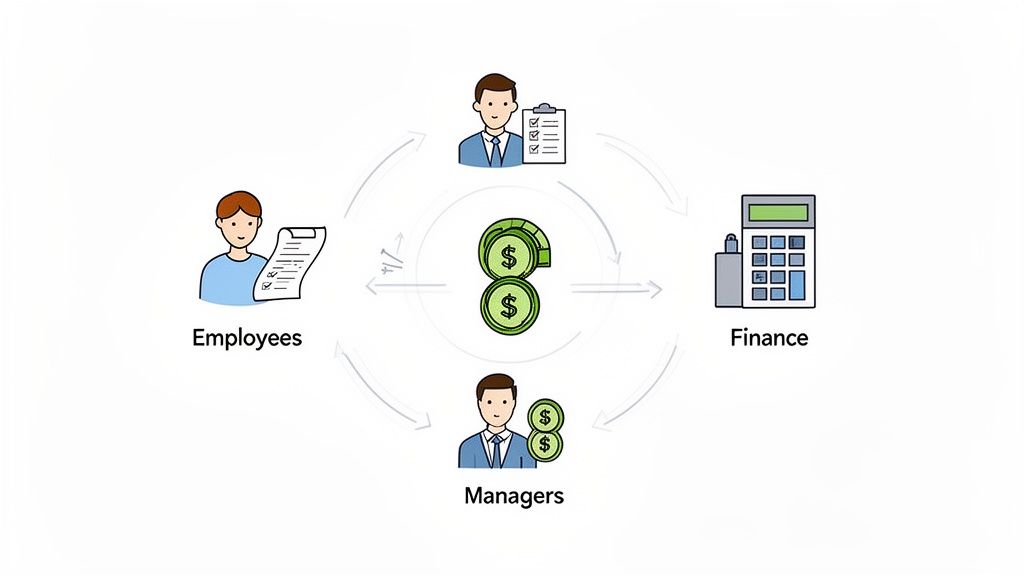
Here’s who does what:
Employees: These are the people on the front lines, spending their own cash for business needs. They kick off the process by submitting a claim with their receipts and paperwork.
Managers: They’re the first line of defense. Their job is to quickly check that an expense is legitimate, falls within company policy, and was actually for business.
Finance/HR teams: This is the final checkpoint. They give everything one last review for compliance, process the actual payment, and keep the books clean for tax time.
Just like modern recruiters use smart tools like PeopleGPT to stop wasting time on manual sourcing, today’s finance and HR leaders need a system to kill the administrative drag of expense reports. If you’re a scaling company that cares about moving fast and getting things right, you have to master this.
And remember, how you handle expenses goes hand-in-hand with the overall employee benefits that help you attract and keep great people.
Why a streamlined process matters
You might think a manual spreadsheet is “good enough for now,” but that’s a classic trap. This mindset fails to account for the hidden costs that add up fast. A 2022 survey from the Global Business Travel Association revealed that the average cost to process a single expense report is a staggering $58. And when your process is manual and confusing? That number climbs even higher.
But here’s the thing. Fixing your process unlocks more than just cost savings. It builds a culture of trust where employees feel respected and know they’ll be paid back quickly. That alone removes a massive source of workplace stress, letting your team focus on their real jobs instead of chasing down money they’re owed. This is one of the core principles of an effective streamlined recruitment process.
At the end of the day, an efficient reimbursement system isn’t just an administrative task to check off a list—it’s a strategic asset that fuels growth.
Breaking down the types of reimbursement
Not all reimbursements are created equal. Trying to manage a $50 software subscription the same way you handle a candidate’s cross-country flight is a recipe for chaos. The first step toward building a reimbursement system that actually works is understanding the different flavors of expenses your team will throw at you.
Think of it this way: each category has its own financial footprint and set of rules. Getting this right from the beginning saves you from accounting headaches and compliance nightmares down the road.
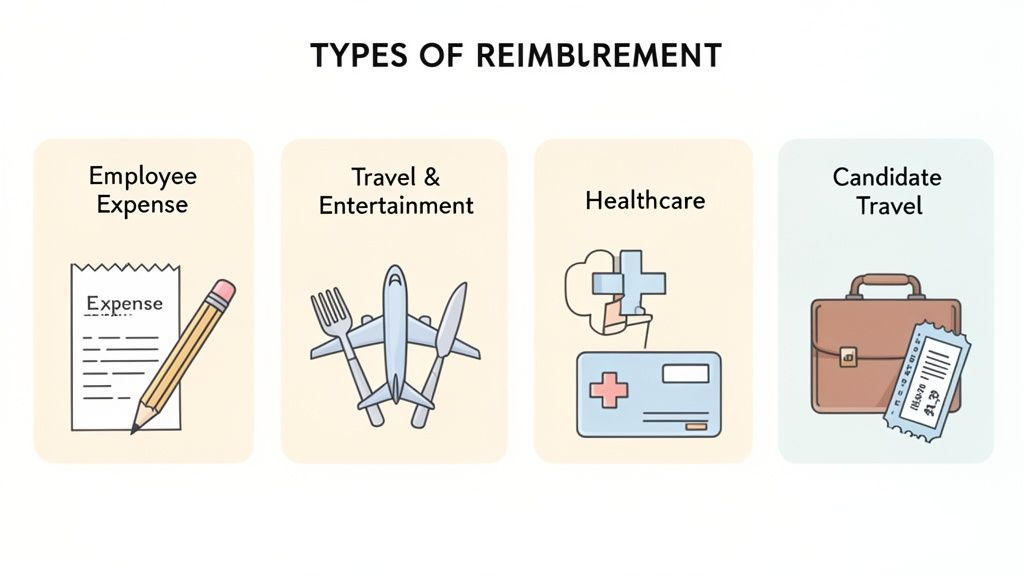
Employee expense reimbursement
This is your bread and butter—the everyday costs your team members pay out-of-pocket to get their jobs done. It’s the lifeblood of a nimble operation, empowering people to get what they need without getting tangled in red tape.
We’re talking about things like:
A software engineer expensing a new SaaS tool to speed up a project.
A marketing manager paying for a professional development webinar.
The office manager grabbing supplies for the breakroom.
A remote employee buying an ergonomic chair for their home office setup.
These are usually smaller purchases, but don’t let the low dollar amounts fool you. The sheer volume can create a massive administrative drag if you don’t have a simple, clear process. A solid policy here shows your team you trust them and want them to have the tools they need to succeed, much like equipping them with the best sourcing tools for recruiters.
Travel and entertainment (T&E) expenses
For many companies, T&E is a major budget line item. This bucket covers all the costs tied to business travel and building client relationships, and these expenses tend to be larger and more complex.
Common T&E examples include:
Flights and transportation: Airfare, rental cars, and rideshares for client visits or conferences.
Accommodation: Hotel stays for business trips.
Meals: Dinners with clients, team meals while on the road, or coffee meetings.
The biggest challenge with T&E is substantiation. The IRS is picky here, and a simple credit card statement won’t cut it. They need detailed receipts that prove the who, what, where, when, and why for every single expense. A poorly documented T&E report is a red flag that can lead to denied deductions and painful penalties if you ever get audited.
Healthcare and candidate reimbursement
These last two categories might be less frequent, but they pack a huge strategic punch. They directly impact your ability to care for your team and attract the best talent on the market.
Healthcare reimbursement: This usually involves tax-advantaged accounts like Health Savings Accounts (HSAs) or Flexible Spending Accounts (FSAs). Employees use these funds for qualified medical expenses, and the company facilitates the process. This is closely tied to your overall benefits package, including other valuable fringe benefits that help you keep your best people.
Candidate reimbursement: When you’re trying to win over a top-tier candidate, every detail matters. Covering their flight, hotel, and meals for a final-round interview is non-negotiable. A smooth, fast reimbursement process shows you respect their time and reinforces that your company is professional and well-run. A clunky, slow process can leave a bad taste and might even cost you the hire, a risk no freelance recruiter can afford.
Common reimbursement types at a glance
Reimbursement Type | Common Examples | Primary IRS Consideration |
|---|---|---|
Employee Expense | Software, office supplies, professional development, remote work equipment | Expenses must be “ordinary and necessary” for business operations. |
Travel & Entertainment | Flights, hotels, client meals, rental cars | Requires detailed substantiation (receipts showing who, what, where, when, why). |
Healthcare | FSA/HSA claims for medical, dental, and vision expenses | Governed by specific plan rules and regulations for tax-advantaged accounts. |
Candidate Travel | Flights, lodging, and meals for interview candidates | Must be directly related to the recruitment process to be considered a business expense. |
Getting friendly with the IRS: how to keep reimbursements tax-free
Here’s where a simple payback gets serious. Many believe that as long as you pay an employee back for something they bought for the business, you’re in the clear. The opposite is true. Without the right system in place, that friendly reimbursement can quickly become a massive tax headache for both you and your employee.
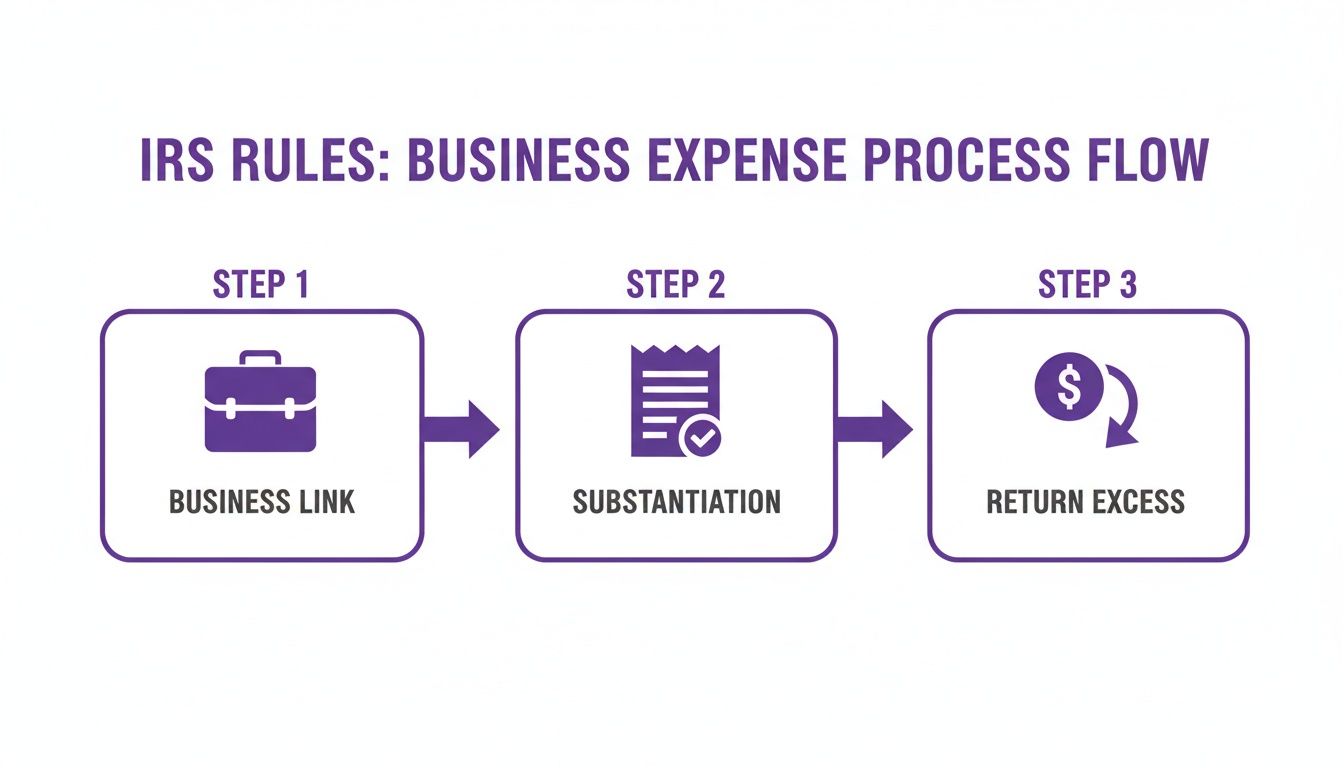
What’s the secret? It all comes down to what the IRS calls an accountable plan. Think of it as the official rulebook for making reimbursements tax-free. If your process checks all the boxes, the money you give back is a clean, non-taxable business expense. But if it doesn’t, the IRS sees that money as regular wages, meaning it’s subject to all the usual income and payroll taxes. This is a critical detail, especially when working with an independent contractor.
The three pillars of an accountable plan
An accountable plan sounds intimidating, but it’s built on three core principles. Nail these, and your reimbursement process goes from a potential liability to a smooth, transparent part of your operations. You must meet all three conditions.
It has a clear business connection: The expense must be directly tied to doing business. An employee buying a software license to do their job? Perfect example.
It’s properly substantiated: The employee has to account for their spending in a reasonable amount of time. This means handing over proof—like detailed receipts—that show the amount, date, location, and business purpose.
Excess funds are returned: If you give an employee an advance and they spend less, they have to return the extra cash to the company within a reasonable period.
Here’s the bottom line: if you’re missing even one of these pillars, you don’t have an accountable plan. And that means every dollar you reimburse could be treated as taxable income.
Why documentation is your best defense
“Proper substantiation” is the step where most companies trip up. A credit card statement just won’t cut it. The IRS wants to see detailed proof that directly links the purchase to a legitimate business activity.
A 2024 report from the Treasury Inspector General for Tax Administration flagged ongoing problems with improper expense deductions, showing that the IRS is paying close attention to documentation during audits. Missing paperwork is one of the fastest ways to get your business expenses thrown out.
So, what does good documentation actually look like?
Receipts: Get digital or physical receipts that clearly show the merchant, date, an itemized list of what was bought, and the final amount.
Purpose: Insist on a clear, written explanation of why the expense was necessary. For something like a client dinner, this should include who was there and what business was discussed.
Timeliness: Employees need to get their expense reports in promptly. A good rule of thumb is within 30-60 days of the purchase. This discipline is essential for accurate recruiting metrics and financial health.
How to build a scalable reimbursement policy
Let’s move from theory to action. A great reimbursement policy isn’t just a rulebook; it’s a strategic document that should automate decision-making for 90% of scenarios. Think of it as the guardrails that empower your team to spend confidently while protecting the company’s bottom line. Without one, you’re stuck making one-off decisions—the very definition of unscalable.
The goal is to build a system so clear it answers questions before they’re even asked. This frees up your finance and HR folks from being perpetual gatekeepers, allowing them to focus on more strategic work, similar to the benefits of HR outsourcing. A solid policy is the foundation of an efficient, trust-based reimbursement process.
But here’s the problem most companies run into: they create policies that are either too vague (hello, loopholes) or so restrictive they create massive bottlenecks. The sweet spot is finding the right balance between control and empowerment.
The essential components of your policy
To build a policy that scales right alongside your company, you need to nail a few core components. Each piece plays a critical role in creating a framework that’s both transparent and effective.
A clear purpose statement: Kick things off by explaining why the policy exists. Is it to ensure fair and timely reimbursement, stay compliant with tax laws, or manage company cash responsibly? A clear purpose gets everyone on the same page from the start.
Defined roles and responsibilities: Who submits expenses? Who signs off on them? Who actually cuts the check? Clearly outline the responsibilities for employees, managers, and the finance team to avoid any confusion.
Specific expense categories: Get granular on what is and isn’t reimbursable. Create distinct categories like software subscriptions, travel, professional development, and client entertainment. No gray areas.
Sensible spending limits: Set reasonable limits for categories like daily meals on the road or hotel stays. This provides clarity and prevents awkward conversations about over-the-top spending.
A transparent workflow: Map out the entire process, from submitting a claim to getting paid. Be specific about timelines, what counts as proper documentation (e.g., itemized receipts), and which tools everyone should be using.
Communicating your policy for maximum buy-in
Nailing the policy is only half the battle. How you roll it out will make or break its success. Just emailing a PDF and hoping for the best is a recipe for disaster. Effective communication is crucial to avoiding confusion and that dreaded “malicious compliance,” where employees follow the letter of the law but not the spirit.
Frame the policy as a tool for empowerment, not control. Explain how it actually makes the reimbursement process faster and fairer for everyone involved. Hold a quick training session to walk through the workflow and answer questions on the spot. Finally, make the policy dead simple to find in a shared company drive or wiki.
A strong reimbursement policy really starts with solid financial habits. For a deeper dive into managing your company’s spending, check out these small business expense tracking tips. When your expense tracking is on point, any reimbursement system you implement will run that much smoother.
Using automation to streamline your workflow
Manually processing a reimbursement claim is a slow, error-prone dance of spreadsheets, paper receipts, and endless email chains. It’s a system that belongs in a museum, yet many companies still cling to it. This manual drag doesn’t just frustrate employees; it quietly drains hours of productive time from your finance and HR teams.
The shift to modern, automated software isn’t just an upgrade; it’s a complete system overhaul. Think of it as the difference between sending a letter by horse and sending an email. The core idea is simple: let technology handle the repetitive, rule-based tasks so humans can focus on exceptions and strategy, much like the best AI recruiting tools.
This is where the real magic happens.
Key features that drive efficiency
A truly effective platform moves beyond simple digital submissions. The best tools are built around specific features designed to eliminate friction at every step of the reimbursement process.
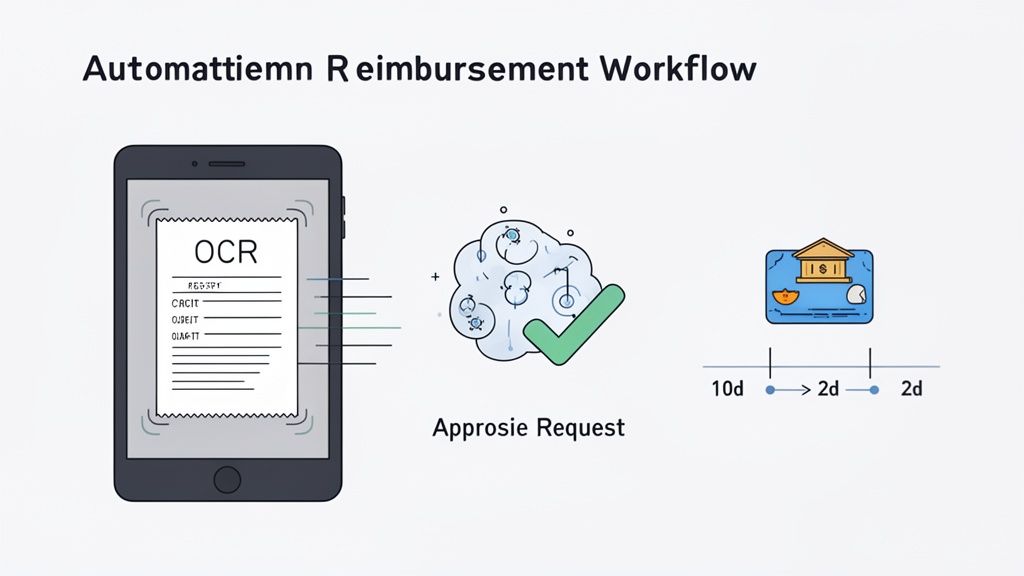
OCR receipt scanning: Employees simply snap a photo of a receipt. Optical Character Recognition (OCR) technology automatically pulls the vendor, date, and amount, pre-filling the expense report. No more manual entry.
Automated policy checks: The software is programmed with your company’s rules. It instantly flags out-of-policy expenses—like a flight booked outside the approved cost window—before they even reach a manager for review.
Direct deposit integrations: Once an expense is approved, the system automatically triggers a payment directly to the employee’s bank account. This alone can cut payment cycles from weeks down to just a few days.
But there’s a problem most tools ignore: the human approval bottleneck. Even with digital submissions, managers often still have to manually review every single line item, creating delays. This is where modern AI changes the game.
The power of AI in approvals
The most advanced systems use AI to intelligently separate routine requests from genuine exceptions.
Here’s how it works: the AI instantly approves standard, in-policy requests (like a $15 lunch on a travel day) while flagging outliers (like a $300 dinner) for a human to look over.
A company that implemented this AI-driven approach reduced its average reimbursement processing time from 10 days to just 2. They didn’t just digitize their old process; they redesigned it for speed.
This is the same efficiency principle that powers today’s top 10 AI recruiting tools for 2026. Smart automation removes the administrative burden, unlocking focus and speed. The impact is felt across industries; for instance, the global healthcare reimbursement market, driven by similar needs, is projected by Grand View Research to grow from USD 27.18 billion in 2025 to USD 84.60 billion by 2032.
To truly streamline your workflow, look into integrating specialized tools. Many powerful business expense tracking apps offer comprehensive management, automating everything from receipt capture to reporting. This kind of tech-forward approach is essential, as effective automation is closely linked to a better employee experience—learn more in our article about automated employee onboarding.
FAQs: employee reimbursement (2026)
Are reimbursements taxable income?
No, as long as you follow IRS rules for an “accountable plan.” Otherwise, the money is considered wages and is fully taxable to the employee.
How long should we keep reimbursement records?
The IRS generally advises keeping employment tax records for at least four years. Modern digital expense management tools make this completely automatic.
What if an employee loses a receipt?
Your policy should have a “missing receipt affidavit” process where the employee formally documents all the expense details and signs off on it.
Conclusion
Mastering employee reimbursement isn’t about navigating a bureaucratic maze; it’s about building a financially smart, scalable company. By setting up a clear, automated system, you turn a major compliance risk into a process that builds trust and protects your bottom line. This unlocks the operational speed needed to grow your team and your business without creating a tangled web of financial problems later on.
Sign up for Juicebox (it's free!)
Run your first search for free. Find and engage top talent across 800M+ profiles. Trusted by 5,000+ customers.