.svg)
SIGN UP FOR JUICEBOX (IT’S FREE!)

Who are you looking for?
Thank you! Your submission has been received!
Oops! Something went wrong while submitting the form.


A solid hiring plan is more than just a wish list of open roles—it’s the strategic roadmap connecting your talent needs directly to your company's growth. It's what turns reactive, fire-drill recruiting into a proactive engine for attracting and keeping top-tier talent, ensuring you hire smarter, not just faster.
Ever stared at a generic hiring plan template? It often feels like you're trying to navigate a new city with an old, crumpled map. It's frustrating and gets you nowhere fast.
Most templates fixate on headcount but completely miss the strategic backbone. What good is a list of roles if you have no idea where to find the right people, how much they actually cost, or what it takes to lure them away from competitors? Most platforms offer static templates, but they lack the real-time market intelligence to make them actionable. This is the gap we built Juicebox to fill.
The hard truth is that most plans are built on assumptions, not intelligence. They become static documents, created in a vacuum and totally disconnected from the realities of the talent market. A recent Gartner study shows 87% of companies are already dealing with—or expect to face—skills gaps by 2026. This makes a proactive strategy more critical than ever.
Conventional wisdom says you finalize a job description and then start sourcing. That’s backward. A modern, effective hiring plan begins with talent supply and market intelligence before a single JD is drafted.
What's the bottom line? This "sourcing-first" framework reframes the entire process. Instead of asking, "Who do we need?" you start by asking:
Answering these questions first stops you from creating impossible-to-fill "unicorn" roles. It grounds your plan in reality, letting you build a strategy that's both ambitious and achievable. This is where getting a real competitive edge with top AI recruiting tools for 2026 becomes a no-brainer.

When you understand talent distribution and compensation benchmarks from the get-go, you can build a hiring plan that sets your team up for success from day one.
This strategic pivot is huge, especially as hiring goes global. With 57% of companies planning to hire internationally according to a 2024 Veris Insights report, you can't afford to ignore multi-market analysis. A sourcing-first approach gives you the data you need to make smart calls on where and how to hire.
By adopting this mindset, you can dramatically streamline your recruitment process and transform your plan from a static document into a dynamic engine for growth.
Every great building starts with a blueprint, not just a pile of bricks. The same principle applies to building a great team. A solid hiring plan template isn't just a list of job titles; it's a strategic guide that forces you to think through every detail before you post a single job.
This isn't just about plugging holes in the org chart. It’s about defining the why behind every single hire. You move from simply backfilling a role to asking bigger questions, like, "What specific skills does the marketing team need to crush its Q3 goals?" This approach builds clarity and alignment right from the start.
You might think taking the time to build a plan is a luxury you can't afford. But that upfront investment is precisely what saves you from disastrous mis-hires and blown budgets. A rushed hire based on a vague job description is a problem waiting to happen, often leading to issues like malicious compliance down the road.
A truly effective blueprint isn't a checklist; it's a connected system where each part builds on the last. It all flows together.
But there’s a problem most tools ignore: How do you get accurate data for that budget? Relying on last year's salary surveys won't cut it.
This is where real-time market intelligence becomes non-negotiable. For example, platforms like Juicebox have Talent Insights that pull live data on compensation bands for specific roles in specific cities. Suddenly, you can project total hiring costs with incredible accuracy.
By grounding your budget in real-world data, you transform it from a financial exercise into a strategic tool. It allows you to have informed conversations with finance and set realistic expectations with hiring managers from day one.
When you don't do this foundational work, you’re basically flying blind. You end up chasing candidates you can't actually afford, writing job descriptions for roles that don't exist in the real world, and creating a ton of friction between recruiting, finance, and leadership.
Think of your hiring plan as a shared language for the entire company. It’s the single source of truth that ensures everyone—from the recruiter sourcing candidates to the CFO who has to approve the final offer—is on the same page. That’s how you build a hiring engine that’s both predictable and scalable.
Posting a job and praying for the perfect applicant is a recipe for mediocrity. A modern hiring plan template needs a deliberate, multi-channel sourcing strategy that puts you in control. It's time to bust a pervasive myth: that all the top talent lives on LinkedIn.
The opposite is often true. We've seen clients consistently source over 80% of their key hires from other platforms entirely. The best candidates—the ones who aren't actively looking—are often found in niche communities, professional forums, or through targeted outreach based on their actual work, not just their profile keywords. This is a critical component for any team, including a freelance recruiter.
This is where your plan shifts from passive to proactive.
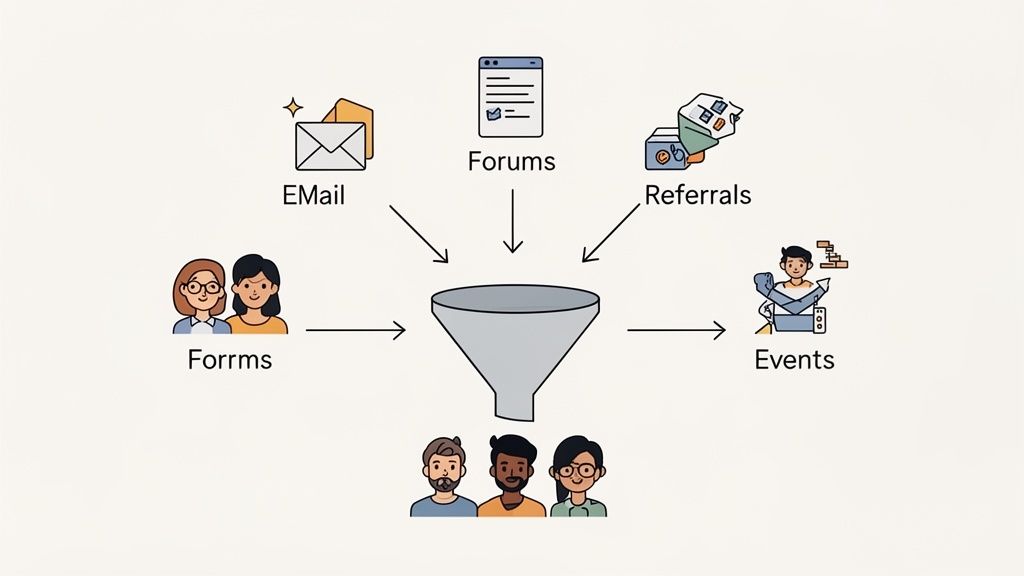
Before you send a single message, you need to know where your ideal candidates actually spend their time online. A proactive strategy means identifying and mapping these talent pools before you even have a role open. You're not just looking for individuals; you're looking for the ecosystems they inhabit.
Here's a better way to think about it. Your sourcing channels might include:
Here’s the problem most sourcing tools ignore: managing all these different channels is a logistical nightmare. How do you possibly search across dozens of platforms, verify contact info, and run personalized outreach campaigns without your entire day becoming a blur of manual tasks?
This is where AI-driven sourcing platforms completely change the game. Instead of building complex Boolean strings, you can use natural language to find exactly who you need. (We cover this in detail in our guide on how to source candidates.)
A modern workflow in a tool like Juicebox’s PeopleGPT looks like this:
This isn't just about finding people faster. It's about building a predictable, scalable pipeline of qualified candidates for every single role in your hiring plan template. You stop relying on luck and start engineering your success.
A plan without metrics is just a wish list. To turn your hiring plan template into a real management tool, you need to bake in accountability from the very beginning. That means defining the key performance indicators (KPIs) that actually signal success for your organization.
Forget the vanity metrics. Let's focus on the handful of data points that have a real impact on business outcomes. These aren't just numbers on a spreadsheet; they're the vital signs of your recruiting health.
What gets measured gets managed.
Every company is different, but a solid set of recruiting metrics usually boils down to four core pillars. Your first job is to establish a baseline for each, then set ambitious—but realistic—targets for improvement.
To keep a close eye on your plan's performance and track these metrics, a good hiring dashboard is invaluable.
You might think tracking all this sounds overly complicated, but it's simpler than you imagine. The real challenge isn't the tracking itself; it's getting everyone to agree on what "good" looks like before you start hiring. This simple, proactive step saves a ton of debate down the line.
One of the biggest drags on time-to-fill? A clunky, ambiguous approval process. We've all been there—a verbal offer gets held up for days (or even weeks) waiting for a final sign-off from finance or leadership.
Your hiring plan template has to explicitly map out the approval workflow for both new roles and candidate offers. It needs to clearly answer:
A streamlined workflow is a massive competitive advantage. Ramp, the corporate card company, used clear metrics and a tight approval process to slash their average time-to-hire by 30% in a single quarter in 2022. That's how you build a hiring engine that delivers predictable, impressive results.
What are the most critical recruiting metrics for a startup?
Focus on time-to-fill and quality-of-hire. Speed and impact are everything when you need every new hire to be a force multiplier.
How do I measure quality-of-hire accurately?
Combine quantitative data (90-day performance scores) with qualitative feedback (hiring manager satisfaction surveys) for a complete picture.
Should hiring metrics be tied to recruiter compensation?
Yes, but carefully. Tying bonuses to metrics like quality-of-hire and source effectiveness encourages strategic thinking over just filling seats.
Alright, you've done the hard work. Your strategic hiring plan is built, the role briefs are sharp, the budget is locked in, and your metrics are ready to go. So... now what?
This is where the rubber meets the road—bridging the gap between a great plan and actual execution. A powerful AI platform doesn't just support your plan; it brings it to life.
Look, your hiring plan template is the roadmap, but technology is the engine. Instead of manually grinding through dozens of sourcing channels, verifying contact info, and sending outreach, you can automate the entire top-of-funnel grind. This is how you take that strategy off the page and put it to work at scale.
Modern AI recruiting tools let you deploy autonomous agents that work for you 24/7. These agents can continuously source candidates that match your exact criteria, learning from your feedback to get smarter over time. Sourcing goes from a manual, time-sucking task to a consistent, automated pipeline.
The real key is to make your plan an active part of your workflow, not just a document that gathers dust in a folder somewhere. This happens when the data from your plan flows seamlessly into your system of record. With integrations into 41+ ATS platforms like Greenhouse and Lever, your headcount goals, role requirements, and budget constraints are always synced with what your team is doing day-to-day.
This integration is non-negotiable, especially when budgets are tight. A recent SHRM report found that 65% of HR leaders face flat or reduced budgets, squeezing every drop of ROI out of your efforts is critical. At the same time, the World Economic Forum projects a net increase of 69 million new jobs by 2027, putting immense pressure on teams to close skills gaps with precision.
It's no surprise then that 80% of recruiters are looking to invest in AI to make every dollar and every hour count.
The flow below shows the core hiring metrics your AI-powered system should be constantly tracking and improving.
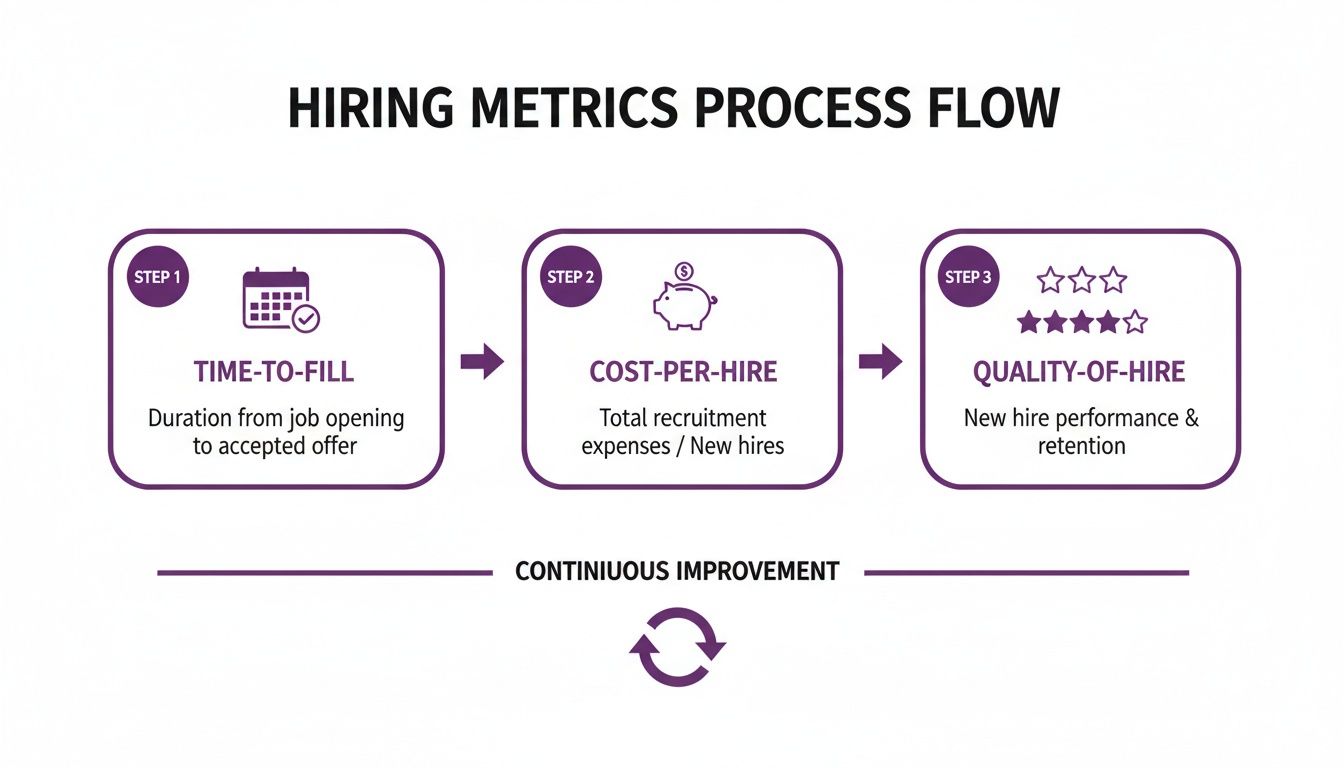
This isn't just about tracking numbers. It's about creating a virtuous cycle where a data-driven plan, powered by AI, directly connects your daily actions to your long-term strategic goals.
You might be thinking this level of automation is only for huge enterprise teams with massive budgets. The opposite is true. AI-powered execution is what allows small, lean teams to punch way above their weight.
This is where all the previous steps—from defining the role to setting metrics—really pay off. A well-structured plan, amplified by the right tech, is a true force multiplier. It allows a single recruiter to manage multiple complex searches at once, building robust talent pipelines without getting completely burned out.
This is exactly how we grew Juicebox to 2,500 customers with no sales team—by using a lean, technology-first approach. By effectively using AI for recruitment, you can find similar efficiencies and turn your hiring plan into a real competitive advantage.
By connecting your strategic hiring plan template to an AI execution engine, you don't just fill roles faster. You build a predictable, scalable, and data-driven talent acquisition function that directly fuels business growth.
This is the final piece of the puzzle: turning a thoughtful strategy into tangible, repeatable results that give your company the talent it needs to win.
A strategic hiring plan isn’t just another document; it’s the operational blueprint for building a team that wins. By grounding your strategy in real-time market data, you transform reactive, chaotic hiring into a predictable engine for growth. This unlocks the ability for even small teams to compete for top talent and scale without breaking a sweat.
{{large_cta}}
Run your first search for free. Find and engage top talent across 800M+ profiles. Trusted by 5,000+ customers.
.png)