.svg)
SIGN UP FOR JUICEBOX (IT’S FREE!)

Who are you looking for?
Thank you! Your submission has been received!
Oops! Something went wrong while submitting the form.


Talent sourcing is all about proactively identifying, attracting, and engaging qualified passive candidates to build a pipeline. It’s a strategic pivot from just waiting for applicants to show up. Instead, modern sourcing human resources means you actively hunt for the best talent, often well before a job is even posted. This approach isn't just a tactic; it's a fundamental shift that allows companies like Ramp to hire critical roles 5x faster by finding talent competitors can't.
Let’s be honest: the old playbook for sourcing talent is broken.
Too many recruiters are still stuck wrestling with clunky, overly complex Boolean strings and sending out LinkedIn InMails that mostly go unanswered. It’s a manual, reactive process that feels more like a chore than a strategic function. It's slow, unpredictable, and simply can't keep up.
But there’s a bigger problem most legacy tools completely ignore:
The entire sourcing world has been built on a myth: that all the best talent lives on LinkedIn. The reality is the exact opposite. A huge number of hires actually come from other places—think GitHub, academic sites, personal portfolios, and niche communities.
If you're only searching on LinkedIn, you're missing out on a massive pool of incredible people. This is where a modern sourcing engine changes the game entirely.
Today, modern talent sourcing operates less like old-school recruiting and more like a finely tuned supply chain. It’s about building a predictable, high-quality pipeline of candidates by taking a systematic approach to streamline the recruitment process.
Here’s the bottom line.
This whole workflow can be broken down into three core stages: Find, Verify, and Engage.
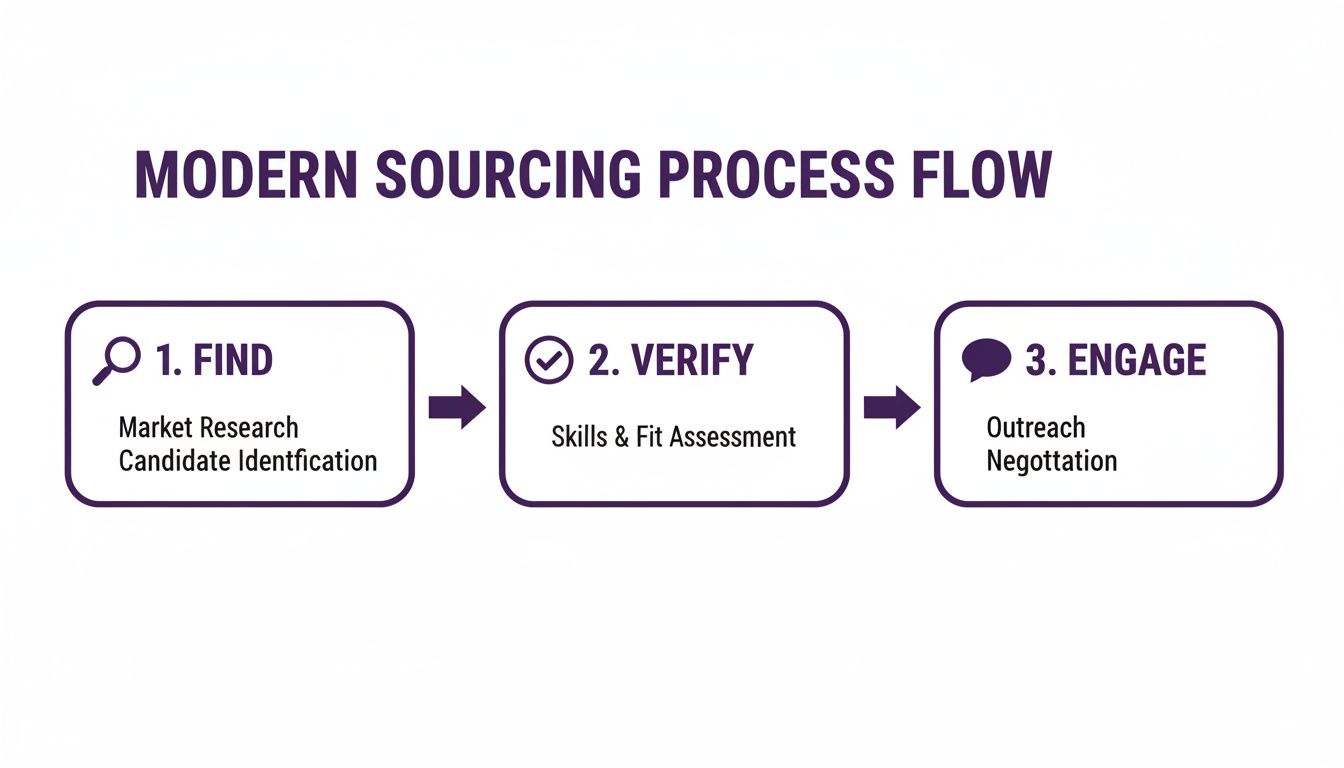
This integrated system is quickly becoming essential. The global talent acquisition software market hit USD 10.8 billion in 2024 and is projected to climb to USD 24 billion by 2034, growing at an 8.5% CAGR (source: Future Market Insights, 2024). That rapid growth just underscores how critical efficient sourcing has become in a hyper-competitive market.
For years, sourcers prided themselves on their ability to craft ridiculously intricate search strings to uncover hidden profiles. And while that skill was once valuable, it’s a bottleneck in today’s environment. It’s slow, hard to scale, and still traps you inside single-platform data silos.
You can master all the advanced Boolean search techniques you want, but you're still playing a game with outdated rules.
Instead of wrestling with manual queries, AI-powered platforms like PeopleGPT let you use plain English. You can just describe who you're looking for.
Example Prompt: "Find me a senior backend engineer in San Francisco with experience scaling a product from 1M to 10M users at a Series B fintech company."
That single prompt can search across 800 million profiles from over 30 sources, verify their contact info, and get an outreach sequence ready to go—all in a matter of minutes. This is a fundamental shift away from the tedious, one-by-one profile reviews that define legacy sourcing. It’s not just about finding people anymore; it’s about finding the right people, way faster than your competition.
The difference between the old way and the new way is stark. It's not just an incremental improvement; it's a complete overhaul of the process, speed, and scope of what's possible.
| Metric | Legacy Sourcing (e.g., LinkedIn Recruiter) | Modern AI Sourcing (e.g., PeopleGPT) |
|---|---|---|
| Search Method | Manual Boolean strings (e.g., “engineer” AND “fintech”) | Plain-English prompts (natural language) |
| Candidate Pool | Limited to a single platform (e.g., LinkedIn’s ~1B users) | Aggregated across 30+ sources (GitHub, papers, etc.) with 800M+ profiles |
| Time to Shortlist | Hours or days | Minutes |
| Data Verification | Manual process, often requires separate tools | Automated contact verification and data enrichment |
| Cost Structure | High per-seat license fees + extra for InMails | Lower subscription costs, often with unlimited outreach |
| Scalability | Difficult to scale; dependent on individual recruiter skill | Easily scalable across the entire team |
Simply put, while legacy tools like those detailed in our SeekOut pricing guide keep you locked in a walled garden, modern AI sourcing opens up the entire internet, finds exactly who you need, and does it in a fraction of the time.
A great hire starts with a crystal-clear picture of who you're looking for. The problem? Most job descriptions are just vague, cobbled-together wish lists. This is one of the biggest failure points in the entire sourcing process.
Before you ever type a single search query, you need to build a data-backed Ideal Candidate Profile (ICP).
What does this mean for you?
This isn't about gut feelings or what the hiring manager thinks they want. It’s about grounding your search in reality. You might have a "perfect" unicorn candidate in mind, but a quick look at the market data could reveal that only a handful of those people exist on the planet. Right away, your search is set up to fail.
This proactive, data-first approach is the bedrock of modern data-driven recruitment. It shifts the conversation from, "We can't find anyone!" to, "Here's who is actually out there, and here’s exactly how we'll find them."
First things first: stop thinking in generic job titles and start thinking in tangible outcomes. The hiring manager doesn't just need a "Senior Software Engineer." They need someone who can solve a specific business problem.
Your job is to translate that business need into concrete, searchable attributes. Here’s how that plays out:
This changes the game. You're no longer just checking boxes on a resume; you're pinpointing candidates with a proven history of delivering the results you actually need.
It’s easy to assume you can find someone with Series B fintech experience who also has deep expertise in machine learning. But assumptions rarely survive contact with reality. This is where market data prevents you from chasing ghosts.
The proof is in the numbers. Smart sourcers use talent insights to validate their ICP before launching a full-blown search. This means digging into real-time market data to answer some critical questions:
The screenshot below from a platform like PeopleGPT shows how you can get these insights instantly, turning a vague idea into a concrete, actionable search strategy.
A dashboard like this immediately tells you if your target is realistic, what it will cost, and where to start looking. It’s the difference between sourcing blind and sourcing with a map. Exploring top AI recruiting tools can further enhance this process.
Once your data-backed ICP is locked in, you can use advanced filters to slice through the noise and get to the most relevant candidates. This goes way beyond simple keyword matching.
By layering specific, outcome-oriented filters, you ensure that every candidate in your initial outreach list is highly qualified, dramatically increasing your pass-through rates and reducing time-to-fill.
For example, instead of just searching for "product manager," you can dial in the focus with filters like:
This level of precision ensures your initial talent pool isn't just large—it's deeply relevant. That’s how you set the stage for a much more efficient and successful search.
Let's be honest: the best candidates are almost never active job seekers. Your next game-changing hire probably isn't scrolling through job boards or flipping their LinkedIn status to "Open to Work."
This means that effective sourcing human resources today is all about reaching the massive, hidden talent pool of passive candidates. It requires a strategic shift away from the usual channels, which are completely saturated with competition anyway.
What if your dream candidate doesn't even have a polished LinkedIn profile? It's more common than you think. Many of the most talented engineers, designers, and researchers are far more active on platforms like GitHub, Behance, or academic sites like Google Scholar. Relying on a single source is like fishing in a small pond when there's an entire ocean of talent just out of sight.
This is exactly where AI-driven, multi-source aggregation changes the game.
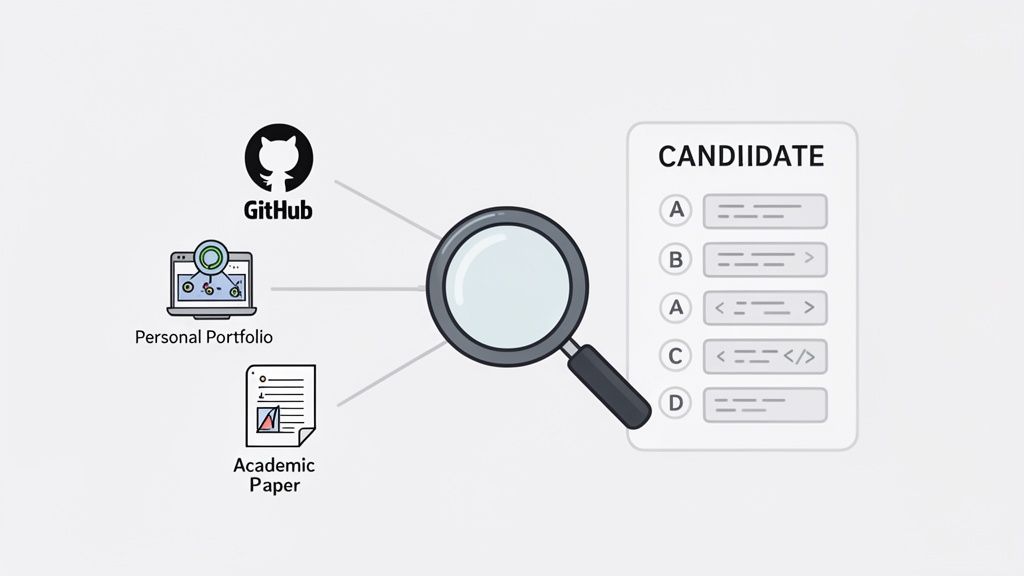
Think about it like this: modern sourcing tools pull together all these disparate data points—code repositories, design portfolios, published papers—to build a complete, 360-degree view of a candidate. By connecting these puzzle pieces, you can evaluate talent based on their actual work and accomplishments, not just a self-reported resume.
You're probably thinking, "Manually searching all those sites would take forever." And you're right. Doing this by hand isn't scalable and would bury any recruiting team in busywork. That’s why the old way is broken, and it's precisely the problem AI solves.
The next big leap in sourcing human resources is agentic automation. Imagine an AI agent working for you 24/7, constantly scanning over 30 platforms to build talent pipelines based on your Ideal Candidate Profile. This isn't science fiction; it's how top teams are operating right now.
Here’s how it works in practice:
This hands-off approach frees you from the tedious, top-of-funnel work. You get to focus on the high-value task: actually engaging with highly qualified, pre-vetted candidates.
But there's a problem most tools ignore: How do you find people who are practically invisible on traditional networks? Take an engineer who contributed to a groundbreaking open-source project but has a minimal social media presence. Legacy tools like the ones discussed in our LinkedIn Recruiter pricing guide would miss them completely.
A multi-source platform like PeopleGPT connects the dots.
For instance, a simple prompt can generate a diverse, high-quality talent pool in minutes. This is the exact process that helped companies like Ramp and Perplexity close critical roles five times faster. Our detailed guide on AI sourcing strategies breaks down more of these advanced workflows.
This shift isn't just a trend; it's fast becoming the standard. A Korn Ferry report found that 84% of global talent leaders plan to integrate AI into their recruitment strategies by 2026. This move is driven by the need to close skills gaps, which 63% of employers cite as their biggest hiring barrier.
By tapping into these hidden talent pools, you're not just finding better candidates—you're building a real competitive advantage by sourcing where your competitors aren't even looking.
Finding a fantastic candidate is a huge win, but it’s only half the battle. The real challenge is getting them to actually reply.
In a world where top talent gets dozens of generic, copy-pasted messages a week, your outreach has to cut through the noise. This is where most recruiters drop the ball. They find the perfect person and then send a terrible, low-effort email that gets instantly archived. It's a massive waste of a perfectly good lead.
The key isn't just what you say, but how and when you say it. It requires a thoughtful, multi-step approach grounded in personalization and, maybe most importantly, deliverability.
You might think your outreach is failing because your messaging is off. While that’s part of it, there's a more fundamental problem: your emails might not even be reaching their primary inbox.
Look, it's a simple truth.
Many sourcing tools provide unverified, stale contact data. Sending messages to these addresses is like shouting into the void—it damages your sender reputation and ensures your future emails land in spam. This is why built-in, real-time verification is non-negotiable for effective sourcing human resources.
When your platform automatically verifies emails, you're not just guessing anymore. You’re ensuring your carefully crafted message actually lands where it can be read. This simple step is what separates amateur outreach from professional execution.
For instance, one rapidly scaling tech company made a single change: they switched to a platform with integrated verification and a three-step outreach sequence. The result? They saw a 3x lift in candidate reply rates within one month. The success wasn't a fluke; it was a direct result of ensuring their messages got delivered and then following up systematically.
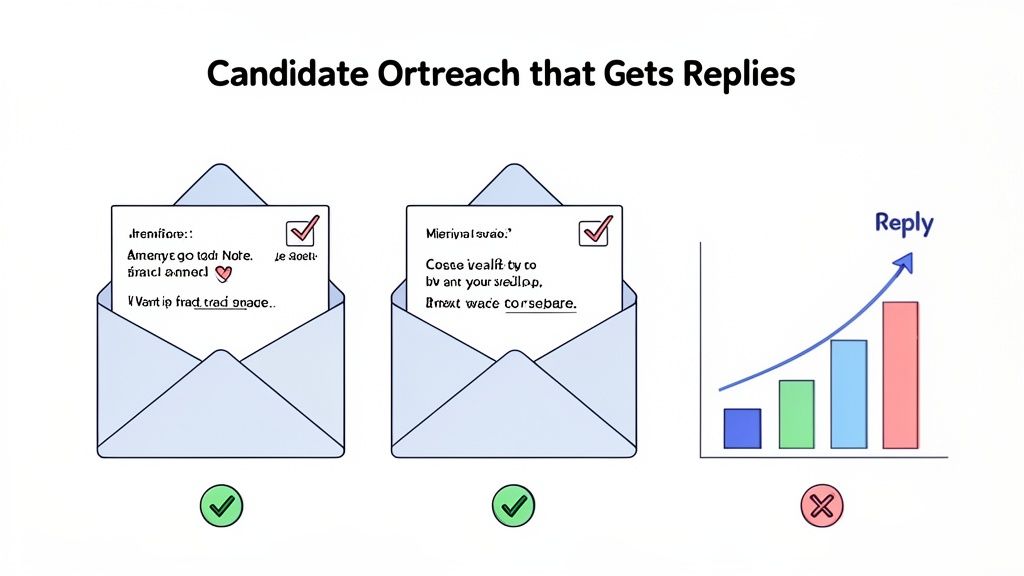
This visual shows the direct link between personalized, verified outreach and a measurable increase in engagement, a topic we explore further in our guide to recruitment emails.
A single email is easy to ignore. A persistent, polite, and value-driven sequence is much harder to overlook. You don't need a complex, 10-step behemoth, either. A simple three-step cadence is often all it takes to get a response.
Here is a breakdown of a proven sequence that respects the candidate's time while keeping you top-of-mind. While there are many great recruiting email templates to draw from, the structure is what truly matters.
This structured approach shows professionalism and respect for their time. It’s a stark contrast to the endless, generic pings that flood their inboxes.
| Step | Timing | Focus | Example Snippet |
|---|---|---|---|
| 1. The Hook | Day 1 | Hyper-Personalized Opener — reference a specific project, talk, or piece of work to prove relevance. | “Saw your recent talk on scaling Kubernetes at KubeCon—your point about sidecar proxies was brilliant.” |
| 2. The Gentle Nudge | Day 3 | Value-Add Follow-Up — restate the opportunity and connect it directly to their expertise. Keep it short. | “Following up on my last note. I think your experience with distributed systems would be a huge asset for our team…” |
| 3. The Breakup Email | Day 7 | Polite Closing — acknowledge their time and close the loop respectfully. | “Assuming now isn’t the right time. I’ll take you off my list, but feel free to reach out if things change.” |
Some teams even mix in other channels like SMS. To ensure your SMS outreach is not only effective but also compliant and engaging, consider adopting these text message marketing best practices.
You can't improve what you don't measure. It's that simple.
In sourcing, it’s far too easy to get caught up in vanity metrics—"profiles viewed" or "emails sent." These numbers might pad a weekly report, but they tell you next to nothing about whether you're actually any good at your job. They don't correlate with hires.
To get a real grip on performance, you have to treat your sourcing process like a funnel. That means meticulously tracking how candidates move from one stage to the next. If you're not tracking this, you’re basically sourcing in the dark.
This isn't just a "nice-to-have." According to a 2024 Gartner study, talent acquisition is the top priority for 20% of organizations and a top-three focus for another 26%. In a market this competitive, flying blind isn't an option.
The most revealing metrics are your pass-through rates. This is the percentage of candidates who successfully advance from one stage to the next. These numbers are your diagnostic tools—they immediately tell you where your process is humming along and where it's falling apart.
Start by tracking these core conversions:
By keeping a close eye on these rates, you can stop guessing and start making targeted fixes right where the leaks are happening.
Seeing your pipeline laid out like this makes it painfully obvious where things are getting stuck. It helps you stop wasting time and focus on the metrics that actually lead to hires. It also provides insights that are much deeper than standard Indeed alternatives.
While pass-through rates tell you about the health of your funnel, other metrics are needed to paint the full picture. Of course, things like Time to Hire Metrics are critical for gauging efficiency and spotting bottlenecks.
But speed isn't everything.
The real goal isn't just to fill a seat fast; it's to fill it with the right person who will stick around and make an impact.
Quality of Hire is the ultimate metric. It’s harder to measure, sure, but it's the one that truly matters.
You can get a handle on it by looking at:
These data points, both qualitative and quantitative, give you a much deeper read on your effectiveness. You can explore the full range of important recruiting metrics that top-tier teams obsess over.
This is where modern AI tools change the game completely.
In the old way of doing things, learning from a bad search was a slow, manual chore. You'd run a search, review the results, tweak your Boolean string, and run it again. And again. With an AI agent, every bit of feedback you give it creates a rapid learning cycle.
When you give a thumbs-up or thumbs-down on a candidate profile, you’re not just sorting a list—you’re actively training the algorithm on what "good" looks like. This creates a powerful flywheel effect. The AI learns your preferences, refines its search on the fly, and gets smarter and more accurate with every click.
This turns measurement from a boring, backward-looking report into an active, continuous improvement engine. Your sourcing human resources efforts become more precise and effective with every single search you run.
The era of the recruiter as a manual search operator is officially over. Let's be honest, sourcing human resources effectively is no longer about who can write the most convoluted Boolean string or lose hours scrolling through endless profiles.
The future belongs to recruiters who act more like strategic conductors, orchestrating AI agents and data insights to build powerful talent pipelines.
The modern sourcer's real job isn't to find names—it's to define the mission. You give the AI your Ideal Candidate Profile, and it takes over, executing the search across dozens of platforms, 24/7.
This autonomous approach completely flips the script. Instead of a long checklist of tedious, manual tasks, your workflow becomes a strategic, feedback-driven process. Organizations like SHRM, the world's largest HR association, have been highlighting this shift toward tech-driven talent strategy for years.
Your role evolves into one of refinement and genuine engagement. You provide feedback to sharpen the AI’s accuracy and focus on building relationships with the high-caliber candidates it brings to you. It's a fundamental change in how we approach talent acquisition, impacting everything from dealing with malicious compliance to managing a 9/80 work schedule.
By delegating the repetitive top-of-funnel work to autonomous agents, you free up critical bandwidth to focus on what humans do best: strategy, relationship-building, and closing candidates.
This isn't just a small step forward; it's a giant leap in efficiency and impact. It transforms the entire function from a reactive, transactional cost center into a proactive, strategic partner that directly fuels company growth. By embracing this new way of working, you don’t just fill roles faster—you build a sustainable competitive advantage in the war for talent.
What is the primary goal of sourcing human resources?
To proactively find and engage qualified passive candidates—those not actively looking for jobs—to build a robust talent pipeline for current and future roles.
How does AI improve the talent sourcing process?
AI automates the heavy lifting of searching across dozens of platforms, verifies contact data, and helps personalize outreach, freeing up recruiters for strategy.
Why is sourcing beyond LinkedIn so important?
Many top engineers, creatives, and specialists are more active on platforms like GitHub or academic sites, representing a vast, untapped source of quality talent.
What are the most important sourcing metrics to track?
Focus on pass-through rates between sourcing stages (e.g., Sourced-to-Screen) and the ultimate metric: Quality of Hire, measured by performance and retention.
Ultimately, modern sourcing human resources is about finding and engaging top talent that your competitors will never even see. By automating the top of your funnel with an AI that scours the entire internet, you move from a reactive order-taker to a strategic partner who builds predictable, high-quality talent pipelines. This unlocks the ability to consistently hire the right people—the ones who will actually drive your company forward.
Ready to stop wrestling with outdated tools and start building a world-class talent pipeline? Start sourcing with PeopleGPT.
{{large_cta}}
Run your first search for free. Find and engage top talent across 800M+ profiles. Trusted by 5,000+ customers.