.svg)
SIGN UP FOR JUICEBOX (IT’S FREE!)

Who are you looking for?
Thank you! Your submission has been received!
Oops! Something went wrong while submitting the form.

AI was supposed to make recruiting easier: it promised faster processes, higher caliber candidates, and more time to spend on relationship-building. However, LinkedIn’s 2026 research finds that even though recruiters have fewer open roles to fill, 66% feel it’s been harder to find qualified talent over the past year. At the same time, recruiting teams are under increasing pressure to fill roles faster and uncover those sought-after “hidden gem” candidates every org wants in their lineup.
So, what’s going wrong, and how can recruiters avoid being overwhelmed by the changing tide and still achieve their goal of finding exceptional people?
Due to the wave of AI slop infiltrating current hiring funnels, inbound recruiting has become impossible to control or scale in its current form. The average candidate now sends 239% more applications than they did before ChatGPT’s release in November 2022. And that may be an underestimate. These aren’t high-quality applications, nor are they 100% authentic.
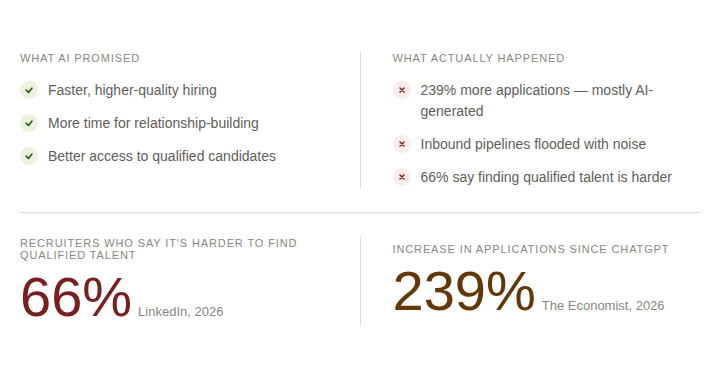
Inbound is broken. And the only way to overcome the volume of low-quality applications is to use outbound channels like direct sourcing, email outreach, and referrals to find and hire qualified candidates.
To make outbound work without ballooning team size, recruiting teams need a way to coordinate sourcing, signals, and handoffs without relying on manual effort at every step. AI systems become the coordination layer that connect hiring signals with execution, enabling talent work to function at scale.
For that layer to exist, we need talent engineering: a philosophy focused on owning and designing candidate discovery systems, rather than leaving hiring to chance or volume.
Now, as recruiting becomes more system-driven, ownership-heavy, and tightly coupled to AI, adopting a talent engineering mindset is less a novelty and more a necessity.
When a company needs to hire at scale, for example sourcing 100 engineers, the talent engineering approach isn't to manually search LinkedIn. It's to build and refine a system that continuously pinpoints relevant candidates and routes them to recruiters, who then focus on judgment-heavy work: building relationships, assessing nuance, and closing best-fit candidates.
The companies that recognize this shift early will certainly hire differently. But they’ll also build a hiring advantage that compounds over time; because they’ve named, owned, and invested in a concept others are still struggling to define.

At Juicebox, our customers are bringing similar conversations to us, using our platform as part of their talent engineering system. Along with needing to source faster, teams are also debating who owns their recruiting infrastructure. Some experiment by giving each recruiting team member control of their own Juicebox agent. Others assign responsibility to a single person managing dozens of agents; in effect, operationalizing the talent engineering concept as part of their existing role.
The goal now is to switch to precision, redesigning discovery and applying human judgment later, where it matters most. What’s still unclear is how quickly talent engineering will spread as a new approach. History suggests that when underlying work changes, the thinking around it quickly follows. We only have to look at the rise of GTM engineering to recognize that pattern.
The clearest indicator of talent engineering as the philosophy of the moment can be found in xAI, which recently announced it was hiring for a dedicated Talent Engineering team. The function works closely with both recruiting and engineering, and is explicitly framed around first-principles thinking - treating recruiting as an engineering problem rather than a sourcing exercise.
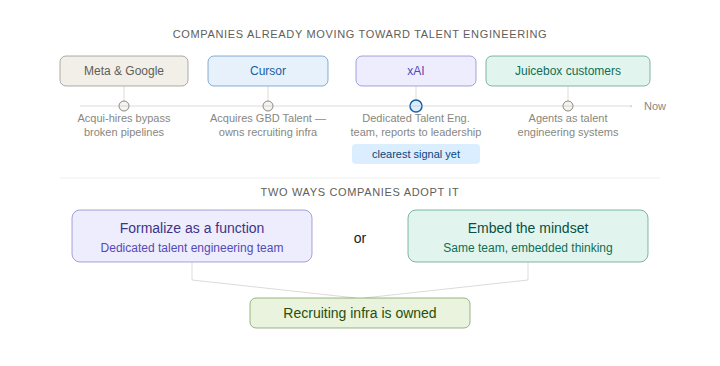
Some companies will go this far and formalize talent engineering as a dedicated function. Others will embed the same thinking across their existing team. Either way, the significance isn't in the title, but in the decision to treat recruiting infrastructure as something that needs deliberate ownership.
Run your first search for free. Find and engage top talent across 800M+ profiles. Trusted by 4,000+ customers.