
Published on
Last Updated
Imagine your ideal candidates aren’t just hanging out on one or two job boards. They’re scattered across dozens of professional networks, online communities, and portfolio sites. A modern talent sourcing platform is your central command center to find them all. It’s a specialized search engine that helps you proactively discover top-tier candidates who haven’t even applied to your jobs yet.
The core benefit is simple: it transforms recruiting from a manual, time-sucking numbers game into a precise, automated strategy. Our company, Juicebox, builds a talent sourcing platform called PeopleGPT, designed to give recruiters this exact advantage.
TL;DR: Why a Modern Talent Sourcing Platform is a Must-Have
Expands talent pool: Aggregates candidate data from 30+ sources (not just LinkedIn), revealing hidden talent.
Saves time: Uses natural language AI to replace clunky Boolean searches, finding candidates in seconds.
Improves efficiency: Unifies finding, verifying, and outreach into one seamless workflow, eliminating manual steps. Ramp cut their time-to-hire by 60% in just three months with Juicebox.ai.
Increases ROI: Replaces multiple expensive, single-purpose tools with one cost-effective system.
What is a modern talent sourcing platform?
Let’s use an analogy. Traditional recruiting is like fishing in a single, crowded pond with a simple rod and reel. You might catch something, but you’re elbow-to-elbow with every other recruiter, all competing for the same fish.
A modern talent sourcing platform is like giving your team a high-tech sonar system that maps the entire ocean. It reveals rich, undiscovered fishing grounds far from the competition.
But there’s a problem most tools ignore.
Simply finding more profiles isn’t the answer. The real bottleneck is the fragmented workflow: searching in one tool, verifying contacts in another, and sending outreach from a third. Instead of just managing a flood of incoming applications, modern platforms unify this outbound recruiting process. They pull together data from across the open web to build detailed profiles, giving you a clear view of the entire talent market—not just the small fraction actively looking for a job. This proactive approach is a game-changer for finding top-tier, passive talent.
At its core, a modern talent sourcing platform is designed to work hand-in-glove with a robust applicant tracking system (ATS). While the sourcing tool finds new leads, the ATS helps you organize and manage them. Our guide on what an applicant tracking system is explains this relationship in more detail.
The shift from manual searching to AI-powered discovery
For years, “sourcing” meant wrestling with complicated Boolean strings and manually sifting through thousands of profiles on a single network. The big problem with that old method? It’s painfully slow, incredibly inefficient, and misses over 80% of the available talent pool hiding on other platforms.
A true talent sourcing platform changes the game completely by introducing a few key breakthroughs:
Multi-source aggregation: It pulls candidate data from 30+ sources like GitHub, Behance, and academic sites—not just LinkedIn. This creates a 360-degree view of a person’s skills based on their actual work, not just what they put on a resume.
Natural language search: Forget clunky Boolean logic. You can now use plain English. For example, you can just ask for “software engineers in Austin with experience building fintech apps who have worked at a Series B startup.” The AI actually understands what you mean. We’ll show you how to find better sourcing tools for recruiters.
Data verification: It goes beyond just finding profiles. The best platforms automatically verify contact information, making sure your outreach actually lands in the right inbox and slashing your bounce rates.
This evolution is exactly why the talent acquisition software market is seeing such explosive growth. Valued at over USD 2.1 billion in 2024, it’s forecasted to hit USD 7.8 billion by 2033 as more companies realize that finding great talent is their biggest bottleneck. You can dig into this growth in recent market analysis reports.
Ultimately, a modern talent sourcing platform isn’t just another tool; it’s a strategic shift. It moves your team from a reactive, volume-based game to a proactive, precision-based one, helping you find and engage far better candidates in a fraction of the time.
Why traditional sourcing methods no longer work
For years, recruiters have been fed a simple, yet deeply flawed, mantra: sourcing is a numbers game. The more outreach you send, the more hires you’ll make. Simple, right?
Wrong. The opposite is true. Sourcing is a precision game.
Relying on legacy tools like LinkedIn Recruiter, where every recruiter is fishing in the same overfished pond, puts you at a huge strategic disadvantage. Those endless InMails and dismal engagement rates aren’t a sign of hard work; they’re symptoms of a broken system.
You might think that having access to the largest database is the answer.
But here’s why that fails. This “walled garden” approach is exactly the problem.
The myth of the all-in-one database
Legacy platforms want you to believe that every candidate worth hiring is neatly cataloged inside their system. This creates a massive blind spot.
Think about it. A brilliant software engineer might have a bare-bones LinkedIn profile but a hyperactive GitHub repository. A world-class designer could be showcasing their portfolio on Behance, not bothering to update their job title.
When your main tool only sees self-reported data from a single network, you’re missing the true story of a candidate’s skills and achievements. This outdated model creates three critical bottlenecks:
Inflated costs: A single seat for LinkedIn Recruiter can set you back over $10,800 per year. You’re paying a premium to compete with millions of other recruiters for the same saturated talent pool. Find better LinkedIn Recruiter alternatives.
Wasted hours: Recruiters spend hours wrestling with complex Boolean strings and manually sifting through thousands of irrelevant profiles—a tedious process that modern tools have made obsolete.
Low engagement: Top candidates get hammered with dozens of generic messages every single day. If you can’t personalize your outreach based on their actual projects or contributions, your message is just more noise.
But even if a tool expands the search pool, there’s another problem that most platforms ignore.
The whole workflow falls apart if you can’t efficiently find, verify, and engage with the right people.
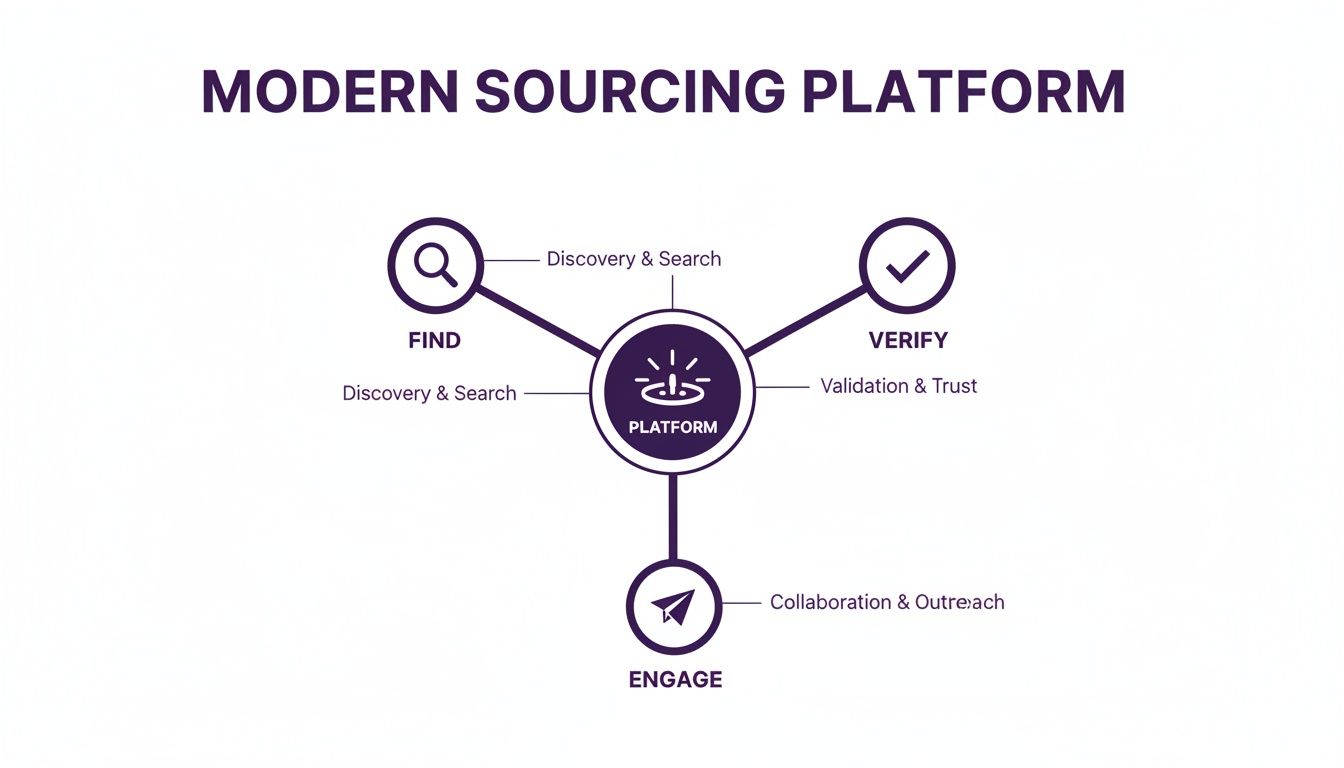
This is where a modern talent sourcing platform comes in. It doesn’t just find names; it integrates the core functions of finding candidates, verifying their information, and initiating outreach into one cohesive system.
Inefficiency is baked into the old model
Let’s walk through the traditional workflow. You spend hours searching on one platform, copy-pasting profiles into a spreadsheet, using another tool to guess an email, then uploading that list to a separate outreach tool. Each step is a point of friction where data gets lost and time is wasted.
One company, Box, discovered this fragmented process was adding 3–5 hours of manual work per role before they finally consolidated their tools.
This isn’t just inefficient; it’s completely unscalable. It turns recruiters into administrative assistants instead of the strategic talent advisors they need to be. It also makes it nearly impossible to track meaningful recruiting metrics.
“Pipeline volume. Number of coffee chats. How many passive candidates you engaged last quarter. These are internal metrics… But they are not value. They are noise.” - Brian Fink, Recruiting Strategist
The old way of doing things generates a lot of activity but very few results. To actually find and connect with the best people, you need a fundamental shift in both technology and strategy.
This means moving away from closed-off databases and toward an open, integrated approach. The core challenge isn’t just finding names; it’s about building a scalable system to connect with the right people, wherever they are. This is exactly what the new category of talent sourcing platform, built for the modern web, is designed to solve.
The differences between the old and new ways of sourcing are night and day. Let’s break it down.
Legacy tools vs modern sourcing platforms
Feature | Traditional Sourcing Tools (e.g., LinkedIn Recruiter) | Modern Talent Sourcing Platform (e.g., PeopleGPT) |
|---|---|---|
Talent Pool | Single, self-reported database (a “walled garden”). | Aggregated from dozens of sources across the web. |
Search Method | Manual Boolean strings requiring constant tweaking. | Natural language and AI-powered semantic search. |
Candidate Data | Limited to what users enter on one profile. | Holistic view including projects, code, and contributions. |
Workflow | Fragmented: multiple tools for search, contact, and outreach. | Unified: find, verify, and engage in one platform. |
Personalization | Generic, based on job titles and keywords. | Deeply personalized, based on real-world accomplishments. |
Cost Model | High per-seat license fees plus add-ons (InMails). | More flexible, with a higher ROI. |
Simply put, while traditional tools keep you trapped in a competitive, noisy environment, modern platforms give you the intelligence and efficiency to break out and find talent no one else can see.
The core components of a high-impact sourcing platform
What really separates a game-changing talent sourcing platform from just another tool in your tech stack? It’s not about the longest feature list. It’s about how a few core, integrated components work together to create a seamless workflow that actually gets results.
Think of it this way: effective sourcing is a three-part mission. You have to find the right people, verify their information, and successfully engage them. The best platforms weave these three stages into one fluid motion, cutting out the clumsy handoffs between different tools that absolutely kill productivity.
Multi-source candidate aggregation
First things first, you need to see the entire talent market, not just a tiny slice of it. Most traditional tools lock you into their single database, which is like trying to map the ocean by only looking at one bay. A high-impact platform shatters those walls.
By pulling in candidate data from 30+ professional networks and online sources—think GitHub, Behance, academic journals, and personal portfolios—it builds a complete, 360-degree view of a candidate’s skills. You get to see their actual work, contributions, and projects, not just the job titles they list on one profile. This instantly expands your talent pool way beyond the oversaturated networks where everyone else is fishing.
AI-powered natural language search
Okay, so you have access to a vast talent ocean. Now, how do you find the exact person you need?
The big myth in sourcing is that you need to be a Boolean wizard. The opposite is now true.
Modern AI makes that entire skill set obsolete. Instead of typing out complicated syntax, you simply describe who you’re looking for in plain English. For example:
“Product managers in New York who have scaled a mobile app from 10k to 1M users and have experience at a fintech company.”
This natural language approach lets you focus on the strategic what instead of the technical how, making sourcing faster and more intuitive for your whole team. It’s a huge part of the bigger shift toward using comprehensive talent intelligence software to make smarter, data-backed hiring decisions.
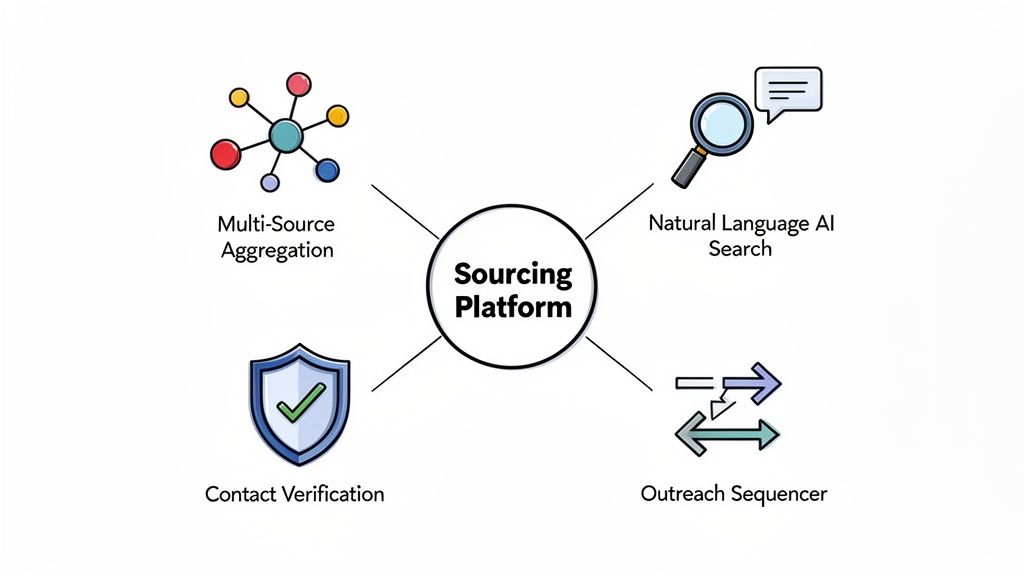
As you can see, these core components—aggregation, AI search, verification, and outreach—are all unified within a single interface. This integrated design is what lets recruiters go from a simple idea to a qualified shortlist in minutes, not hours.
But finding great profiles is only half the battle.
What good is the perfect candidate if you can’t actually reach them? This is where the final, crucial components come into play.
Integrated contact verification and outreach
Finding a profile is just the beginning. The next critical step is getting accurate contact info and having a reliable way to engage the candidate. A top-tier talent sourcing platform doesn’t just find people; it gives you the tools to connect with them.
Here’s how it works:
Built-in verification: The platform automatically finds and verifies personal and work email addresses, which dramatically cuts down on bounce rates. Companies like Box found that consolidating their tools and automating verification saved them 3–5 hours of manual work per role.
Outreach sequencers: Instead of exporting lists to another tool, you can build and launch personalized, multi-step email campaigns right from the platform. According to research from Woodpecker, sending just one follow-up can boost reply rates by 40%.
This integrated system closes the loop. It transforms sourcing from a disjointed, multi-tool mess into a single, efficient workflow. A recruiter can go from an initial search idea to a list of verified, engaged candidates without ever leaving the platform. This completely changes the speed and effectiveness of their work.
For example, a recruiter at Ramp used this exact workflow to slash their time-to-hire by 60% in just three months.
How AI is reshaping talent acquisition
Let’s be honest, the term “AI” gets thrown around so much it’s starting to lose its meaning. A lot of recruiting tools just slap a shiny “AI” sticker on their old tech without actually changing anything fundamental.
This is what’s known as “AI-washing.” It’s like putting a fancy GPS screen in a horse-drawn carriage. Sure, it looks modern, but you’re not getting to your destination any faster.
A truly modern talent sourcing platform built with AI from the ground up works completely differently. It’s less of a dumb keyword filter and more like a brilliant human colleague. Instead of just matching words on a profile, it gets the context, the intent, and all the little nuances. This is the difference between finding someone who mentions a skill and identifying a candidate who has truly mastered it.
This leap forward is powered by things like large language models and vector search. Think of it this way: old search tools are like a librarian using a dusty card catalog, forced to look for exact keyword matches. True AI is like having a conversation with that same expert librarian, who understands what you’re really asking for and pulls amazing books you never would have thought to request.
From keywords to intent
For years, the best sourcers were the ones who could craft ridiculously complex Boolean search strings. That entire skillset is now becoming obsolete. Why? Because modern AI focuses on the intent behind your search, not just the specific words you use.
Here’s a simple comparison to show you what I mean:
The old way (Boolean):
("Java Developer" OR "Software Engineer") AND "Fintech" AND ("AWS" OR "GCP") AND ("San Francisco" OR "SF Bay Area") NOT "Intern" NOT "Junior"The new way (natural language): “Find me senior Java developers in the Bay Area who have experience in fintech and cloud platforms.”
The AI-powered approach doesn’t just scan for those keywords. It digs deeper, analyzing career paths, project histories, and contributions across dozens of platforms to find people who fit the concept of your ideal hire. This is the core of how AI is being used for recruitment to deliver incredible precision at a massive scale.
But here’s the catch most AI recruiting tools miss: finding thousands of potential matches is useless if their data is stale or you can’t get in touch with them. Speed without accuracy is just noise. This is where an integrated, AI-native talent sourcing platform really shines. It connects the dots between discovery, verification, and outreach.
Ramp, a financial services company, cut their time-to-hire by 60% in just three months by using PeopleGPT’s unified AI workflow to find and engage top-tier candidates hiding outside of LinkedIn.
The tangible business impact of AI
The rush to adopt AI in recruiting isn’t just hype; it’s driven by real, measurable business results. The global talent acquisition software market hit USD 10.8 billion in 2024 and is on track to more than double to USD 24 billion by 2034. This explosive growth proves that investing in smart hiring tech is no longer optional—it’s essential for any company that wants to compete for talent. You can discover more insights about this market growth.
AI-driven sourcing delivers outcomes you can actually measure:
Drastically reduced time-to-hire: By automating the soul-crushing parts of sourcing, teams can fill critical roles in a fraction of the time.
Higher quality candidates: AI is brilliant at uncovering hidden gems—passive candidates with proven skills who make for better long-term hires.
Increased recruiter efficiency: Recruiters get to spend more time building relationships and closing candidates, and less time buried in administrative busywork.
An AI-native talent sourcing platform doesn’t just speed up the old, broken process. It introduces a fundamentally smarter way to build a world-class team, turning sourcing from a manual chore into a strategic, high-impact advantage.
Choosing and implementing a sourcing platform
So, you’re ready to make a change. Good. But let’s be clear: picking the right talent sourcing platform isn’t about ticking boxes on a feature list. It’s about finding a tool that slots right into your team’s existing workflow, not forcing them to wrestle with a bloated, over-engineered system.
It’s tempting to think the big, enterprise-first platforms are the safest bet. But that’s a classic mistake. These tools often fail spectacularly because their complexity is a feature, not a bug—and it creates a ton of friction. When recruiters are faced with clunky interfaces and weeks-long onboarding, they just go back to their old spreadsheets. Your expensive new software ends up gathering digital dust.
The real key is agility and simplicity.
Evaluation criteria that actually matter
When you’re vetting platforms, cut through the noise and focus on these three things. They’re what will actually drive recruiter productivity and better hiring outcomes.
Data quality and source diversity: Is the data fresh? A platform is only as good as the information it runs on. Ask vendors how often they refresh their candidate profiles. Even more important: where does that data come from? A tool that pulls from 30+ sources will always give you an edge over one that’s stuck in a single, closed network.
Ease of use and speed to value: Can a brand-new recruiter get a search running in 60 seconds? The best platforms use natural language search, which means you don’t need to be a Boolean wizard to find great candidates. A fast setup empowers your team to see results on day one, which is the single most important factor for getting them to actually use the tool. For a deeper look, check out our guide on the best sourcing tools for recruiters.
Integrated workflow: Does this tool connect the dots? A platform that makes you find people, then export a list to another tool for verification, then another for outreach, is just shuffling the same old problems around. You’re trying to escape that fragmented workflow, not recreate it. A unified system is non-negotiable.
The market for these tools is exploding for a reason. Companies are finally realizing the power of a single, SaaS-based system. The recruitment marketing platform space alone was worth USD 1,186 million in 2023 and is on track to hit USD 2,656.9 million by 2033. Cloud-based solutions already own over 55% of that market. This isn’t a trend; it’s a fundamental shift away from clunky, on-premise dinosaurs toward flexible, scalable tech. (Read the full research about recruitment platform market growth).
A simple implementation framework
Switching tools shouldn’t be a month-long migraine. A modern talent sourcing platform should be up and running in minutes, not weeks. Here’s a simple four-step process to get your team rolled out smoothly and see immediate adoption.
Set up key integrations (10 minutes): Start with your Applicant Tracking System (ATS). This is your source of truth and ensures candidate data flows seamlessly, preventing duplicates. Good platforms offer one-click connections to tools like Greenhouse, Lever, and Ashby.
Run a pilot search (5 minutes): Get every team member to run a search for one of their active, hard-to-fill roles. This isn’t just training; it’s an instant “aha!” moment that proves the platform’s value by uncovering new, relevant candidates right away.
Build one shared project (15 minutes): Create a collaborative project for a high-priority opening. Invite the hiring manager to review the first slate of candidates. This simple step gets everyone on the same page and shows off how quickly you can build a quality pipeline.
Launch a test outreach campaign (30 minutes): Use the built-in email sequencer to send a small, two-step campaign to a handful of sourced candidates. This closes the loop and proves the entire end-to-end workflow—from discovery to engagement—works inside one system.
The whole thing takes about an hour. By focusing on a quick, tangible win for a real role, you build momentum and get the team genuinely excited about their new workflow.
The future of sourcing is autonomous AI agents
Moving from manual Boolean strings to natural language AI was a huge step for sourcing. But what’s coming next is a whole different ballgame. What if your talent sourcing platform could do the heavy lifting for you, even while you sleep?
That’s the idea behind autonomous, agentic AI. It’s a massive shift from active searching—where a recruiter is always behind the wheel—to genuine, automated sourcing.

Imagine deploying an AI agent that works for you 24/7. You give it a role, lay out your ideal candidate profile, and it just… goes. This isn’t just a saved search pinging you with alerts; it’s a dynamic system that thinks.
How autonomous sourcing works
An AI agent doesn’t just pull a static list of names. It actively learns from your feedback and fine-tunes its search on the fly.
Here’s what that actually looks like:
Continuous discovery: The agent is always scanning the market for fresh candidates who match your criteria, feeding a steady stream of qualified talent right into your pipeline.
Smart feedback loops: When you thumb-up or thumb-down a candidate, the agent learns your preferences. It recalibrates to find more people like your top picks and fewer like the ones you passed on.
Proactive engagement: The most sophisticated agents can even kick off personalized outreach, warming up passive candidates so you can jump in when the conversation is already rolling.
This tech isn’t about replacing recruiters. It’s about giving them superpowers. Research from Aptahire shows AI-powered tools can cut costs by up to 30% by handling the repetitive grunt work. This frees up your team to do what humans do best: build relationships and close top-tier candidates. To get a deeper look at this, check out our full guide on how Agent 2.0 works.
From tool to teammate
You might be thinking this sounds like a “black box” where you give up all control. But that’s a failing model, because recruiters need transparency. A well-built agentic AI gives you full visibility into what it’s doing while it handles the grind.
Look at RingCentral’s success with attribute-based AI. By aiming the technology at specific outcomes, their team saw 40% more engagement from underrepresented talent groups. It’s proof that when you direct AI correctly, it enhances a recruiter’s strategy—it doesn’t replace it.
The agent stops being just a tool and becomes more like an incredibly efficient junior sourcer, working tirelessly to build your pipeline around the clock.
FAQs: best talent sourcing platform (2026)
How is a talent sourcing platform different from an ATS?
A sourcing platform finds new, passive candidates across the web. An ATS manages applicants who have already applied. They are two sides of the same coin.
Do I need to be a tech whiz to use an AI sourcing platform?
Not at all. Modern platforms understand plain English. If you can write an email, you can find top talent without needing complex Boolean search skills.
Is a sourcing platform worth it for a small team?
Absolutely. It saves time and replaces multiple tools, often delivering a higher ROI for smaller teams by letting them compete with much larger companies.
Can these platforms source for non-technical roles?
Yes. A good platform pulls from dozens of sources beyond just tech sites, making it highly effective for finding sales, marketing, and finance talent.
The bottom line
Here’s the real benefit: a modern talent sourcing platform turns recruiting from a manual, time-sucking numbers game into a precise, automated strategy.
This shift unlocks the ability for any team—no matter the size—to find and hire world-class talent faster than their competitors, building the engine that will drive your company’s growth.
Start sourcing with PeopleGPT
Sign up for Juicebox (it's free!)
Run your first search for free. Find and engage top talent across 800M+ profiles. Trusted by 5,000+ customers.