.svg)
SIGN UP FOR JUICEBOX (IT’S FREE!)

Who are you looking for?
Thank you! Your submission has been received!
Oops! Something went wrong while submitting the form.


Trying to make sense of all the different types of recruiting software out there feels like assembling a puzzle with pieces from ten different boxes. You’ve got Applicant Tracking Systems (ATS), Candidate Relationship Management (CRM) tools, and a whole slew of sourcing platforms—all with overlapping features and head-spinning acronyms.
It’s a mess.
And it’s costing you top talent.
The reality is, most recruiting stacks aren't cohesive hiring engines; they're cluttered toolboxes. This guide breaks down the essential types of recruiting software, reveals the hidden costs of a fragmented system, and shows how to build a modern tech stack that gives you a genuine competitive advantage. We’re not just listing tools; we’re providing a framework for choosing the right ones for your growth stage.
TL;DR: The 4 Core Types of Recruiting Software
Most recruiters aren't working with a cohesive hiring engine. They're stuck with a cluttered toolbox. You probably have an ATS just to stay compliant, a separate LinkedIn Recruiter license that can cost over $10,000 per year for finding people, another for verifying their emails, and yet another for sending outreach sequences.
Each tool tackles one tiny part of the problem, but they almost never play nicely together.
What’s the bottom line?
This patchwork approach creates huge issues that are quietly sabotaging your hiring goals.
When your software doesn't talk, your data gets trapped in silos. Candidate info ends up stranded on little islands—a profile in your ATS, a conversation history in your CRM, and sourcing notes buried in a spreadsheet. This forces recruiters into a soul-crushing cycle of manual data entry, constantly exporting and importing CSV files just to get a single, unified view.
Here’s what that fragmentation is really costing you:
The real problem isn’t a lack of tools; it's the lack of a central, intelligent system that connects the most critical parts of the hiring workflow: finding, verifying, and engaging candidates. Most teams believe adding more "best-of-breed" tools makes their process stronger. The opposite is true. The "integration tax" and manual labor needed to bridge all the gaps cancel out any specialized benefits. This is exactly where AI-native platforms are changing the game.
Think of a recruiter’s toolkit. You’ve got a bunch of different tools, each designed for a specific job—one to attract candidates, another to manage them, and a third to keep them warm for future roles. A great recruiter knows which tool to grab and when.
The problem? Most of the time, these tools don’t talk to each other.
This is where the hiring process usually falls apart. You end up with siloed data, repetitive manual work, and a clunky experience for everyone involved. Let's break down the main categories to see why this happens and how to fix it.
At its heart, an Applicant Tracking System (ATS) is a database built for compliance and organization. Its main job is to manage inbound candidates—the people who actively apply to your open roles. Think of it as a digital filing cabinet where every resume is stored, sorted, and tracked to keep you on the right side of hiring laws. For a look at how to streamline your recruitment process, check out our guide.
Recruiting coordinators and HR generalists are the primary users here. They rely on the an ATS to:
But here’s the catch: an ATS is fundamentally reactive. It’s designed to handle a flood of applicants, not to help you go out and find the best people. According to Zippia, a staggering 75% of qualified candidates are passive, meaning they aren’t actively looking for a new job. Your ATS is completely blind to this massive talent pool, which makes it pretty useless for strategic, proactive sourcing.
While an ATS waits for people to come to you, sourcing platforms help you find everyone else. These are the proactive tools that let sourcers and recruiters identify and engage passive candidates who would otherwise never know your company exists. They pull data from countless sources—professional networks like LinkedIn, public records, and social profiles—to create a searchable map of the entire talent market.
This is where sourcing tools really shine:
But even with a powerful sourcing tool, you run into another wall. All that rich candidate data lives in a separate system from your ATS. This forces recruiters into a painful, manual cycle of exporting lists from one tool and importing them into another, creating a huge disconnect between your proactive sourcing and your official system of record.
A Candidate Relationship Management (CRM) tool tries to bridge the gap between sourcing platforms and the ATS. Its purpose is to help you build and nurture long-term relationships with potential hires, often before a specific role even opens up. If a sourcing tool is for finding new leads, a CRM is for cultivating a pipeline of "warm" candidates you can tap into later.
Recruiters use CRMs to:
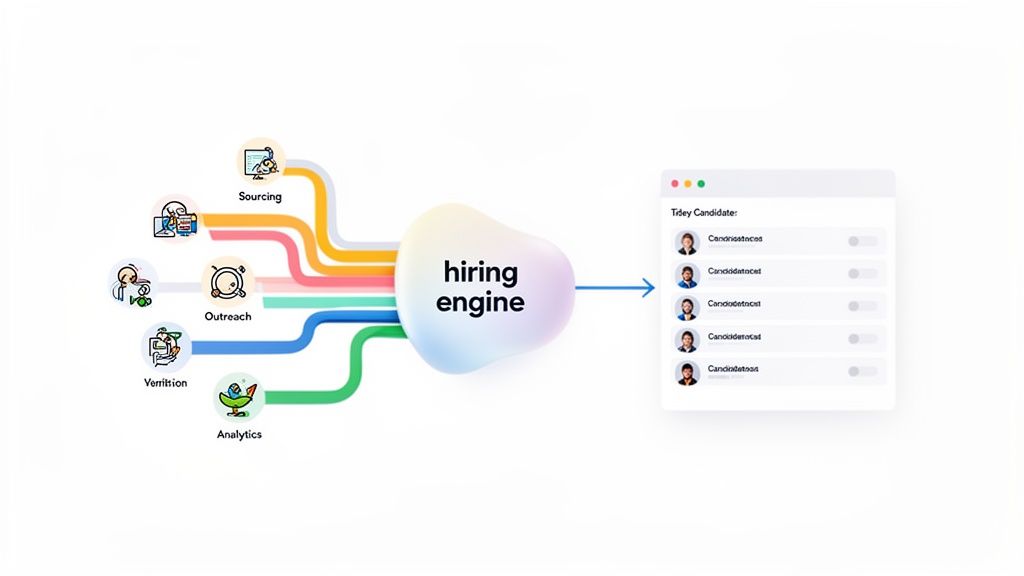
In a modern tech stack, these distinct systems are increasingly being unified under a more intelligent, AI-driven platform.

Types of recruiting software are consolidating under a single AI-powered platform.
This diagram shows the shift: instead of three separate tools, an AI platform can act as the central brain, connecting the functions of sourcing, outreach, and application management into a single, cohesive system.
Beyond those big three, you'll find a whole ecosystem of specialized types of recruiting software designed to solve very specific problems.
This market is booming. The global recruitment software market was valued at USD 3.77 billion in 2023 and is expected to reach USD 5.5 billion by 2031, growing at a 7.85% CAGR, according to Mordor Intelligence. This growth signals a strong demand for specialized solutions, but it also makes the fragmentation problem even worse.
Each of these tools is powerful on its own, but the real friction comes from stitching them all together. A sourcer finds a great candidate in one platform, manually adds them to a CRM for nurturing, and then, months later, has to re-enter their information into the ATS. This creates duplicate records, a messy data trail, and a ton of wasted time.
Most companies think adding more specialized tools strengthens their hiring process. The logic feels sound: buy a "best-of-breed" solution for sourcing, another for outreach, and a separate one for assessments. The common wisdom is that this specialized approach gets the best results.
The opposite is often true.
This strategy almost always creates a fragmented tech stack, where each tool becomes its own little data island. Information gets trapped, workflows break, and recruiters are forced into tedious, manual work just to keep the hiring engine from stalling.

You might think your powerful, specialized tools give you an edge. But there's a problem most tools don't talk about: the hidden "integration tax." This isn't just a line item on an invoice; it's the sum of all the friction, wasted time, and missed opportunities caused by a disconnected system.
Look. This tax shows up in a few painful ways:
A fragmented stack forces your team to operate with one hand tied behind their back. Every hour spent on manual data transfer is an hour not spent building relationships with top-tier candidates. This isn't just inefficient; it's a strategic liability.
What’s the bottom line? The time and money spent trying to stitch together different types of recruiting software often cancel out the benefits you thought you were getting from specialized tools in the first place.
You might think the integration tax is a minor inconvenience. It’s not. That manual grunt work directly impacts your ability to compete for talent. A survey by the Society for Human Resource Management (SHRM) found that it takes an average of 36 days to fill an open position. A huge chunk of that time is lost to administrative friction between systems.
That delay gives top candidates plenty of time to accept competing offers.
The solution isn't just another tool. It's consolidation. Tech companies like Ramp proved this. By consolidating their sourcing, data verification, and outreach into Juicebox, they were able to slash their time-to-hire by 60% within just three months. This shift allowed them to move faster and secure top engineering talent before competitors even had a chance to schedule a first call.
A unified platform solves the fragmentation problem at its root. Instead of acting as a passive database, an AI-first system becomes an active partner in the hiring process.
Here’s the difference:
By eliminating the need to constantly switch between different types of recruiting software, you free up your team to focus on what they do best: building relationships and closing candidates. This is the core problem that modern, AI-powered platforms are built to solve.
The biggest drag on modern hiring? The endless tab-switching. Jumping between a sourcing tool, then a data verifier, then an outreach sequencer isn't just annoying—it’s a massive bottleneck. Each tool adds friction, creating a process that’s slow, expensive, and riddled with opportunities for error. AI-native platforms are built specifically to solve this mess by collapsing those separate steps into one smart workflow.
Instead of just slapping an "AI" label on old software, these tools are engineered from the ground up to bring the most critical top-of-funnel activities under one roof. It’s a fundamental shift in how recruiting actually gets done.
The old way of sourcing forced recruiters to become experts in Boolean logic, spending hours crafting intricate search strings just to find qualified people. This wasn't just tedious; it was incredibly rigid. One slightly wrong query could easily exclude hundreds of perfect-fit candidates.
AI-native platforms do away with this completely.
With a tool like PeopleGPT, a recruiter just types a plain-English prompt, the same way they’d describe the ideal candidate to a colleague.
For example: "Find me senior backend engineers in San Francisco who have worked at a YC-backed fintech startup and have experience with Go and AWS."
This natural language approach makes sourcing more intuitive and exponentially faster. It opens up the ability to find top talent to anyone on the team, no specialized training required. It’s a world away from the clunky, command-line feel of traditional tools.
Here’s what that looks like in action inside PeopleGPT.
The platform takes a simple prompt and instantly turns it into a ranked list of candidates from over 30 different sources, shaving hours off manual search time.
Finding candidates is just step one. The real magic happens when sourcing, data verification, and outreach are all wired together. In a fragmented tech stack, a recruiter finds a profile on one platform, switches to another tool to find their email, and then uploads that list to a third tool just to send an email sequence.
An AI-native platform brings this entire process together. A sourcer can:
This unified workflow turns a process that used to take hours into one that takes minutes. When a company like Ramp cuts its time-to-hire by 60%, it’s a direct result of this kind of efficiency. By getting rid of the manual handoffs between different types of recruiting software, they can engage top candidates before competitors have even found their profiles. In a tight talent market, that’s a game-changing advantage.
A fragmented stack doesn't just slow you down; it scatters your data. When your sourcing, outreach, and ATS data all live in separate silos, you can't get a clear picture of what's actually working. Standalone market intelligence platforms are expensive and often give you a rearview-mirror look at the market.
AI-native platforms fix this by centralizing data and offering real-time talent analytics. Because the entire top-of-funnel process happens in one place, the system can generate insights on:
The broader shift toward cloud-based recruitment software has been a major tailwind for this kind of consolidation. In fact, the cloud deployment segment of the market is projected to grow by USD 1.3 billion by 2031, largely because these platforms offer faster updates and far better analytics. You can read the full research about recruitment software market trends.
Ultimately, consolidation isn’t just about making life easier; it's a strategic move that delivers real wins in speed, cost, and data accuracy. For a deeper dive into how it works, check out our guide on AI recruiting tools.
Not all companies need the same types of recruiting software. A solo founder's hiring needs are worlds apart from a 500-person scale-up's, and picking the right tools for your growth stage is the secret to hiring efficiently without lighting your budget on fire.
There's a common trap early-stage founders fall into: thinking they need a massive, enterprise-grade HRIS from day one to "look professional." This almost always backfires. You end up saddled with a slow, bureaucratic system built for compliance, not speed. Early on, sourcing power and flexibility are what really matter, not administrative bloat. Let's look at the best tools for different stages.
When you're a small, scrappy team, every single hire is make-or-break, and speed is your ultimate weapon. Your goal is to find top-tier talent without getting bogged down by clunky, complicated software. Your tech stack needs to be lean, powerful, and laser-focused on proactive sourcing.
At this stage, your core needs are simple:
This one-two punch prioritizes finding the right people over managing a process. It keeps your costs low while giving you the firepower to compete against much bigger companies for talent.
But there’s a bottleneck most tools ignore here. Even with a great ATS and sourcing tool, you're still stuck manually verifying emails and juggling outreach sequences. This is where consolidating into a single platform like PeopleGPT that handles search, verification, and outreach gives you a massive time-to-hire advantage.
As your company grows, so does the complexity of hiring. You’re probably hiring for multiple departments, your recruiting team is expanding, and your tech stack is starting to look a little… crowded. Maybe you have a LinkedIn Recruiter license, an outreach tool like Gem, and a few data providers floating around.
This is the exact moment where consolidation becomes a massive ROI driver.
You're no longer just hiring; you're building a scalable hiring engine. The goal is efficiency and a crystal-clear view of your recruiting metrics. A fragmented stack with redundant tools is your biggest enemy. We see teams all the time paying for three separate tools that could easily be replaced by one intelligent platform. For example, a single seat of LinkedIn Recruiter can cost over $10,000 per year, a cost that becomes very hard to justify.
At the scale-up stage, the winning move is to consolidate redundant tools for sourcing, data enrichment, and outreach into a single, unified platform. This cuts costs, eliminates data silos, and gives you a single source of truth for your entire top-of-funnel strategy.
Take Ramp, for example. They managed to cut their time-to-hire by a staggering 60% in just three months by ditching their scattered tools for a consolidated platform. Their team stopped wasting time on manual data entry and could finally focus on what actually matters: building relationships with candidates. Knowing when to look for Indeed alternatives is part of making this strategic shift.
Here’s a simple framework to help you figure out what you need at each stage.
Deciding on your recruiting stack shouldn't be a guessing game. The right tools depend entirely on where you are in your growth journey—what works for a five-person startup will hamstring a 200-person company. This table breaks down the essentials based on your company stage and primary hiring goals.
Ultimately, this framework helps clarify which types of recruiting software will give you the most bang for your buck. It’s all about making sure your tools support your growth instead of slowing you down.
An AI sourcing platform. Early on, speed and proactive outreach are everything. You must find top talent before they even hit the market.
No. An ATS is reactive; it manages inbound applicants. Sourcing tools are proactive; they find the 75% of talent that isn't actively applying.
Traditional tools automate administrative tasks. True AI tools automate strategic work, like finding and matching candidates with natural language.
Buying too many single-purpose tools. This "Franken-stack" creates data silos, bloats costs, and slows down your entire hiring process.
Choosing the right types of recruiting software isn't about collecting shiny objects; it's about building a single, cohesive system that works together. By consolidating the most critical top-of-funnel functions—sourcing, verification, and outreach—you eliminate the manual work that bogs recruiters down.
This unlocks their capacity to do what they do best: build relationships, sell the vision, and close the best talent. That’s how you build a hiring engine that consistently outruns the competition.
{{large_cta}}
Run your first search for free. Find and engage top talent across 800M+ profiles. Trusted by 5,000+ customers.



.png)