.svg)
SIGN UP FOR JUICEBOX (IT’S FREE!)

Who are you looking for?
Thank you! Your submission has been received!
Oops! Something went wrong while submitting the form.

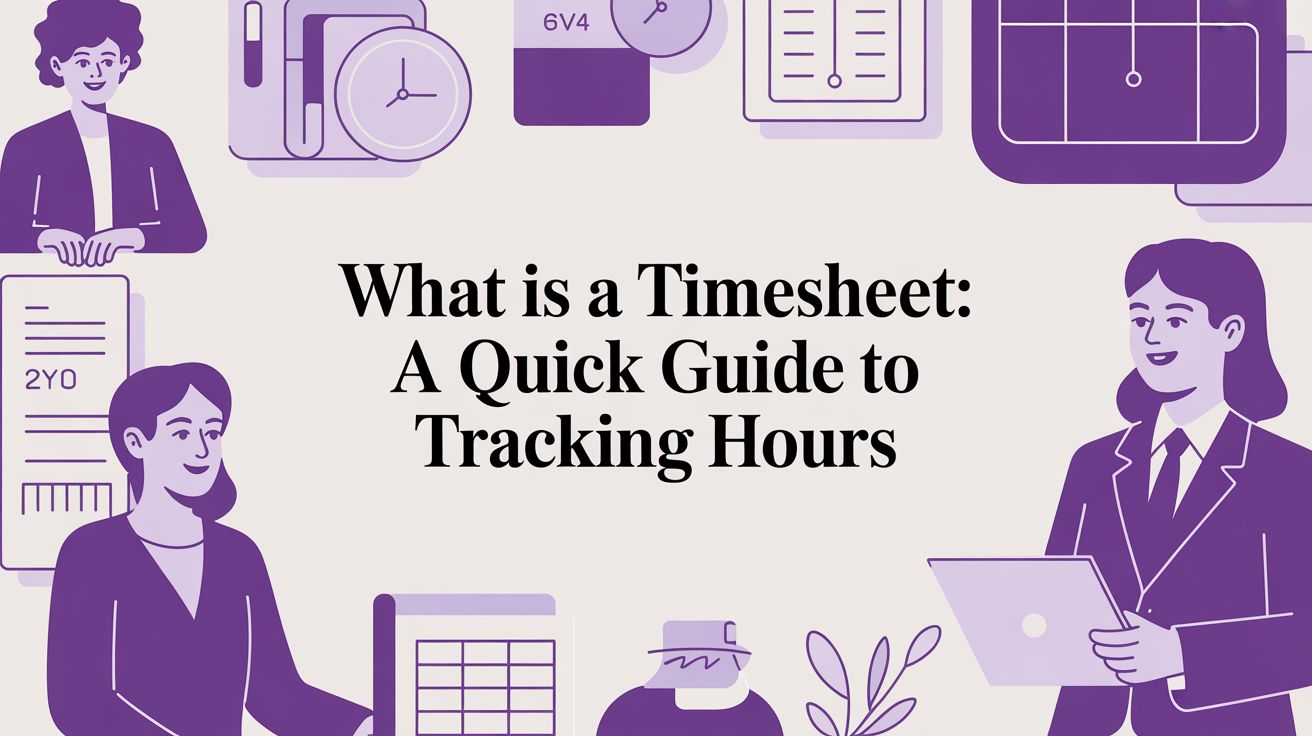
A timesheet is, at its most basic, a simple record of hours worked. It's the classic log of start times, end times, and breaks that ensures everyone gets paid accurately for their time. But in today's business world, timesheets have evolved; its real job is so much bigger than that.
At Juicebox, we see it as the foundational data source for workforce intelligence, not just a payroll chore.
In this guide, you'll learn what is a timesheet and how to move beyond basic timekeeping and turn your timesheet into a strategic compass for profitability and growth.
A timesheet is a record of an employee's hours worked during a pay period. Its primary functions are:
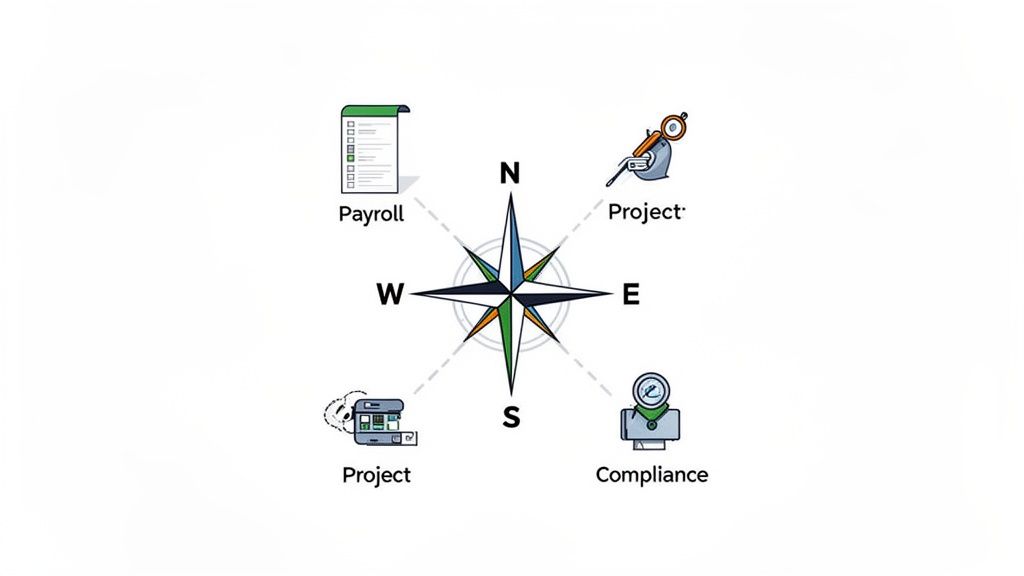
ALT: what is a timesheet compass showing directions for Payroll, Project, Compliance, and Project.
Let's be honest—most of us see filling out a timesheet as a chore. It feels like one more piece of admin work to tick off before the weekend. But thinking of a timesheet as just a payroll tool is like using a top-of-the-line smartphone only to make calls. You're completely missing its true power.
The modern timesheet is a business compass. It's the foundational data that guides your most critical decisions, pointing your company toward profitability, efficiency, and compliance.
Before we go deeper, this table breaks down the essential roles a timesheet plays in any organization. Think of these as the cardinal directions on your business compass.
Essentially, every function builds on the last, turning a simple log of hours into a powerful source of business intelligence. Getting this right is a key part of how to streamline your recruitment process and beyond.
You might think any timesheet is better than none. Why that fails? Bad data from outdated, manual methods can be more damaging than no data at all, leading to flawed budgets and expensive compliance missteps.
It’s shocking how many businesses still rely on paper. Roughly 38% of US employees still use paper timesheets. Even worse, managers report having to correct a staggering 80% of manual timesheets they receive. This isn't just an inconvenience; it's a massive drain on resources and a huge source of financial risk.
In contrast, an APA study found that companies using digital timesheet software reduce payroll errors by up to 44%. The difference is night and day.
When you start treating a timesheet as a strategic asset, you unlock a whole new level of insight. Every single entry is a data point. When you put them all together, they tell the story of how your business actually runs.
This data allows you to:
Ultimately, what is a timesheet is far more than a log. It’s the source of workforce intelligence that every scaling company needs to thrive. This guide will show you exactly how to harness that power.
The timesheet has evolved right alongside the modern workplace. What started as a simple necessity for factories and workshops has morphed into a powerful data source, perfectly mirroring our shift from manual labor to knowledge work.
It all began with actual sheets of paper. These were the original timesheets—rudimentary logs where employees would simply write down their start and end times. While it got the job done (mostly), this method was a nightmare of human error, lost documents, and countless hours managers spent just trying to tally up the numbers for payroll.
Here’s a look at a classic printable paper timesheet:
This format is straightforward but leaves everything to manual entry and calculation. Mistakes weren't just possible; they were practically guaranteed.
Then came the digital revolution, and spreadsheets briefly took the throne. They were a step up, sure, automating basic calculations and making records a bit easier to store. But there’s a problem most tools ignore: they still relied entirely on manual data entry, were notorious for broken formulas, and gave you zero real-time visibility into project costs or where your team's effort was actually going.
Most people believe that any timesheet is better than nothing. The opposite is true. Bad data from manual methods can be more damaging than no data at all. When you base your budgets, client quotes, or resource plans on flawed information, you're setting yourself up to fail. This leads to what some experts call "data debt"—where poor information compounds over time, creating massive financial and operational risks down the road.
This is exactly where modern time-tracking software changes the game. These tools automate the whole process, from logging hours with simple start/stop timers to integrating directly with payroll and project management systems. They deliver the clean, reliable data you need for effective workforce optimization.
For any company looking to scale, moving to an integrated software solution isn’t a luxury—it’s a fundamental requirement for survival and growth. It’s the difference between guessing where your resources are going and knowing for certain.
These platforms elevate time tracking from a boring administrative chore to an active strategic function. They provide the kind of real-time insights that are essential for managing a modern, dynamic workforce, similar to the benefits seen in top AI recruiting tools.
A good timesheet is more than just a list of start and end times; it's the blueprint for how work gets done in your business. Once you understand the core components, you can turn a simple administrative chore into a seriously powerful tool. The format might change from paper to pixels, but the essential building blocks stay the same.
What's the bottom line? These elements create a clear, auditable record of someone's time. But what really separates a basic log from a strategic asset are the details that connect those hours to specific business outcomes. That's where the real insights are hiding.
Every timesheet, no matter how simple or advanced, needs a few key pieces of information to be useful for things like payroll, client billing, and project management.
This is the bare minimum. As businesses move from paper to software, they can capture these details automatically and with much greater accuracy.
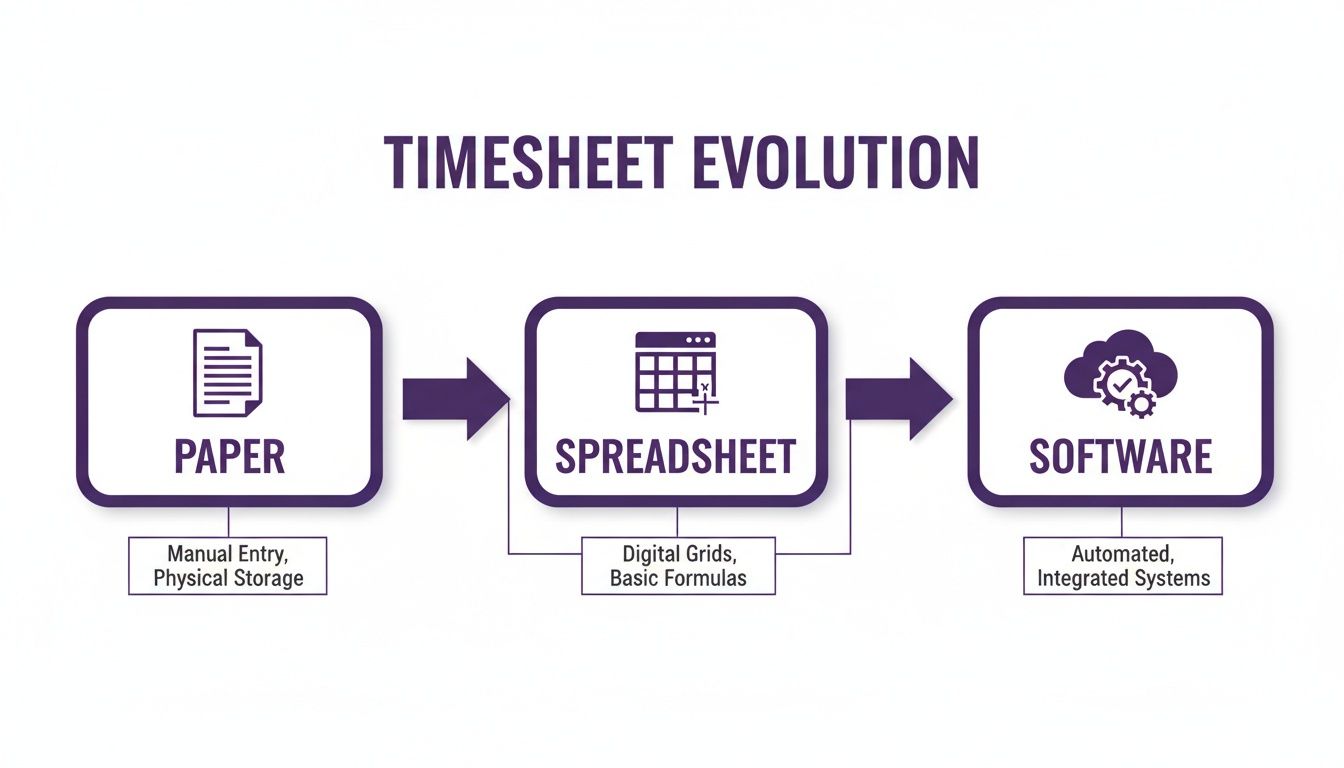
This evolution isn’t just about convenience; it’s about moving from simple timekeeping to gathering complex data that can actually inform your business strategy.
Ready to move beyond just running payroll? Adding a few more fields can give you a much clearer picture of your business.
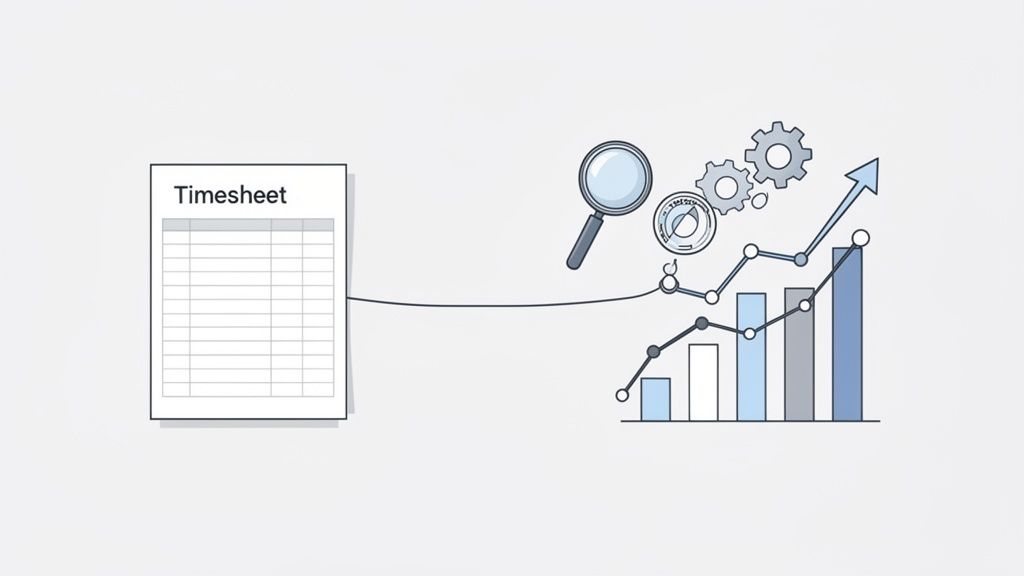
Collecting timesheet data is one thing. Turning it into a strategic advantage is something else entirely. Most businesses stop at payroll, leaving a massive pile of valuable data on the table. But the sharpest companies know what is a timesheet is not just an admin task—it's the raw material for building a smarter, more efficient, and more profitable company.
Here’s the deal. This data gives you a clear, unbiased look at your company's most valuable asset: its time. It’s how you move from just putting out fires to proactively planning your next move, especially when it comes to putting the right people on the right tasks.
The first and most obvious win from accurate timesheet data is flawless payroll. It's foundational. Solutions that offer features like payroll that syncs with lessons taught eliminate errors, ensure precise compensation, and build a bedrock of trust with your team.
But here’s the problem most tools ignore: simply paying people correctly doesn't tell you if their time was invested wisely.
That’s where profitability analysis comes in. By connecting hours worked directly to specific clients and projects, you can finally get answers to the tough questions:
Here's a real-world example: A mid-sized consulting firm was struggling with shrinking margins. They got serious about project-based time tracking and discovered that 20% of their projects were causing 80% of their budget overruns. Armed with this insight, they overhauled their quoting process and resource allocation. The result? They boosted profit margins on fixed-price projects by 18% in just six months. This kind of data can even inform your SeekOut pricing strategy for client work.
Beyond the bottom line, timesheet data is a powerful lens for understanding how work actually gets done. We know from a 2021 Salesforce study that up to 60% of work hours are spent on tasks with limited impact. A staggering 68% of employees report not having enough uninterrupted time to focus. Timesheet data helps you see exactly where the effort is going, allowing leaders to carve out and protect that precious focus time and align day-to-day work with the big-picture goals.
This data also happens to be the backbone of your labor law compliance. Accurate, timestamped records create an indisputable audit trail for regulations like the FLSA, protecting your business from messy and expensive legal challenges. This becomes even more critical as you start using things like predictive analytics for HR to make smarter, data-driven staffing decisions.
Picking the right timesheet tool can feel like a massive decision, but it doesn’t need to be. The secret is matching the solution to where your company is right now and where you plan to be in a few years. What works brilliantly for a five-person startup will grind to a halt for a 50-person team.
Forget getting bogged down in endless feature comparisons. Instead, zero in on what actually matters for growth. We're talking about seamless integrations with your existing payroll and project management software, solid mobile access for a team on the move, and reporting that turns raw hours into actionable business insights.
The global time tracking software market is on a tear, projected by Fortune Business Insights to jump from USD 4.98 billion in 2022 to a staggering USD 13.06 billion by 2030. This explosion is happening because businesses are finally realizing that efficient digital tools are the bedrock of effective scaling.
The question isn't if you need a tool, but which one is built to handle your ambition.
To make this choice a bit easier, here’s a simple framework based on your company's stage. It helps you cut through the noise and focus on what you actually need.
You might think you can just stick with a simple solution as you grow. Why that fails? A tool that isn't built for your next stage creates data silos, compliance headaches, and administrative bottlenecks that actively slow you down.
Investing in a system that can grow with you is one of the smartest operational moves you can make. It’s a core piece of the tech stack we cover in our guide to the best HR software platforms in 2026.
Yes. In the U.S., the 2000 ESIGN Act gives electronic signatures the same legal weight as pen and paper, provided they meet security standards.
The federal Fair Labor Standards Act (FLSA) requires keeping records for at least three years, but state laws can require longer. Always check local regulations.
Absolutely. A detailed timesheet is the backbone of a professional invoice for any freelance recruiter, preventing billing disputes and ensuring you get paid for your work.
The biggest mistake is treating them only as a payroll tool, ignoring the goldmine of data on project costing, resource allocation, and team productivity.
So, what is a timesheet? At the end of the day, it's so much more than just a record of hours worked. Think of it as a detailed ledger of your company's most valuable investment: your team's time and energy.
When you graduate from manual spreadsheets to an intelligent, automated system, you’re no longer just doing administrative work. You're unlocking a powerful source of business intelligence. This shift lets you move past simply paying for hours and start strategically investing in outcomes, giving you the clarity to see which projects are truly profitable, where your resources are best spent, and how to drive real, sustainable growth.
See how Juicebox works and start turning your workforce data into a competitive advantage. Try it now:
{{large_cta}}
Run your first search for free. Find and engage top talent across 800M+ profiles. Trusted by 5,000+ customers.