
An automated hiring process uses technology to handle the repetitive, time-consuming parts of recruiting—sourcing, screening, and outreach—freeing up your team to focus on building relationships and closing candidates. It’s not about replacing recruiters with robots. It’s about building a smart, scalable system that multiplies your team’s impact and lets you hire top talent faster.
This guide is different. We’re not just listing tools; we’re giving you a framework built on Juicebox’s experience helping high-growth companies like Ramp and Cognition Labs build their hiring engines.
TL;DR: How to Build an Automated Hiring Process
Audit your current process: Identify manual bottlenecks in sourcing, verification, and outreach. Traditional hiring fails because it’s a series of disjointed, labor-intensive tasks.
Design a sourcing & verification engine: Use AI to search across 30+ platforms (not just LinkedIn) and automatically verify candidate data to build a high-quality talent pipeline.
Automate personalized outreach: Create multi-step, personalized email sequences that use specific data points (like GitHub projects) to get replies.
Integrate with your ATS: Connect your sourcing tools to your ATS (Greenhouse, Lever, etc.) for a single source of truth and seamless data flow.
Measure and optimize: Track key metrics like pipeline velocity and pass-through rates to continuously refine your workflow and improve ROI.
Why traditional hiring fails and how automation fixes it
If you’re staring down another missed hiring target, you’re not alone. Most recruiting teams operate with a manual, disjointed process that is fundamentally broken. We’ve been sold a myth that more effort—more hours scrolling LinkedIn, more spreadsheets, more copy-pasted emails—will lead to better results.
The reality? The opposite is true. That approach is like digging a new well every time you need a glass of water instead of building a pipeline. Each search is a separate, exhausting slog that doesn’t build on the last one.
The real cost of manual recruiting
The problem isn’t a lack of effort; it’s a lack of a system. Manual hiring is a series of bottlenecks that actively works against your goals.
Think about the “operational tax” of simple tasks like coordinating schedules—something that eats up a staggering 38% of a typical recruiter’s time, according to a 2023 GoodTime report. Or consider the trap of relying solely on a single platform like LinkedIn, where a huge slice of the best talent isn’t even looking. For more on this, you can explore the full talent operations report here.
These little inefficiencies add up. In fact, a shocking 90% of companies missed their hiring goals recently, with one in three missing by a wide margin. But here’s the key: companies that used AI-driven tools were 1.6x more likely to hit their targets.
This is where a true automated hiring process changes the game. It’s not about buying a few disconnected tools that slap an “AI” sticker on the box. It’s about designing a single, fluid engine that moves candidates from discovery to interview without friction. It’s a strategic shift away from the old-school methods many freelance recruiters still use toward a much smarter, integrated approach.
Let’s break down how these two worlds compare.
Manual vs automated hiring at a glance
The difference isn’t just incremental; it’s a complete shift in how you operate, what you can achieve, and where your team spends its time.
Activity | Manual Process (The Old Way) | Automated Process (The New Way) | Impact |
|---|---|---|---|
Sourcing | Hours spent on LinkedIn, manually reviewing profiles, starting from scratch for each role. | AI searches millions of profiles across dozens of sources in real-time. | 10x faster candidate discovery, access to a wider talent pool. |
Verification | Manually checking profiles, guessing contact info, high bounce rates. | Instantly verifies contact data and cross-references profiles for accuracy. | Higher data accuracy, better deliverability, and more engagement. |
Outreach | Writing individual emails, tedious manual follow-ups, low response rates. | Personalized, multi-step outreach sequences run on autopilot. | Saves 5-10 hours per week, significantly boosts response rates. |
Candidate Experience | Slow communication, scheduling delays, candidates dropping off. | Instantaneous updates, easy self-scheduling, consistent engagement. | Drastically reduces candidate drop-off and improves employer brand. |
Cost | High cost-per-hire due to recruiter time, agency fees, and lost productivity. | Lower cost-per-hire by reducing manual hours and agency reliance. | Significant budget savings and higher recruiter productivity. |
Ultimately, automation turns recruiting from a reactive, labor-intensive chore into a strategic, proactive function that builds a sustainable pipeline of talent.
From disjointed tools to a unified engine
Most teams think they’re automating when they buy a scheduling tool or an email sequencer. That’s just patching leaks in a sinking ship. A real automated hiring process connects three core functions into a single, seamless workflow:
Sourcing: Finding qualified candidates across dozens of platforms, not just one.
Verification: Automatically confirming contact information and cross-referencing profiles to ensure you’re talking to the right person.
Outreach: Engaging candidates with personalized, multi-step sequences that don’t need manual babysitting.
When these pieces work in harmony, you build a hiring pipeline that never sleeps. Instead of starting from zero for every open role, you have a constantly running engine surfacing pre-vetted talent. This is the fundamental shift that platforms like Juicebox enable—moving from reactive “well-digging” to building a proactive, automated pipeline. For lean teams trying to compete for top talent, it’s the only way to win when speed is everything. We offer a deep dive into how to streamline your recruitment process for this kind of efficiency.
Designing your sourcing and verification engine
The core of any great automated hiring process is a smart sourcing and verification engine. This isn’t just about finding more people. It’s about consistently finding the right people, on autopilot, from a talent pool that’s way bigger than what any single platform can offer. Your goal is to build a system that constantly surfaces high-quality, pre-vetted talent for your pipeline.
But there’s a problem most tools ignore. They find profiles, but they don’t verify them, leaving you with bad data and bounced emails.
Moving beyond LinkedIn and manual searches
Relying solely on LinkedIn is a huge strategic mistake. You’re fishing in the same crowded pond as every other recruiter, fighting over the same 20% of talent that’s actively visible.
The other 80%—the passive, high-value candidates—are scattered across dozens of other platforms like GitHub, Kaggle, and various niche professional networks. These are often the best candidates, but they’re invisible to traditional methods. If you’re looking for alternatives, check out these top 10 AI recruiting tools for 2026.
An automated engine breaks you out of that walled garden. Tools like PeopleGPT are built to search across 30+ sources at once, digging up profiles you would have completely missed.
This flow shows how the whole thing works together.
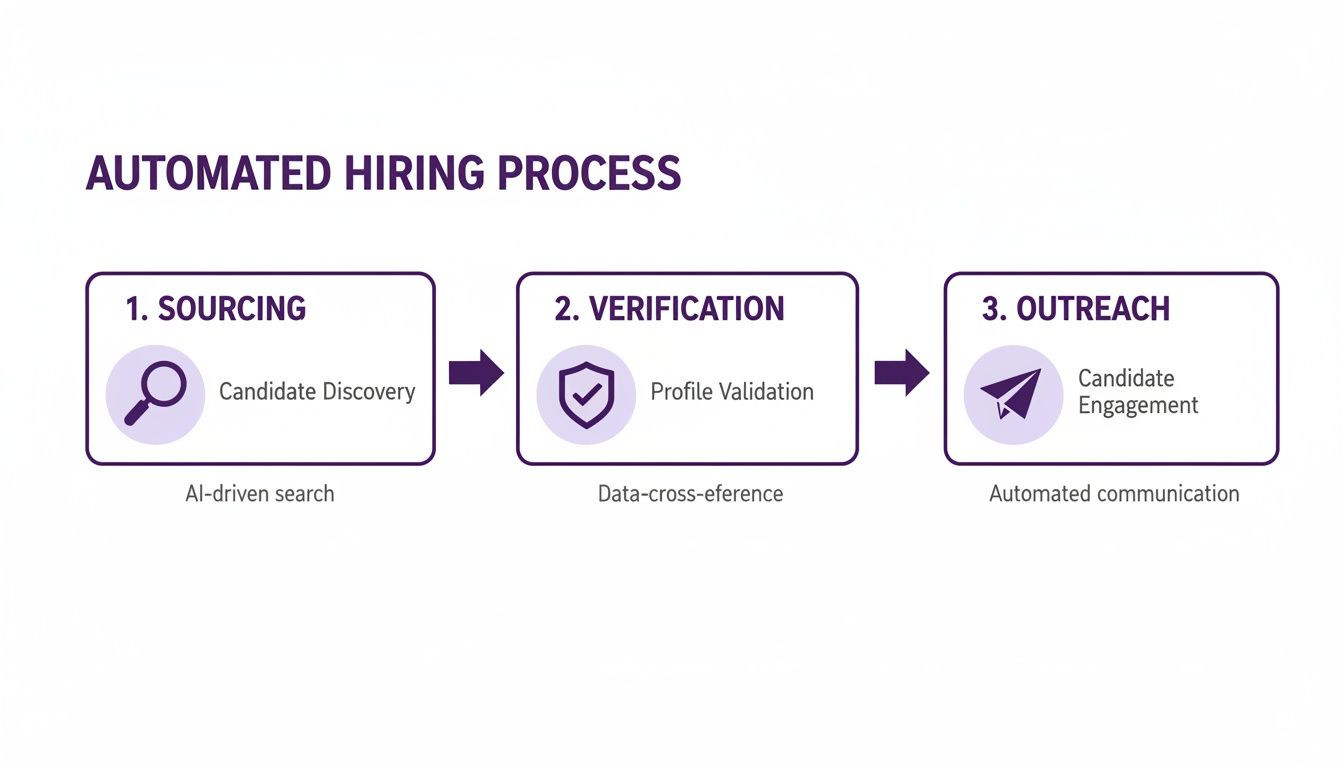
The key takeaway here is that these stages are deeply connected. Strong verification makes your outreach way more effective, and broad sourcing gives you the raw material for the entire funnel.
You might think sourcing across so many platforms would create a data management nightmare. In a manual world, you’d be right. But automation flips this on its head by pulling scattered data points into a single, cohesive profile. And that’s where verification becomes so critical.
Building a multi-layered verification workflow
In an age of AI-generated everything, the risk of dealing with fake or embellished profiles is higher than ever. A name and a generic profile summary just don’t cut it.
Your automated system has to act as a credibility filter, ensuring the talent you find is authentic before you reach out. This is a non-negotiable step in a solid automated hiring process.
What does that look like?
Email validation: The system automatically finds and verifies professional email addresses, drastically cutting bounce rates.
Cross-referencing profiles: It pulls data from multiple sources—like a candidate’s GitHub, personal portfolio, and a conference speaker bio—to build a richer, more reliable profile.
Data enrichment: The engine can add crucial details like a company’s funding rounds, a university’s ranking, or specific project contributions, giving you valuable context.
For example, Ramp used this exact tactic—sourcing broadly and verifying meticulously—to achieve a 3x lift in reply rates within just a few months. Because every candidate was real and every data point was accurate, their outreach felt hyper-relevant and stood out. This drives home the importance of effective candidate sourcing strategies built on a foundation of clean data.
From prompt to pre-vetted pipeline
The real magic of this engine is how simple and fast it is. You can build a high-quality, pre-verified talent pool with a single, clear instruction.
Think about a prompt like this:
Find me a senior backend engineer in San Francisco who previously worked at a YC-backed fintech startup and has experience with Rust.
Here’s what happens next. In seconds, the engine:
Searches dozens of platforms for profiles matching these exact criteria.
Analyzes career histories to pinpoint past work at YC-backed companies.
Cross-references GitHub or personal project repos to confirm actual Rust experience.
Verifies contact info and enriches the profile with any other available data.
What used to take a recruiter hours of tedious searching and cross-checking now happens in under a minute. You’re not just finding people; you’re building a targeted, high-intent talent pool on demand. This is what makes a scalable automated hiring process actually possible.
Automating outreach that actually gets replies
Finding top-tier talent is only half the battle. Getting them to open, read, and reply to your outreach is the other. This is where most hiring funnels spring their biggest leaks.
There’s a persistent myth that an automated hiring process has to be cold and impersonal. Many recruiters believe automation and personalization are opposing forces. The exact opposite is true. When done right, automation is the only way to deliver true one-to-one personalization at scale.
You might think sending hundreds of truly personalized emails is impossible without a massive team. Why does that thinking fail? Because it frames the problem incorrectly, assuming personalization has to be a manual, one-off effort. Modern tools completely flip that script.
Building scalable personalization
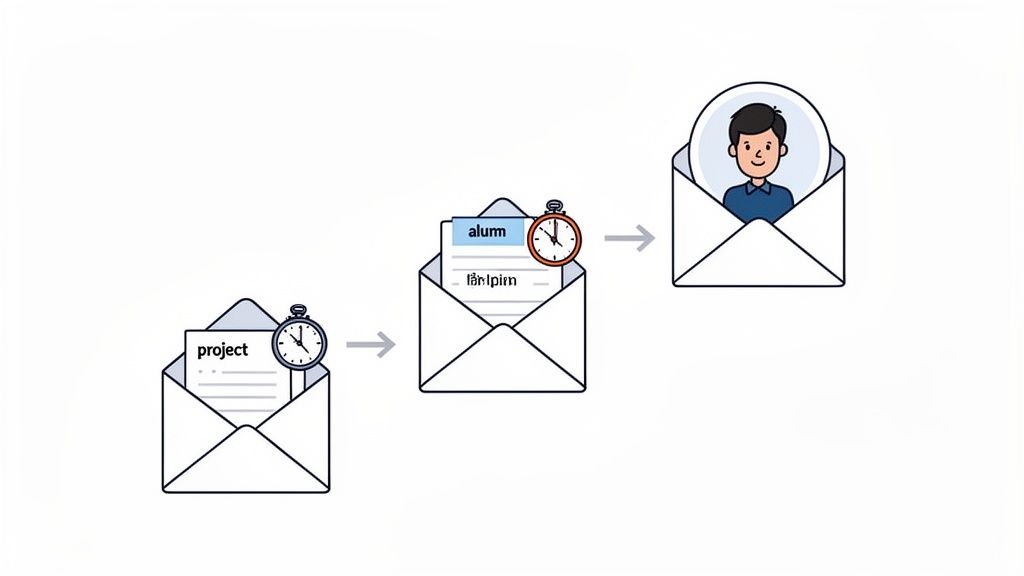
The secret isn’t writing every single email from scratch. It’s about building a system that can dynamically pull unique data points from a candidate’s enriched profile and weave them into a thoughtful, multi-step sequence.
What kind of data points?
A specific project they mentioned on their GitHub repository.
A mutual connection or a shared university experience.
Their previous work at a notable company (like a YC-backed startup).
A recent award they won or a conference they spoke at.
These are the details that transform a generic template into a message that feels researched and relevant. The technology does the heavy lifting of finding these hooks, so you can focus on crafting a compelling narrative. For a deeper look, our guide on how to write a recruiting email that gets results is a great resource.
This level of detail drives serious engagement. Take Ramp, a growth-stage fintech company. They saw a 3x lift in reply rates in just three months by implementing this exact tactic. Their outreach felt personal because it was built on verified, specific data points sourced and organized automatically.
Crafting a multi-step outreach sequence
A single email is rarely enough. Top candidates are busy and often overlook the first message, so an automated, multi-step sequence is critical for staying top-of-mind.
But here’s the thing. An effective sequence evolves with each step, adding new value or a different angle.
Here’s a simple but effective framework:
Touch 1 (day 1): The personalized hook. Reference that specific project or accomplishment. Keep it short, focused on them, and clearly state the opportunity.
Touch 2 (day 3): The value-add. This follow-up can offer a piece of interesting content related to their field, like a new industry report or a tech talk from one of your senior engineers.
Touch 3 (day 7): The final nudge. This is a brief, polite check-in, letting them know you won’t follow up again unless you hear back.
The key is timing and testing. Data from thousands of campaigns shows that a 2-4 day gap between follow-ups is optimal. Anything less feels aggressive; anything more loses momentum. Always be A/B testing your subject lines.
This structured approach ensures persistence without becoming spam.
The role of verification in outreach
Your brilliantly crafted outreach sequence is useless if it never reaches the candidate’s inbox. This is why verification is so tightly integrated with outreach in any high-performing automated hiring process.
High email bounce rates don’t just mean missed opportunities; they can damage your domain’s sending reputation. An automated system that validates contact information before the first email is sent is absolutely non-negotiable.
This ensures:
High deliverability: Your messages consistently land in the primary inbox.
Clean data: Your candidate database remains accurate and reliable.
Protected reputation: Your domain isn’t getting blacklisted by email providers.
By marrying intelligent sourcing with robust verification and personalized outreach, you build a system that doesn’t just send emails—it starts conversations.
Integrating your pipeline with your ATS
So you’ve built this incredible engine for sourcing and outreach. But if that engine doesn’t talk to your system of record—your Applicant Tracking System (ATS)—the whole automated hiring process starts to fall apart.
Without a seamless connection, you’ve just created a new bottleneck: manual data entry. Recruiters get bogged down for hours, copy-pasting candidate info from one system to another, killing the efficiency you just built.
The goal is a closed-loop system where data just flows. A candidate your AI finds should pop up in your ATS—whether it’s Greenhouse, Lever, or Ashby—with all their sourcing data and communication history intact. Check out some popular Indeed alternatives that offer these integrations.
You might be thinking this sounds like a massive IT project. A few years ago, you’d have been right. But today’s API-first platforms have completely changed the game. Setting up these connections is now a matter of minutes.
Why a connected system is a non-negotiable
The ATS is the backbone of modern recruiting. The market for these platforms is on track to hit USD 3.2 billion by 2026, and a staggering 97.4% of Fortune 500 companies use one. The data doesn’t lie: companies that nail their ATS implementation report that hiring is 2-3x easier across critical metrics like quality of hire and time-to-hire. If you’re serious about an automated hiring process, seamless integration isn’t just a nice-to-have; it’s essential. You can dig into more of these recruitment stats here.
When your sourcing platform and ATS are in sync, you finally get end-to-end visibility. You can track a candidate from discovery to a signed offer, giving you crystal-clear data on what’s working.
Mapping data fields for a flawless sync
The secret to a successful integration lies in mapping the data fields between your sourcing tool and your ATS.
Focus on these core fields:
Candidate information: Name, email, phone number, and links to profiles like LinkedIn or GitHub.
Source data: Automatically tag every candidate with where they came from (e.g., “PeopleGPT,” “GitHub,” “Referral”).
Campaign/project: Tag candidates to the specific role or sourcing project they belong to (e.g., “Senior Backend Engineer - Q4”).
Communication history: Log all outreach emails and replies directly in the candidate’s activity feed inside the ATS.
Proper tagging is the most critical step, and it’s the one most teams mess up. Without it, you can’t generate meaningful reports. You’ll have no idea which sourcing channels are actually delivering hires.
This level of data hygiene is what separates a functional integration from a strategic one. By mastering your Applicant Tracking System basics, you can turn it into a powerful analytics engine.
Creating a closed-loop reporting system
Once your systems are connected and data is flowing cleanly, you can finally answer the questions that matter. Which sourcing platforms yield the most hires? What’s our pass-through rate from initial outreach to the first interview?
This closed-loop system allows you to move from gut-feel decisions to data-driven strategy. If you see that candidates from a specific platform are consistently falling out, you know exactly where to dig in. This feedback loop lets you continuously refine and optimize your automated hiring process.
The implication is huge: this integration unlocks true accountability and measurement for your talent acquisition efforts. It’s no longer a black box.
How to measure and optimize your automated workflow
An automated hiring process is a data-generating machine. But all that data is useless if you’re not using it to get better.
What’s the bottom line? The goal here is to build a feedback loop where your workflow is constantly learning and improving. Every interaction, from a candidate opening an email to accepting an offer, is a signal. You just have to listen to the right ones. If you’re managing a complex work week, like a 9/80 work schedule, this data-driven efficiency becomes even more critical.
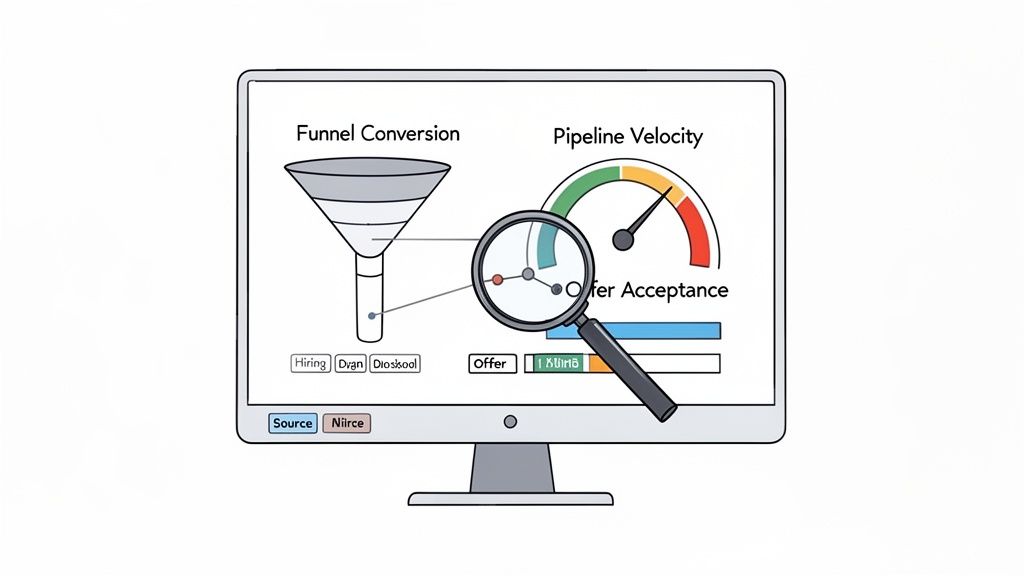
Identifying your core KPIs
Forget overwhelming dashboards. A handful of core metrics can tell you 90% of what you need to know about the health of your hiring engine. These KPIs show you where you’re efficient and, more importantly, where you’re leaking talent.
Here’s a breakdown of the metrics that truly matter.
Key metrics for an automated hiring process
Metric | What It Measures | Industry Benchmark | How to Improve It |
|---|---|---|---|
Pipeline Velocity | The average time a candidate spends in each stage of your hiring funnel. | < 30 days from first contact to offer. | Automate interview scheduling, set deadlines for hiring manager feedback, and use templates for quicker communication. |
Pass-Through Rate | The percentage of candidates who advance from one stage to the next. | 20-25% from outreach to first interview. | Refine your sourcing prompts for better candidate quality. A/B test outreach subject lines and messaging. |
Cost-Per-Hire | The total cost of a new hire, broken down by sourcing channel. | < 15% of the role’s annual salary. | Track candidate sources automatically to identify and double down on high-ROI channels. Cut spend on underperforming ones. |
Offer Acceptance Rate | The percentage of candidates who accept a formal job offer. | > 90% for competitive roles. | Ensure compensation is market-aligned, personalize the offer experience, and maintain quick communication during the offer stage. |
Monitoring these numbers is the bedrock of a truly data-driven recruitment strategy. They’re direct indicators of your process’s health.
You might think you need a dedicated data analyst for this, but modern tools have these analytics built right in, giving you a real-time pulse on your pipeline without touching a spreadsheet.
For instance, Cognition Labs used built-in reporting to spot a drop-off in their engineer pipeline. By analyzing pass-through rates, they realized their initial outreach wasn’t resonating. A quick tweak to their messaging boosted interview rates by 40% in just two weeks. That’s the power of real-time data.
Establish a weekly optimization rhythm
Data is only as good as the action it inspires. The best way to turn insights into improvements is with a weekly review.
The process is simple:
Review the dashboard: Pull up your core KPIs. What’s changed since last week?
Ask “Why?”: Form a hypothesis. Is your pass-through rate from outreach to screen dropping? Why?
Implement one change: Tweak one variable at a time. A/B test a new subject line. Refine your PeopleGPT prompt.
Measure next week: Did it work? If the needle moved, double down. If not, try a new hypothesis.
This iterative cycle is how you fine-tune your automated hiring process from good to great.
Use market intelligence to stay competitive
Your internal metrics are only half the story. You also need to know how your strategy stacks up against the market.
This is where integrated talent intelligence gives you a serious edge. Use analytics to keep an eye on external benchmarks:
Market supply: How many qualified candidates for your role actually exist in a specific city?
Salary bands: Are your compensation packages competitive enough to attract top-tier talent?
DEI benchmarks: How does the diversity of your candidate pool compare to industry averages for that role?
This ensures your automated hiring process isn’t just fast—it’s also smart.
The future is autonomous: how AI agents are transforming hiring
The final leap in building an automated hiring process isn’t just about executing tasks faster—it’s about achieving true autonomy. This is where AI agents come in. We’re talking about systems that work for you 24/7 to source, learn, and adapt without needing constant hand-holding.
Think about it this way: basic automation is great at following rigid, pre-set rules. An autonomous agent, on the other hand, can interpret complex goals and actually learn from your feedback. For instance, Juicebox Agents don’t just run a search and stop. They watch which candidate profiles you accept or reject and use that insight to get smarter and refine their search parameters over time.
This changes the entire value proposition from simply ‘saving time’ to ‘multiplying impact.’
And this shift is happening fast. While 83% of organizations still score low on overall AI maturity, a staggering 84% of US staffing processes are already using some form of AI. Looking ahead, experts predict that AI agents will soon handle up to 80% of all transactional recruiting work. You can read the full report on AI in hiring here.
From tool to teammate
It’s really important to grasp the difference between simple automation and true autonomy.
Automation is like a dishwasher. You load it up, pick a pre-set cycle, and hit start. It does the job, but it can’t learn or adapt.
Autonomy is more like a personal chef. They learn your tastes, go shopping for the right ingredients, and create meals that get better and more tailored to you over time.
That’s the real power of an agentic system.
This evolution is already reshaping how modern HR and recruiting teams get work done. For a deeper dive, check out our complete guide on how AI agents for HR are reshaping the industry.
Critically, any reputable platform in this space builds security and compliance directly into its DNA. This means things like GDPR and CCPA are handled automatically, so you can focus on the work, not the paperwork.
Ultimately, this all points to a future where recruiters are freed from grunt work and can focus their energy entirely on strategy, high-stakes negotiations, and building genuine human relationships.
Frequently asked questions
How long does the setup really take?
With modern tools, you can be live in under an hour. Pre-built integrations with major ATS platforms like Greenhouse or Lever are often just a few clicks away.
Is automation going to make recruiters obsolete?
No, it supercharges them. It automates tedious top-of-funnel work so recruiters can focus on high-impact strategy, relationships, and closing candidates.
How does automation help with diversity and inclusion?
AI sourcing tools search a wider range of platforms beyond LinkedIn, surfacing a more diverse talent pool and focusing on skills over traditional networks. A 2024 Phenom report found that AI can expand talent pools by 19x.
What’s the real cost of an automated hiring process?
While tools have a subscription fee, the ROI comes from a lower cost-per-hire by reducing agency reliance and recruiter time spent on manual tasks.
Build a hiring engine, not just a process
A modern automated hiring process isn’t about buying software; it’s about building a strategic system. It transforms recruiting from a reactive, labor-intensive function into a proactive, data-driven engine for growth. This unlocks your team’s ability to hire better talent, faster, and build a sustainable pipeline that gives you a permanent competitive advantage.