Published on
Last Updated
The talent management process is a company’s strategic engine for attracting, developing, engaging, and retaining top performers. This isn’t just a series of disconnected HR tasks. It’s the integrated system that aligns your entire workforce with your core business goals, ensuring you have the right people with the right skills to win—consistently. Without a modern approach, you’re not just losing efficiency; you’re losing the war for talent.
This guide breaks down the exact steps to build a high-impact talent management process that moves beyond reactive HR and becomes a true driver of growth. We’ll cover the six essential stages, why traditional methods fail, and how to use AI to build a lasting competitive advantage. Juicebox uses this framework to help companies like Ramp 5x their hiring speed by replacing broken, legacy systems with an intelligent, unified workflow.
TL;DR: The 6 Stages of the Talent Management Process
Attraction: Build a compelling employer brand that draws in top talent before they even apply.
Sourcing & recruiting: Proactively find and engage the best candidates using multi-source, AI-powered tools.
Onboarding: Integrate new hires into your culture and workflows to maximize retention and speed up their impact.
Development: Invest in continuous employee growth to build the skills your company needs for the future.
Retention: Create an environment where top performers are recognized, engaged, and motivated to stay.
Measurement & optimization: Use data and key metrics to continuously refine and improve the entire process.
What is the talent management process?
Most companies treat talent management like an administrative checklist: run the recruiting process, handle onboarding, and push through performance reviews. But that view is fundamentally broken. A modern talent management process is a proactive, continuous cycle that creates a long-term competitive advantage. It’s the difference between reactively filling empty seats and strategically building a team that can dominate a market.
Think of it like building a high-performance race car. You wouldn’t just focus on the engine and ignore everything else. It’s an integrated system where the engine, chassis, and aerodynamics all work in perfect harmony. In the same way, a strong talent process connects every single stage of the employee lifecycle—from sourcing with tools like PeopleGPT to development—into one cohesive system.
From reactive HR to a proactive growth engine
The biggest myth out there is that talent management is just a support function. The reality is the complete opposite. When done right, it becomes a primary driver of business results. Making the switch from a traditional, reactive HR model to a proactive one is absolutely critical. While old-school HR gets bogged down in compliance and paperwork, strategic talent management is all about building the capabilities you’ll need for the future. You can learn more about the different talent management models and how they shape this strategy.
To really grasp the difference, let’s look at how these two approaches operate side-by-side.
Traditional HR vs strategic talent management
Aspect | Traditional HR (Reactive) | Talent Management (Proactive) |
|---|---|---|
Focus | Administration, compliance, filling open roles. | Building long-term capabilities and employee growth. |
Time Horizon | Short-term, immediate needs. | Long-term, anticipates future skill gaps. |
Process | Siloed tasks (recruit, train, review). | Integrated cycle from attract to retain. |
Decision Making | Based on gut feel or immediate pressure. | Data-driven, aligned with business goals. |
Goal | Minimize risk and handle paperwork. | Maximize employee impact and drive revenue. |
This isn’t just semantics—it’s a fundamental shift in mindset that has a direct impact on your bottom line.
You might think your current process is “good enough” because you’re filling roles. But this approach ignores the massive long-term costs of slow hires, poor-fit candidates, and high turnover. For example, recent Workday research found that while 51% of HR leaders worry about future talent shortages, only 32% feel their teams actually have the skills needed to succeed right now. That’s a huge gap, and it’s exactly what a strategic talent management process is designed to fix.
Legacy tools often make this problem worse by keeping everything in silos. A recruiter might be hyper-focused on filling one role, completely disconnected from the long-term development or retention strategy for that same position. This creates friction, slows down hiring, and ultimately costs the company more than it saves. This is a common pitfall when trying to streamline the recruitment process.
A modern approach, on the other hand, sees every hire as an investment in the company’s future. It uses data to predict what skills you’ll need, builds talent pipelines before roles even open up, and ensures every stage—from first contact to career development—is perfectly aligned. This is how you stop just managing people and start multiplying their impact on the business.
The six stages of a high-impact talent management process
A truly high-impact talent management process isn’t just a random checklist of HR tasks. It’s a cohesive, six-stage lifecycle where each step feeds directly into the next. Think of it like building a high-performance engine—if one part fails, the whole system sputters. But when every stage is dialed in, you get consistent, top-tier results.
This framework takes talent management from a fuzzy buzzword to a practical, step-by-step system. Every stage has a clear job, from grabbing a candidate’s attention all the way to making sure they stick around and thrive for the long haul.
Here’s a look at how this strategic approach flips the script, moving from old-school, reactive HR to a forward-thinking talent engine that actually fuels growth.
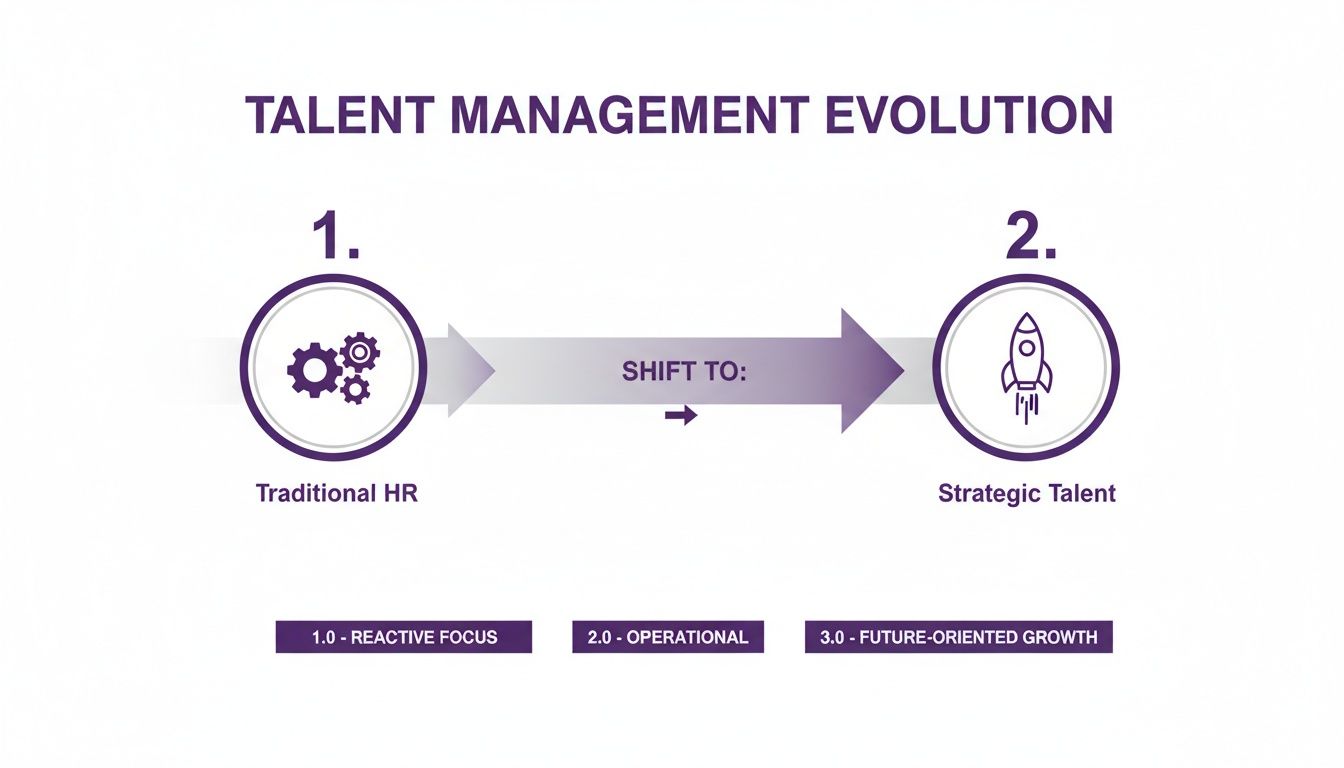
The big takeaway? It’s about ditching the slow, gear-driven tasks and strapping a rocket to your strategy. This is what drives real organizational momentum.
Stage 1: attracting talent
Attraction is where it all starts. It’s about building an employer brand so compelling that the right people are drawn to you before they even look at a job description. This is way more than just posting jobs. It’s about crafting a reputation through authentic storytelling, showcasing your culture, and letting your current team’s success speak for itself.
The goal is to create a magnetic brand that makes top performers want to be part of what you’re building. Key moves here include:
Content marketing: Publishing blog posts, videos, and social media content that gives a real look into your company’s values and day-to-day life.
Employee advocacy: Getting your team to share their honest, positive experiences on platforms like LinkedIn and Glassdoor.
Targeted campaigns: Running brand awareness campaigns aimed at the specific talent pools you’ll need down the road.
Make no mistake, the competition for talent is brutal. The 2023 Global Talent Competitiveness Index (GTCI) ranked 134 countries, with Switzerland, Singapore, and the U.S. coming out on top.
Stage 2: sourcing and recruiting
Once you’ve sparked some interest, it’s time to get active. Sourcing and recruiting is about finding, engaging, and ultimately hiring the best people for the job. This is often the most hands-on—and challenging—part of the whole process. The old way? Recruiters manually digging through resumes and wrestling with complicated Boolean search strings.
But that manual approach is slow, clunky, and usually locks you into a single platform like LinkedIn. It’s a bottleneck.
A modern approach uses AI to completely change the game. Instead of complex Boolean logic, a recruiter can just type a natural language prompt like, “Find senior software engineers in Austin with experience in distributed systems and a background at a high-growth startup.” AI then scans over 30 different sources—not just one—and delivers a curated list of qualified candidates in minutes. This is exactly how you build a talent pipeline that gives you a competitive edge.
Stage 3: onboarding
Onboarding isn’t just about paperwork and a new laptop. It’s the critical window where you integrate a new hire into your company’s culture, workflows, and social fabric. A great onboarding experience sets the tone for their entire time with you and directly impacts retention and how quickly they start making an impact.
A great onboarding program can improve employee retention by 82% and productivity by over 70%. Yet, so many companies throw new hires into the deep end with a short, unstructured process that leaves them feeling completely lost.
A solid onboarding program should be structured and last for at least the first 90 days. The essentials include:
Pre-boarding: Keeping the new hire engaged from the moment they accept the offer to their first day.
Structured orientation: A clear plan for week one that covers company culture, tools, and key introductions.
Role-specific training: Giving them the exact skills and knowledge they need to crush their specific role.
Buddy system: Pairing them up with a seasoned peer for informal support and to answer all the “dumb” questions they’re afraid to ask.
Stage 4: developing employees
Development is where you invest in your team’s growth to build the skills your company will need tomorrow. This is what turns a job into a career. When people see a clear path to level up their skills and advance, they’re far more engaged and much less likely to leave.
This has to be a continuous effort, not a once-a-year formality. It involves:
Regular feedback: Ongoing coaching and real performance conversations, not just a stale annual review.
Personalized learning plans: Pinpointing skill gaps and creating tailored plans to close them.
Mentorship programs: Connecting junior employees with senior leaders who can offer guidance and open doors.
When you hire better-fit candidates from the get-go, this stage becomes so much easier. You’re developing people who are already aligned with your mission and eager to grow, not trying to fix a bad hire. This is where using the best sourcing tools pays dividends.
Stage 5: retaining top talent
Retention is the payoff for getting the first four stages right. If you’ve built a strong brand, hired well, onboarded effectively, and invested in your people, keeping them becomes a whole lot simpler. But it still requires proactive work.
You might think it’s all about the paycheck. While compensation matters, the real drivers of retention are often recognition, doing meaningful work, and having a good relationship with a direct manager. People don’t leave bad companies; they leave bad managers.
Key retention plays include:
Engagement surveys: Regularly taking the pulse of your workforce to spot issues before they become reasons to quit.
Recognition programs: Acknowledging and rewarding employees who live your company values and deliver outstanding results.
Flexible work policies: Offering options that support a healthy work-life balance.
Stage 6: measuring and optimizing
The final stage is all about the data. This is where you figure out what’s working, what’s not, and how to make the entire system better. Without measurement, you’re just flying blind.
Forget vanity metrics. You need to track KPIs that tie directly to business outcomes, like Time to Fill, Quality of Hire, and Employee Turnover Rate. By analyzing this data, you can spot bottlenecks, make a case for new tools, and constantly fine-tune your strategy. For instance, if your Quality of Hire is low, that could point to a problem in your sourcing or interviewing that needs fixing. This data-driven loop turns your talent function from a cost center into a strategic partner that drives measurable value.
Why your current talent management process is broken
A lot of leaders blame their hiring headaches on a slow process. But the truth is usually a lot more uncomfortable. The system isn’t just sluggish; it’s fundamentally broken.
The real culprit? A deep-seated reliance on outdated tools, disconnected data, and manual workflows that feel like running in mud. This creates constant friction, burning out your recruiting team and costing you great candidates.
This kicks off a domino effect of failure. Recruiters waste their days wrestling with complex Boolean strings, manually cross-referencing candidate data, and juggling a dozen different tools that refuse to talk to each other. The result is a chaotic, patchwork system that lets top talent slip right through the cracks.
But there’s an even bigger problem that most legacy platforms just ignore: data decay. A candidate’s profile is a snapshot in time. A few months later, their skills, job title, or contact info could be completely different. When your outreach is built on a foundation of stale data, you’re just sending messages into the void.
Picture this: a top-tier engineer quietly becomes open to new roles but hasn’t bothered to update their LinkedIn profile. Your old-school, single-source process will never find them.
Meanwhile, an AI recruiting platform like Juicebox scanning 60+ sources in real-time picks up on this subtle shift instantly, bubbling them up to the top of a curated list. That’s the difference between reactive hiring and truly proactive talent acquisition.
Sign up for Juicebox (it's free!)
Run your first search for free. Find and engage top talent across 800M+ profiles. Trusted by 5,000+ customers.

The high cost of inefficiency
This broken talent management process isn’t just an annoyance; it’s a direct hit to your bottom line. Every single day a critical role sits empty, you’re bleeding productivity and revenue. The longer it takes to hire, the more your cost-per-hire climbs, eating away at your budget.
These cracks in the system show up in a few painful ways:
Missed opportunities: Your ideal candidates live on platforms like GitHub, specialized industry forums, and personal portfolios. If you’re only looking in one place, you’re invisible to most of the market.
High candidate drop-off: A slow, clunky process is a huge turn-off. The best people have options, and they won’t wait around for a disorganized team to get its act together.
Increased turnover: When you rush to fill a role because of process delays, you make bad hires. This leads to poor fits who are much more likely to leave within the first year, sending your employee attrition rate through the roof.
Recruiter burnout: Nothing kills motivation faster than forcing talented recruiters to do endless, low-value manual tasks. They want to build relationships and close candidates, not fight with broken software.
The core problem is that traditional tools force recruiters to work for the software. A modern system should be working for them, eliminating grunt work, not creating more of it.
The silo and search trap
The final nail in the coffin is the toxic combination of data silos and manual search. Your Applicant Tracking System (ATS) has one set of data, your sourcing tool has another, and your outreach platform has a third. Nothing is connected. Nothing is verified. And nothing updates automatically. This is a challenge even with popular tools, forcing teams to compare things like HireEZ pricing against other platforms to find a single source of truth.
This traps recruiters in a miserable loop of searching, exporting, verifying, and importing. It’s a system designed for failure in today’s fast-moving talent market.
The myth is that more tools equal more power. The reality is the exact opposite. More disconnected tools just create more complexity, slowing everything down and crippling your talent management process before you even get started. This isn’t just a minor flaw—it’s a strategic liability holding your entire company back.
How to build a modern talent management engine with AI
Let’s be honest: for most companies, the talent management process is broken. It’s a clunky, manual system held together by spreadsheets and a patchwork of disconnected tools. Moving past that requires more than just another piece of software; it demands a whole new engine.
Think of an AI-native platform as the central nervous system for your entire talent operation. It connects all the disparate data points, automates the soul-crushing low-value tasks, and creates a single, intelligent workflow. This isn’t about small, incremental improvements. It’s a fundamental shift in how you find, engage, and ultimately hire the people who will build your company.
Let’s walk through a real-world example:
A hiring manager comes to you in a panic. They urgently need a Senior Backend Engineer with a very specific, non-negotiable skillset: they must have experience with large-scale distributed systems, have worked at a YC-backed startup, and be based in the Bay Area.
From manual slog to AI-powered speed
In a traditional setup, this request kicks off days of tedious, manual work. A recruiter starts by wrestling with complex Boolean strings, running the same search over and over again on LinkedIn, and then painstakingly sifting through hundreds of profiles that are mostly noise. After all that, they still have to manually verify contact info.
Now, imagine an AI recruiting engine like PeopleGPT by Juicebox. The process is completely different.
All you need to do is type who you’re looking for in plain English:
“Find me senior backend engineers in the San Francisco Bay Area who have experience with distributed systems and have worked at a YC-backed startup.”
Instantly, Juicebox scans over 800+ million profiles from more than 60+ sources—far beyond the walled garden of LinkedIn—and surfaces a curated shortlist of the best possible candidates.
This completely removes the guesswork and the manual grind, serving up verified, relevant profiles in moments.
What used to take an entire afternoon is now done in less than a minute. The AI doesn’t just find people; it validates their data and gets them ready for outreach. With one click, the recruiter can launch a personalized, multi-step email campaign to the whole shortlist. This is how you win in a competitive market—by combining speed and quality at scale. Learn more about how to use AI for recruitment.
The new framework for talent acquisition
Building a modern talent engine isn’t just about the technology. It’s about adopting a more agile, data-driven mindset. With today’s economic pressures, companies are being forced to rethink their talent strategies. In fact, Mercer’s 2023 Global Talent Trends Study found that 77% of recruiters expect sourcing to get even harder.
This new talent management process stands on three core pillars:
Multi-source aggregation: Pulling candidate data from the entire web, not just one walled garden.
AI-powered curation: Using intelligence to rank and score candidates based on true relevance, saving recruiters from endless manual review.
Integrated workflow automation: Combining search, verification, and outreach into a seamless, one-click process.
To truly build a modern talent engine, you have to embrace this shift. For a deeper dive, check out the benefits of artificial intelligence for business management. This framework is what turns your team from reactive order-takers into strategic talent advisors.
Measuring the success of your talent management process
An effective talent management process isn’t just about feeling productive—it’s about delivering real, measurable results that push the business forward. Without clear metrics, you’re essentially flying blind, unable to prove the value of your efforts or spot the cracks in your strategy.
This is where you stop talking about effort and start showing impact. Tracking the right key performance indicators (KPIs) lets you connect your talent initiatives directly to business outcomes like efficiency, cost savings, and overall workforce quality. Analyzing your recruiting metrics is non-negotiable.
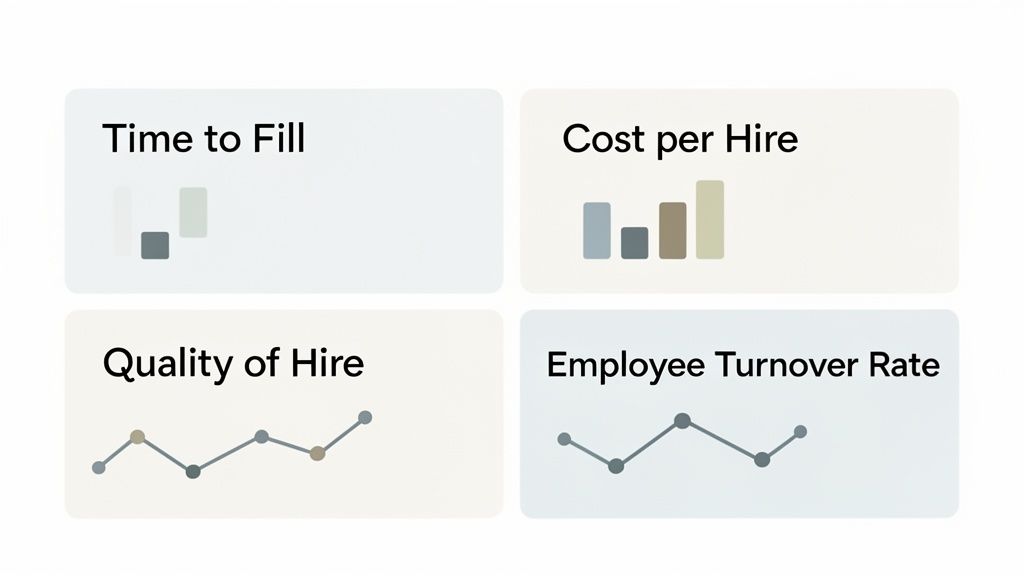
Key metrics for your talent dashboard
To avoid getting lost in a sea of data, focus on a handful of core KPIs. These give you a quick, holistic view of your talent engine’s health and keep everyone aligned on what truly matters.
Below is a quick look at the essential talent management KPIs most tech companies live by. It breaks down what each metric actually measures and provides a solid benchmark to aim for.
Essential talent management KPIs
Metric | What It Measures | Industry Benchmark (Tech) |
|---|---|---|
Time to Fill | The total days from a job requisition’s approval to a candidate accepting the offer. | 40–52 days |
Cost per Hire | The total internal and external recruiting costs divided by the number of hires. | $4,000–$7,500 |
Quality of Hire | New hire performance ratings, manager satisfaction, and retention after one year. | >85% meet/exceed goals |
First-Year Turnover | The percentage of new hires who leave the company within their first 12 months. | <15% |
Tracking these metrics is a great start, but it’s crucial to understand what they’re really telling you.
But here’s the problem most tools ignore: these metrics are often lagging indicators. A high Time to Fill isn’t just a number; it’s a symptom of a deeper issue, like inefficient sourcing, a clunky candidate experience, or a weak employer brand. The real goal isn’t just to track these numbers but to actively improve them.
This is where a modern tech stack creates a massive advantage. An AI-native platform that sources from 30+ platforms instantly widens your talent pool, directly shrinking your Time to Fill. Similarly, AI-powered ranking boosts your Quality of Hire by surfacing better-fit candidates right from the start.
Beyond the numbers: the link to performance
Ultimately, the true test of your talent management process is its impact on employee performance and retention. Yet, many organizations struggle to connect those dots.
The 2023 Global Performance Management Report found a startling disconnect. While 95% of companies have a performance management system, a whopping 80% have completely redesigned it in the last four years. That constant churn signals a deep-seated problem.
A major bottleneck? Only 12% of leaders are actually capable of delivering high-quality coaching, which directly torpedoes talent development and retention efforts.
This highlights why a well-measured process is so crucial. It gives you the hard data needed to justify investments in manager training and better development tools, creating a positive feedback loop that strengthens your entire organization. This data-driven approach is what transforms HR from a cost center into a strategic partner, proving that a well-oiled talent management process is a direct driver of business growth.
FAQs: talent management process (2026)
What’s the most important stage in the talent management process?
Sourcing and recruiting. If you don’t get the right talent in the door, every other stage—development, retention, performance—will ultimately fail.
How can a small startup implement a talent management process?
Focus on the first three stages: attracting, sourcing, and onboarding. Use smart, affordable AI recruiting tools to compete with larger companies without their budgets.
How often should we review our talent management strategy?
Review your core strategy annually, but track your key metrics quarterly. In fast-growing industries, you may need a full review every six months.
Your blueprint for talent-led growth
A modern talent management process is your company’s blueprint for sustainable growth. By moving from a reactive, siloed approach to a proactive, integrated engine, you build a powerful competitive advantage.
This unlocks the ability to hire better people faster, retain them longer, and build a world-class team that can execute on your biggest goals. This is how you stop chasing talent and start attracting it, creating a resilient organization that consistently wins. To lock in that advantage, read our proven strategies for retaining top talent.
Sign up for Juicebox (it's free!)
Run your first search for free. Find and engage top talent across 800M+ profiles. Trusted by 5,000+ customers.