
Most recruiters rely on a single, expensive platform, wondering why their pipeline is dry. Most believe the key is just to search harder on LinkedIn. The opposite is true. Unlocking high-quality hires means diversifying your candidate sourcing channels, because elite talent isn’t waiting on one job board. But with dozens of options, which ones actually deliver ROI for technical roles? The answer isn’t just about adding more tools; it’s about building a systematic, multi-channel sourcing engine.
This guide breaks down the top 12 channels, moving from legacy platforms to the AI-powered tools that help teams close roles significantly faster. Juicebox’s approach is different: we don’t just list sources, we provide a framework for creating an autonomous system that finds candidates for you. We’ll analyze the pros, cons, and specific tactics for each so you can build a sourcing engine that surfaces hidden gems and cuts your cost-per-hire. This isn’t another generic list. It’s a playbook.
This article details sourcing strategies you can use, covering everything from developer-specific communities to leveraging autonomous AI agents to build a robust and responsive talent pipeline. This is where we begin.
TL;DR: best candidate sourcing channels for 2026
Best for enterprise: LinkedIn Recruiter offers the largest professional network but comes with high costs and user saturation.
Best for tech roles: GitHub and Stack Overflow provide direct evidence of coding skill and problem-solving ability, offering high-signal candidates.
Highest ROI channel: Employee referral programs consistently deliver the highest conversion rates, best retention, and lower cost-per-hire. A 2017 study by Oracle found referral hires have 25% higher profit impact.
Most underrated channels: Niche professional associations and university alumni networks offer access to vetted, passive talent with less competition.
Best for automation & speed: AI sourcing platforms like Juicebox’s PeopleGPT aggregate data from all channels, using autonomous agents to deliver verified, interested candidates in minutes.
1. LinkedIn Recruiter & LinkedIn Sales Navigator
As the unrivaled professional social network, LinkedIn is often the default starting point for sourcers, making it one of the most fundamental candidate sourcing channels. Its two premium products, Recruiter and Sales Navigator, provide powerful tools to search its vast user base. LinkedIn Recruiter is the dedicated talent acquisition platform, offering advanced search filters, project folders, and InMail credits specifically for outreach.

Use cases & implementation
LinkedIn Recruiter is the industry standard for enterprise companies and traditional staffing agencies with significant budgets. For instance, a Fortune 500 firm can build entire talent pipelines for recurring roles like “Senior Software Engineer” within the platform. Sales Navigator, while not a recruiting tool, is a cost-effective alternative for smaller teams to perform Boolean searches and identify potential candidates before engaging through other means. A key tactic is using X-ray searches to find profiles without a premium account.
Key considerations & best practices
The platform’s primary limitation is its high cost and single-source nature; all data is confined to LinkedIn’s ecosystem. To maximize ROI, recruiters should master advanced Boolean search techniques and regularly track InMail response rates, which typically hover between 20-40% according to 2023 LinkedIn data. Actively engaging on platforms like LinkedIn remains a core component of many sourcing efforts. For a more affordable, multi-source alternative, check out these Indeed alternatives.
2. GitHub & developer-specific platforms
For technical roles, GitHub is one of the most signal-rich candidate sourcing channels available. As the world’s largest code repository, it hosts over 100 million developer profiles, offering direct insight into a candidate’s actual work. Recruiters and hiring managers can source directly from public repositories, evaluate commit history, and analyze profile activity to find top engineers, DevOps specialists, and data scientists whose skills are publicly verifiable.

Use cases & implementation
This channel is ideal for highly specific technical searches where code quality is paramount. For example, Stripe has sourced infrastructure engineers by identifying contributors to relevant open-source projects. Similarly, early-stage startups can find passionate open-source maintainers who are already aligned with their tech stack. This approach allows companies to assess practical skills and interests before the first outreach, leading to highly qualified candidate pools.
Key considerations & best practices
Bottom line? The main challenge with GitHub sourcing is that it’s not a dedicated recruiting platform; finding contact information can be difficult and time-consuming. To be effective, sourcers should filter by programming language (e.g., Python, Go, Rust) and contribution recency. Reviewing a developer’s contribution graph assesses their activity level, while their starred repositories reveal technical interests. To be more efficient, cross-reference promising GitHub profiles with LinkedIn or use a tool like Juicebox to augment sourcing with verified contact data and recruitment email automation.
You might think that sourcing on developer platforms is too manual and slow. The traditional way, yes. Sifting through repos and trying to guess emails is a time sink. Why that fails: it doesn’t scale. You can’t build a predictable pipeline one profile at a time. The real leverage comes from using AI to automate the discovery and enrichment process. For instance, PeopleGPT can ingest a GitHub URL and instantly return a full profile with verified contact info and a summary of their work, turning a 15-minute task into a 5-second one.
3. Stack overflow & technical Q&A communities
Beyond social networks, technical Q&A communities like Stack Overflow are invaluable candidate sourcing channels for finding proven problem-solvers. The platform hosts over 20 million developer profiles, where reputation scores, badges, and high-quality answers provide objective signals of technical expertise and communication skills. Sourcing here means identifying engineers who not only know the technology but can also articulate complex solutions clearly—a trait highly correlated with on-the-job success.
Use cases & implementation
This channel is ideal for highly specific technical roles where deep domain knowledge is critical. For example, a company hiring a senior backend engineer can filter for users with a 100k+ reputation specifically in the “python” or “kubernetes” tags. Organizations seeking developer advocates can identify candidates who already have a strong community presence and a history of helping others. The user’s “About” section often contains contact information or links to personal websites and GitHub profiles.
Key considerations & best practices
The main challenge is that Stack Overflow is not a recruiting platform, so direct outreach can be seen as intrusive if not handled carefully. Engagement should be personalized and reference a specific, high-quality answer the user provided. Sort by reputation within relevant technology tags to find top experts. For a more integrated approach, use one of the best sourcing tools for recruiters to enrich these sourced profiles and verify their skills.
4. Twitter/X & social media platforms
Beyond dedicated professional networks, social media platforms have evolved into powerful, though less structured, candidate sourcing channels. Platforms like X (formerly Twitter) are particularly valuable in the tech industry, where engineers, founders, and security researchers actively share their work, participate in technical discussions, and build a public portfolio of their expertise. This channel allows recruiters to source candidates based on demonstrated knowledge, communication style, and active engagement within their professional community, offering a more holistic view than a static profile.
Use cases & implementation
This channel excels at finding highly engaged, niche talent that might not be actively looking for a new role. For example, a recruiter can identify top machine learning engineers by monitoring conversations and debates around new model improvements or find security researchers who disclose vulnerabilities publicly. Similarly, a startup can find entrepreneurial talent by following founders who are discussing pivots or sharing lessons learned from previous ventures. The key is to engage with their content authentically before initiating any recruitment outreach.
Key considerations & best practices
The biggest challenge with social media sourcing is the noise and the manual effort required to separate signal from it. What’s the point? Success depends on targeted, consistent monitoring rather than broad, generic searches. Best practices include using advanced search operators to track specific hashtags (e.g., #100DaysOfCode), setting up alerts for keyword combinations, and monitoring the replies of industry thought leaders. You can accelerate verification by using tools like PeopleGPT to cross-reference a candidate’s social profile against verified professional data points.
5. Indeed, ZipRecruiter & job board aggregators
As titans of the job market, platforms like Indeed and ZipRecruiter represent some of the highest-volume candidate sourcing channels available. They aggregate millions of active job seekers and host vast resume databases, providing a direct line to individuals who have explicitly signaled their interest in new opportunities. For recruiters, this means access to a massive pool of candidates who are primed for engagement and often available for immediate hire.
Use cases & implementation
These platforms are the go-to resource for high-volume, non-specialized, and entry-level roles. For example, a large staffing agency can efficiently source hundreds of candidates for warehouse positions by tapping into Indeed’s resume database. Similarly, a tech company needing to quickly fill customer support or junior sales roles can leverage ZipRecruiter’s “Invite to Apply” feature to engage a large, relevant audience with minimal effort, making it ideal for rapid hiring initiatives.
Key considerations & best practices
The primary challenge with job boards is the signal-to-noise ratio; resume data quality is notoriously inconsistent and often outdated. To combat this, recruiters should focus on candidates marked as ‘Recently Active’ within the last 72 hours, as they are far more likely to respond. Using precise negative keywords (e.g., “-manager” when seeking individual contributors) is crucial for filtering out unqualified profiles. A swift follow-up, ideally within 24 hours of a candidate’s activity, dramatically increases engagement rates in these competitive, high-velocity sourcing environments.
6. AngelList (talent) & startup job boards
For recruiters targeting talent with an entrepreneurial mindset, platforms like AngelList (now Wellfound) are indispensable candidate sourcing channels. These ecosystems connect over a million founders, investors, and startup employees, offering a unique window into candidates who thrive in high-growth, early-stage environments. Profiles on AngelList often detail specific startup experience, sought-after tech skills, and even investment interests, providing rich context. But there’s a problem most tools ignore: they only show you who’s looking, not who’s best.
Use cases & implementation
This channel is ideal for Series A/B companies looking to hire talent from established startup networks like Y Combinator alumni or for founders sourcing their first product manager with proven early-stage experience. A venture capital firm, for example, could leverage these platforms to build out the initial engineering teams for its portfolio companies. The key is to find candidates whose career trajectory demonstrates a clear preference for the startup world, making them a strong cultural and experiential fit.
Key considerations & best practices
The primary signal here is an appetite for risk and a passion for building from the ground up. To capitalize on this, filter searches by previous companies (e.g., Stripe, a YC-backed company) to find proven talent. When reaching out, prioritize candidates with founder or early-employee experience and reference shared investors to build instant credibility. Unlike traditional corporate roles, discussions around equity and role impact are often more compelling negotiation points than base salary alone. This is critical.
7. Kaggle & data science communities
For highly specialized data and machine learning roles, generic professional networks often fall short. Kaggle, with its community of over 10 million data scientists and ML engineers, stands out as one of the most signal-rich candidate sourcing channels. The platform’s public competition histories, project portfolios, and peer-reviewed code provide a transparent, merit-based way to identify and evaluate top-tier technical talent that a standard resume cannot offer.
Use cases & implementation
This channel is ideal for sourcing roles where practical, demonstrated skill is paramount. For example, a quantitative hedge fund can directly identify top performers from financial modeling competitions to source for quant researcher roles. Similarly, an AI startup can build a pipeline of ML engineers by targeting grandmasters and masters from relevant computer vision or NLP challenges. This provides a powerful initial validation of a candidate’s abilities.
Key considerations & best practices
The primary advantage of Kaggle is the direct evidence of a candidate’s problem-solving skills and code quality. However, a high ranking alone isn’t sufficient; it’s crucial to review the quality of their public notebooks and code comments, as this reveals their communication and collaboration potential. To maximize effectiveness, filter candidates by their competition medals and recent activity to find engaged experts. Combine a strong Kaggle profile with their academic or professional background to build a complete picture.
8. University alumni networks & campus recruiting
Tapping into university talent pipelines offers a direct line to both emerging and established professionals, making campus recruiting a vital set of candidate sourcing channels. This approach leverages alumni networks, university career services databases, and on-campus events to engage with candidates who have specific, verified educational backgrounds. It’s a proactive strategy for building long-term talent pools from trusted institutions.
Use cases & implementation
This channel is a cornerstone for large tech companies and consulting firms that consistently hire entry-level talent. For instance, a top-tier tech firm might build a dedicated recruiting team for Stanford, MIT, and Carnegie Mellon to secure the best new computer science graduates. Startups can implement a scaled-down version by creating campus ambassador programs to build brand awareness or by focusing outreach on specific graduating cohorts six months before they enter the job market.
Key considerations & best practices
The primary limitation of this channel is its seasonality and the significant resource investment required to build and maintain relationships with university career offices. Success hinges on a long-term strategy, not a one-off career fair visit. To maximize ROI, build a structured internship program that serves as a pipeline for full-time hires and create targeted referral incentives for your own alumni employees. Tracking key recruiting metrics here is vital for proving value.
9. Professional associations & industry communities
Tapping into professional associations and niche industry communities allows recruiters to access pools of pre-vetted, highly engaged talent. These groups, such as the IEEE for engineers or SHRM for HR professionals, often maintain member directories that verify credentials and showcase expertise. This makes them one of the most effective candidate sourcing channels for specialized roles where demonstrated commitment to a field is a key signal of quality. Engagement in these communities, whether through conferences, Slack channels, or forums, indicates a professional’s passion and dedication beyond their day-to-day job.
Use cases & implementation
This channel is ideal for sourcing candidates in fields with strong professional bodies or active communities. For example, a cybersecurity firm can find top-tier talent by engaging with members of SANS or ISSA. A FinTech startup could source experienced developers from specific FinDev meetups. The primary implementation strategy involves joining relevant associations to gain directory access, attending conferences for direct networking, and building relationships with influential community leaders who can provide valuable recommendations.
Key considerations & best practices
Here’s the deal. The main challenge with this channel is that it requires genuine participation and relationship-building, not just transactional outreach. The ROI is measured in quality of hires over volume. To succeed, focus on adding value to the community before you start sourcing from it. Participate in discussions, share relevant content, and connect with speakers and organizers. When you do reach out, reference shared community connections to create a warm, personalized introduction that stands out.
10. Referral programs & employee networks
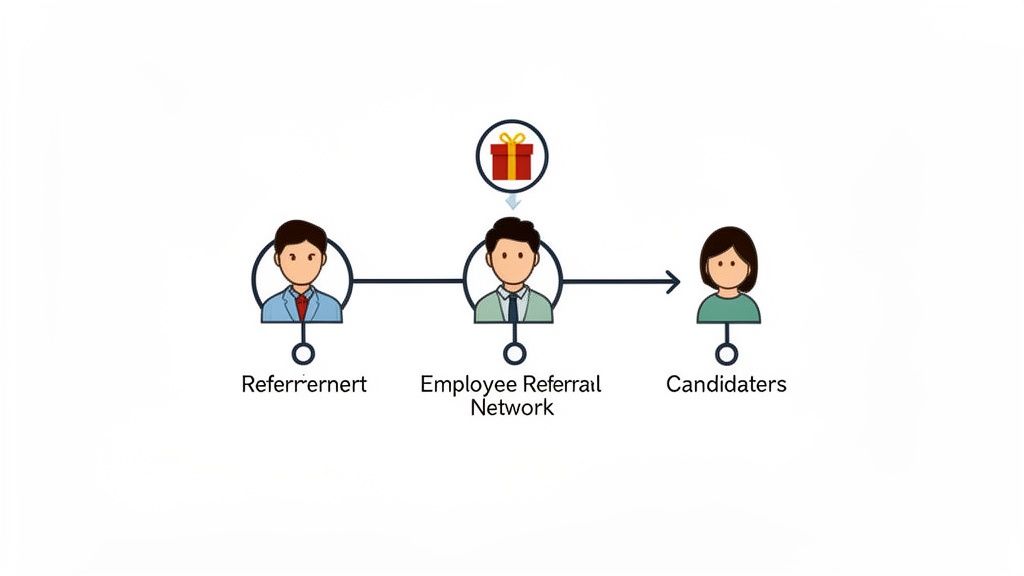
Tapping into your team’s existing connections is one of the most effective and high-ROI candidate sourcing channels available. A well-structured employee referral program incentivizes your current staff to recommend qualified individuals from their professional networks. These candidates often come pre-vetted with a strong understanding of your company culture, leading to significantly higher conversion rates and better long-term retention compared to other sources.
Use cases & implementation
Referral programs are a powerful engine for growth at any stage, but they are particularly crucial for scaling companies needing to maintain a high bar for talent. For instance, tech giants like Google and Uber have famously sourced over 40% of their hires through referrals by offering significant bonuses. A startup can implement a lightweight version by simply creating a dedicated Slack channel for role announcements and making the submission process as frictionless as possible for employees.
Key considerations & best practices
The main risk of over-relying on referrals is creating a homogenous, network-based culture that lacks diversity. To mitigate this, actively encourage employees to refer candidates from underrepresented backgrounds and track the diversity of your referral pipeline. The process must be simple. To learn more about building a robust system, check out our guide on creating an effective employee referral program. Finally, ensure you track key metrics like referral-to-hire ratio and cost-per-hire to demonstrate the program’s value.
11. Recruitment agencies & staffing firms
Partnering with external recruitment agencies and staffing firms is a classic approach to offloading the entire sourcing process. These organizations act as dedicated candidate sourcing channels, leveraging their own networks, tools, and expertise to find, screen, and present qualified candidates. This model is typically fee-based, with permanent placement fees ranging from 15-30% of the candidate’s first-year salary, making it a significant investment.
Use cases & implementation
This channel is most effective for highly specialized, hard-to-fill roles or for managing high-volume hiring surges. A fintech startup might engage a boutique agency specializing in quantitative analysts to find niche talent. Similarly, a rapidly scaling company needing to hire 50+ customer support agents in a quarter could use a staffing firm to manage the entire project, saving immense internal bandwidth and time. For those looking to hire on a contract basis, a freelance recruiter can be a flexible alternative.
Key considerations & best practices
The primary drawbacks are cost and a potential lack of cultural vetting compared to in-house teams. To mitigate this and maximize value, negotiate fees for volume hiring or exclusive partnerships. It’s crucial to build strong relationships with specific recruiters at the firm, treating them as an extension of your team. A hybrid model often works best: use agencies for mission-critical or niche roles while your internal team focuses on core, repeatable hires. This balances speed and cost-effectiveness.
12. AI talent sourcing platforms (SeekOut, HireEZ, Gem, Eightfold)
Next-generation AI recruiting tools represent a significant evolution in how recruiting teams find and engage candidates. These tools aggregate profile data from dozens of public sources, creating a comprehensive talent database that often surpasses single-channel platforms like LinkedIn. By leveraging machine learning, they automate candidate discovery, apply AI-driven scoring to rank profiles, and can even initiate autonomous outreach campaigns, making them powerful candidate sourcing channels for modern teams.
Use cases & implementation
These platforms are ideal for tech startups looking to replace or supplement LinkedIn Recruiter, staffing agencies seeking to automate Boolean search generation, and enterprise TA teams aiming to streamline their recruitment process. For example, a scale-up can use a tool like SeekOut or HireEZ to build a diverse pipeline for a niche role, like “Machine Learning Engineer with Rust experience,” by searching across GitHub, academic papers, and professional directories simultaneously. Check out our guide to the top 10 AI recruiting tools for 2026 for more options.
Key considerations & best practices
The primary differentiator among these platforms is the breadth and depth of their multi-source data coverage. It’s crucial to evaluate their data compliance (GDPR/CCPA) and test any available free tiers before committing to a long-term contract. For example, Juicebox’s PeopleGPT sourced candidates for a “Senior Backend Engineer” role for Vercel, delivering a qualified shortlist in under 60 seconds. When evaluating ROI, look for features like autonomous sourcing agents that can act as a force multiplier for your team.
From channels to system: building your sourcing engine
We’ve explored a wide array of candidate sourcing channels, from the vast networks of LinkedIn and the high-signal depths of GitHub to the targeted communities on Kaggle. But here’s the critical takeaway: mastery isn’t about picking one “best” channel. It’s about architecting an integrated, multi-channel sourcing system.
Relying solely on LinkedIn is like fishing in an over-fished, crowded pond; everyone is using the same bait. This approach leads to fierce competition for a limited pool of active, often unresponsive, candidates. The result? Slower hiring cycles and higher costs. The true strategic advantage lies in diversification.
The shift from manual sourcing to an autonomous engine
The future of talent acquisition is not just about knowing where to look; it’s about building a proactive engine that finds talent for you. This means moving beyond a reactive, channel-by-channel approach and designing a holistic system.
Here’s how this shift changes the game:
High-signal integration: Your system should layer niche channels (like contributions on GitHub) on top of broader platforms. This allows you to verify technical expertise directly from the source.
AI-powered orchestration: Instead of manually cross-referencing candidates, AI-powered tools like PeopleGPT can synthesize data from multiple candidate sourcing channels into a single, unified profile.
Proactive pipeline building: A well-designed sourcing system doesn’t just fill current openings. It continuously scouts for talent and builds a warm pipeline of qualified candidates for future roles.
You might think adding more tools is the answer. But there’s a problem most tools ignore: they still require a human to manually operate them. They might speed up a single task, like finding an email, but they don’t fundamentally change the workflow. An autonomous sourcing engine, by contrast, operates on its own, running your ideal candidate profile against the entire public web to deliver qualified, interested people directly to your inbox. It’s the difference between using a faster shovel and owning a self-driving excavator.
FAQs
What are the most overlooked candidate sourcing channels?
Niche professional associations, university alumni networks, and technical Q&A sites like Stack Overflow are underutilized but offer high-signal, passive talent.
How do I measure the ROI of different sourcing channels?
Track metrics like time-to-fill, cost-per-hire, and offer acceptance rate for each channel to determine its true effectiveness and value to your team.
Can AI completely replace manual sourcing?
AI automates discovery and verification, but human recruiters remain essential for nuanced engagement, relationship building, and closing top candidates.
The modern recruiting landscape demands more than just a list of places to look for people. It requires a system. By moving from disconnected candidate sourcing channels to an integrated, AI-powered engine, you build a powerful competitive advantage.
This unlocks the ability to spend less time searching and more time engaging with the right talent. Instead of manually sifting through profiles, you can focus on building relationships and closing the candidates who will truly move the needle for your company.
Sign up for Juicebox (it's free!)
Run your first search for free. Find and engage top talent across 800M+ profiles. Trusted by 5,000+ customers.