.svg)
SIGN UP FOR JUICEBOX (IT’S FREE!)

Who are you looking for?
Thank you! Your submission has been received!
Oops! Something went wrong while submitting the form.

Let’s get one thing straight: employee morale isn’t some fluffy HR metric. It’s a hard-hitting business KPI that shows up directly on your P&L. Low morale is like bad code in your company’s operating system—when it fails, everything slows down, projects stall, and your best people quietly start updating their LinkedIn profiles.
Most founders believe high employee morale comes from perks and ping-pong tables. That’s a common myth. The opposite is true.
While benefits are nice, real morale is built on trust, clear communication, and a shared sense of purpose. These things are free, but they demand deliberate, consistent effort.
This isn't just another generic HR blog post. It's a playbook built by Juicebox to give you a data-driven framework to diagnose, measure, and improve what makes your team tick, unlike other guides that focus on surface-level fixes.
The first domino to fall when morale dips? Productivity. A disengaged employee isn't just unhappy; they're less effective. This isn't just a feeling—it’s a global trend with massive financial fallout.
Here's the deal:
Global employee engagement hit a new low of just 21% in 2024. That’s a shocking number, translating into an estimated $438 billion loss in productivity worldwide from checked-out workers.
But there’s a deeper problem most companies ignore. Low morale is contagious, and it silently eats away at your company's foundation in ways you might not see until it’s too late.
You might think you can just hire your way out of a morale problem. The truth is, that almost always fails. SHRM estimates that replacing a single salaried employee costs anywhere from 50% to 200% of their annual salary. For a software engineer making $150,000, that’s a potential hit of up to $300,000 for just one departure.
Here’s the bottom line: Proactively investing in employee morale is one of the highest-leverage financial decisions a startup can make. It’s always cheaper to keep great people than to find new ones. Check out our guide to using the best AI recruiting tools to streamline your hiring.
If you want to improve employee morale, you first have to get a real read on it. Most companies reach for a pulse survey, but that’s like trying to diagnose an engine problem by listening to the radio. You’re getting a signal, sure, but it’s probably not the one that matters.
Relying on surveys alone often captures a fleeting mood, not the underlying reality. This leads to well-intentioned but ineffective "fixes" that just waste time and, worse, erode trust.
A much better system involves looking at three different types of signals together. Think of it as creating a continuous listening system, not just a once-a-year check-in.
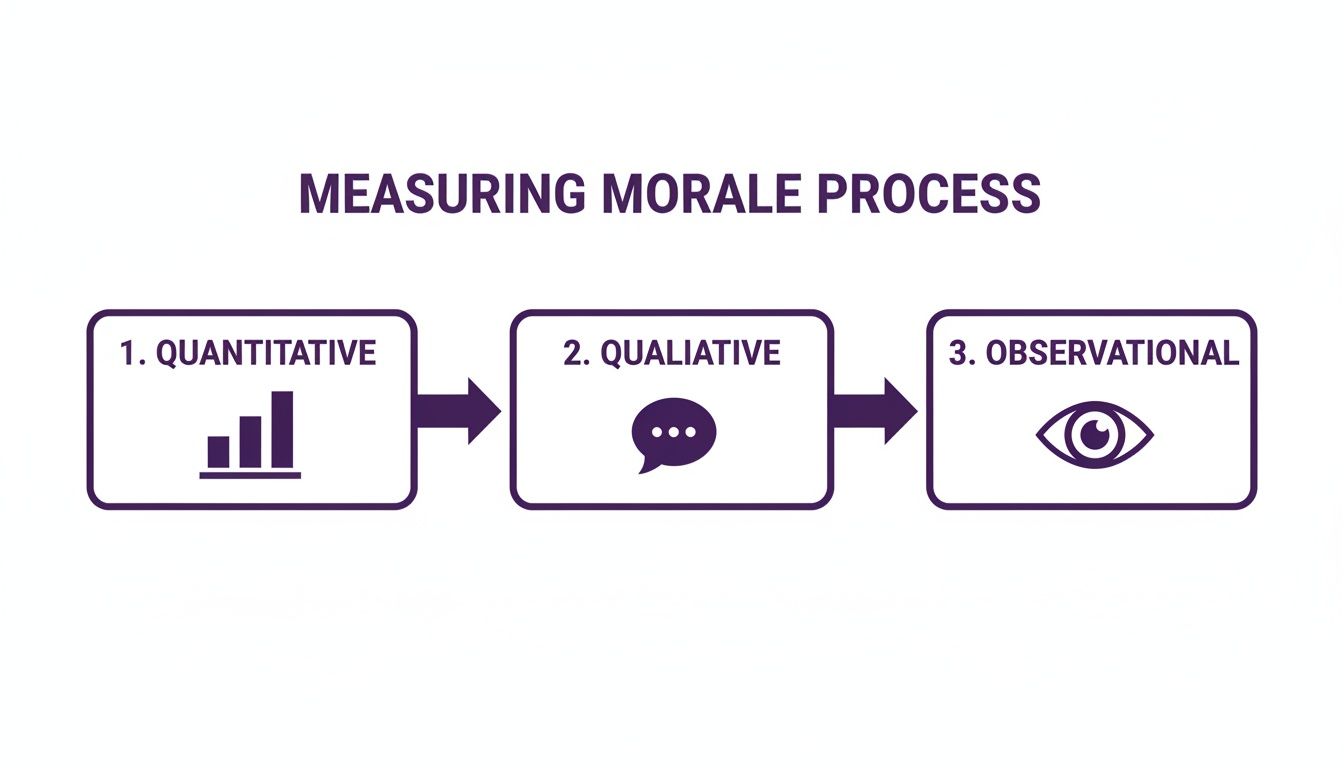
Numbers don't lie. They give you an objective baseline to track morale trends over time and show you exactly where to start digging. The key is to focus on indicators tied directly to team performance.
A few metrics worth tracking:
This is where you get the real story behind the numbers. Qualitative data is about creating an environment for structured, honest conversations where people feel safe enough to tell you what's really going on.
Crucial Insight: Psychological safety is the absolute bedrock of honest feedback. Without it, your qualitative data is junk.
Here's how to gather insights that actually mean something:
The final piece of the puzzle is hiding in plain sight. It’s what managers see and hear every single day. Most companies completely ignore this data, but it's a goldmine.
What to look for:
By weaving together these three data types—quantitative, qualitative, and observational—you stop guessing and start seeing the full picture.
So, you've spotted a dip in employee morale. The real work now lands on your frontline managers. What's the typical corporate response? Throw more training at them and hope for the best.
But there’s a problem most tools ignore: training alone rarely works.
There’s a myth that more training automatically creates better managers. Pouring money into training without giving managers concrete, actionable tools is like handing a chef a cookbook with no ingredients. Real improvement comes from equipping your managers with specific scripts and clear action plans for the hardest conversations. It’s about moving from knowing what to do, to actually doing it.
When an entire team is running on fumes, a generic "take some time off" email is useless. The manager’s job is to become a shield and a strategist.
How to start the conversation:
What to do next:
This rebuilds trust by showing the manager will go to bat for their people.
Layoffs, re-orgs, or a major pivot can crush employee morale. Managers become the primary source of truth and stability. Their communication has to be crystal clear, consistent, and brutally honest.
Key Insight: In times of chaos, your team craves clarity far more than they crave optimism.
How to start the conversation (after the change):
Managers can also actively rebuild connections through activities like these expedition-grade team trust-building exercises. And if you need more guidance, check out our guide on fostering positive employee relations.
Re-engaging someone who has mentally checked out is a delicate operation. The manager's goal is to uncover the "why" without sounding accusatory.
How to start the conversation:
What to do next:
Most leaders treat hiring and morale as two separate functions. This is a huge mistake. Your hiring process is a powerful—and often overlooked—lever for influencing the employee morale of your current team.
What happens next?
A slow, disorganized recruiting function sends a clear message to the people already working for you: "Your burnout doesn't matter as much as our slow process."
Every week an essential role stays open, the burden falls on your existing team. Projects stall, deadlines slip, and your top performers are forced to pick up the slack, leading directly to burnout. They see the empty chair not as a future opportunity, but as a present and growing workload. This can lead to issues like malicious compliance as a coping mechanism.
The problem is that most traditional hiring tools are built for process, not speed. They depend on manual searches and clunky platforms, which practically guarantees a slow hiring cycle, leaving your team to suffer.
The solution is clear. Accelerating hiring is one of the fastest ways to boost morale. This is where modern AI sourcing tools fundamentally change the game. By dramatically cutting the time it takes to find and engage qualified candidates, you can directly improve team morale.
This isn't just theory. Juicebox customer Ramp, a fast-growing fintech company, used Juicebox to scale their engineering team 5x faster. This provided critical support and boosted the confidence of the entire department. It's a clear proof point: efficient sourcing directly supports a healthier work environment.
Key Takeaway: Filling open roles quickly is one of the most powerful, tangible ways to show your team you value their well-being. It’s a direct investment in your company's collective employee morale.
You can learn more by reading our guide on building an automated employee onboarding process.
Alright, you've put out the fires. Now it's time to move from reactive problem-solving to proactively building a culture that lasts. In a high-growth company, keeping employee morale high isn't about flashy perks. It's about consistently reinforcing a system where people feel seen, valued, and trusted.
This system boils down to three core pillars: impactful recognition, clear development paths, and genuine autonomy.
When you get these right, they create a powerful flywheel. Motivated people do great work, which gets recognized. That recognition fuels their desire for growth, which the company supports. This leads to more autonomy, empowering them to make an even bigger impact. And the cycle continues.

Most companies think recognition is about gift cards. It's not. What really moves the needle on employee morale is specific, timely, and public praise that connects someone's work directly to the company's mission.
You might think a quick "good job" in Slack is enough. It's not. It lacks specificity and is forgotten in minutes.
Instead of this: "Great job on the presentation, Sarah."
Try this: "Sarah, the customer data you pulled for today's all-hands was a game-changer. It directly led to us prioritizing the new checkout flow, which is a huge win for Q3."
See the difference? This approach costs nothing but sends a powerful message: you're not just seeing tasks get checked off; you're seeing the value being created. To scale this, build it into your company's operating rhythm.
In a fast-moving startup, formal career ladders are often impractical. But a total lack of visible growth opportunities is a one-way ticket to high turnover. The solution is a lightweight career pathing model focused on skills and impact, not just titles.
This shifts the conversation from, "When do I get promoted?" to, "What skills do I need to develop to take on bigger challenges?"
Create simple "impact frameworks" for key roles. For an engineer, it might look like this:
This gives people the clarity they crave without boxing you into rigid ladders. It helps them see a future at your company, which is critical for long-term employee morale. For a deeper dive, check out our guide to effective workforce planning.
Autonomy is the final piece of the puzzle. Micromanagement is the silent killer of motivation. To build a culture of true ownership, you have to delegate outcomes, not tasks.
Here's the bottom line.
The second approach is frankly terrifying for a lot of managers because it means letting go of control. But it's where real trust is built. It’s where your team feels empowered because it signals you hired them for their brains, not just their ability to follow instructions. To make this stick, you'll need a framework of essential policies to boost morale and productivity.
What's the fastest way to get a read on employee morale?
Combine a quick eNPS survey for a quantitative baseline with manager 1-on-1s that ask structured questions about team energy and roadblocks.
Can you actually improve morale without a big budget?
Absolutely. Focus on high-impact, low-cost actions: consistent public recognition for specific achievements, radical transparency from leadership, and more team autonomy.
How does hiring speed affect the current team's morale?
It's huge. When key roles sit open for months, your existing team picks up the slack, leading to burnout and resentment. Fast hiring is a sign of support.
Are remote teams more prone to low morale?
Not necessarily, but building morale requires more intentionality. Prioritize crystal-clear communication, virtual social events, and robust manager check-ins.
High employee morale isn’t a "nice-to-have"—it's a core competitive advantage. When you get it right, you build a resilient, high-performance organization that becomes a magnet for top talent. This unlocks the ability to shift from constantly backfilling roles to building the future, driven by a team that's genuinely invested in your success.
Try PeopleGPT for free to slash hiring time and keep your team focused and motivated:
{{large_cta}}
Run your first search for free. Find and engage top talent across 800M+ profiles. Trusted by 4,000+ customers.