.svg)
SIGN UP FOR JUICEBOX (IT’S FREE!)

Who are you looking for?
Thank you! Your submission has been received!
Oops! Something went wrong while submitting the form.


Most lists of top recruiting companies are just directories; this guide provides a strategic framework for vetting the right partnership model—agency, marketplace, or in-house AI—to scale hiring effectively.
The best approach to scaling talent acquisition isn't just choosing a top recruiting company, but strategically blending high-value agency partnerships for critical roles with in-house AI sourcing capabilities for efficiency and control.
Finding the right recruiting partner is a high-stakes decision that directly impacts your ability to scale. A great firm feels like an extension of your team, delivering talent that drives growth. A poor choice leads to wasted budget, prolonged vacancies, and costly hiring mistakes. The challenge isn't finding an agency; it's finding the right model for your specific need, whether it's a critical technical hire, an executive search, or high-volume roles.
This guide moves beyond generic lists of top recruiting companies. Instead, it provides a comparative framework, categorizing partners by their unique strengths—from B2B review platforms to vendor management systems. This analysis will help you evaluate traditional agency models against modern, technology-driven alternatives. For example, in-house teams can now leverage platforms like Juicebox, which uses PeopleGPT, a sourcing feature inside the Juicebox platform, to achieve agency-quality results at a fraction of the cost. By the end, you'll have a clear roadmap to selecting the best talent acquisition partner for your company's goals.
Clutch isn't a recruiting company but a crucial first stop. It operates as a comprehensive B2B marketplace where businesses research and connect with top recruiting companies and HR service providers. Its value is rooted in transparent, verified client reviews, allowing hiring managers to make data-driven decisions based on performance rather than marketing.

Its primary strength is the depth and organization of its data. Users can filter potential partners by location, budget, industry focus, and service lines like executive search or RPO. Each firm profile details minimum project size, typical hourly rates, and case studies, providing a clear picture before contact.
| Pros | Cons |
|---|---|
| High Transparency: Verified reviews and self-reported rates provide a clear view of potential partners. | Sponsored Placements: Paid listings can appear above more qualified organic results. |
| Powerful Filtering: Excellent tools to narrow down choices by specialty, budget, and location. | Self-Reported Data: Hourly rates and project minimums are provided by vendors. |
| Free Market Research: The platform and its pricing guides are free for buyers to use. | Varying Profile Quality: The level of detail can differ significantly between firms. |
Clutch helps you find an external recruiting partner; it doesn't replace the sourcing function itself. The firms you find on Clutch use their own tools and processes. This contrasts with building an in-house team that leverages the best talent acquisition software or using AI-native platforms like Juicebox for direct sourcing. Clutch is the map; Juicebox is the AI-powered vehicle that gets you there faster.
ClearlyRated isn't a direct recruiting firm but a vital verification layer for finding the best ones. It operates a service-quality-driven directory centered on its annual "Best of Staffing" awards, which are based on achieving exceptionally high Net Promoter Scores (NPS) from clients and placed candidates. Think of it as the JD Power award for the recruiting industry.
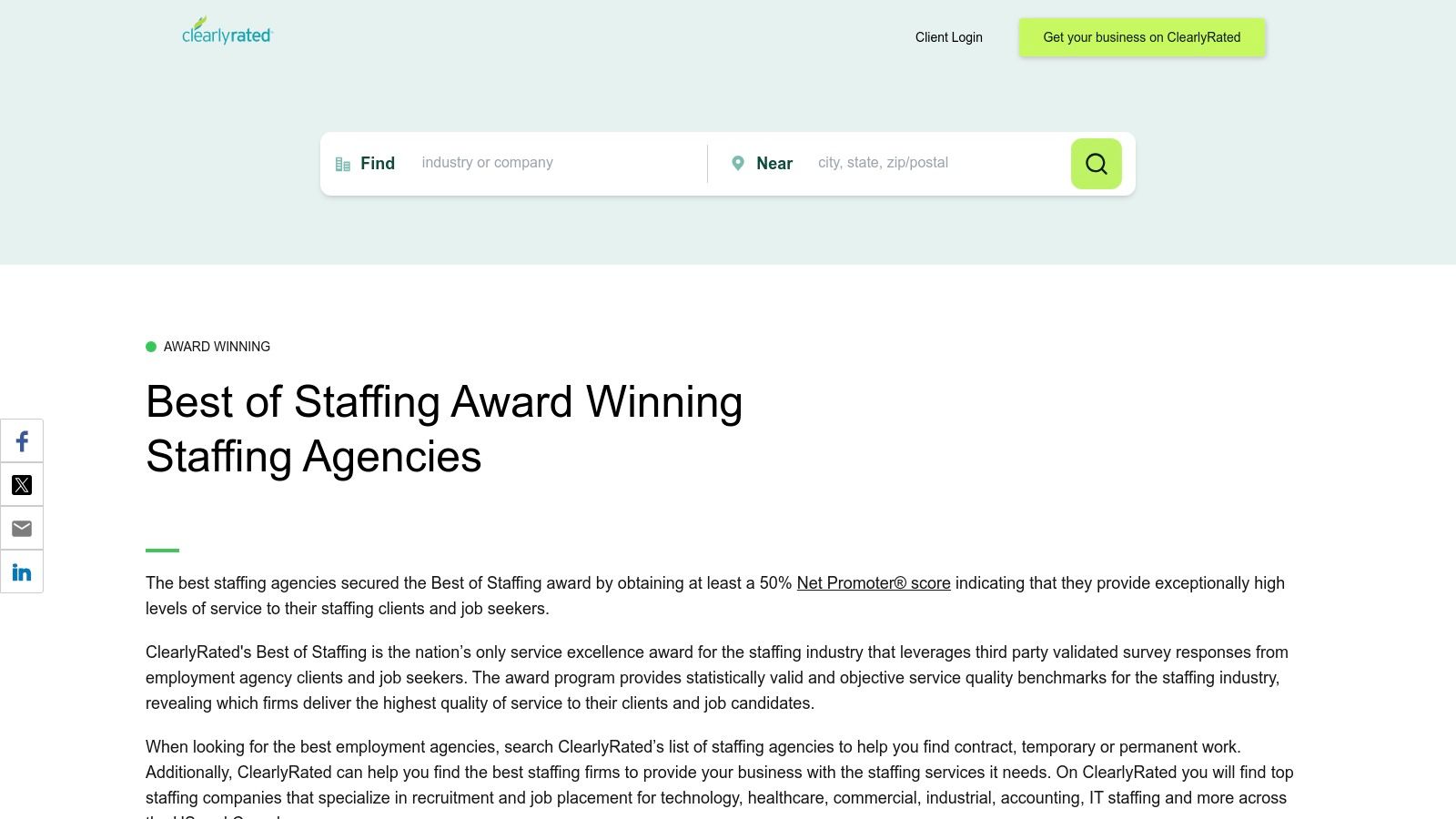
Its core value is its focus on third-party validated proof of excellence. While other directories rely on reviews, ClearlyRated’s lists are built on confidential satisfaction surveys. This creates a curated list of firms that have demonstrated superior service quality, making it easier for hiring managers to find a reliable partner among thousands of US and Canadian agencies.
.tbl-scroll{contain:inline-size;overflow-x:auto;-webkit-overflow-scrolling:touch}.tbl-scroll table{min-width:600px;width:100%;border-collapse:collapse;margin-bottom:20px}.tbl-scroll th{border:1px solid #ddd;padding:8px;text-align:left;background-color:#f2f2f2;white-space:nowrap}.tbl-scroll td{border:1px solid #ddd;padding:8px;text-align:left}ProsConsEmphasis on Service Quality: Validated NPS data provides a reliable measure of partner performance.Fewer Small/New Agencies: Newer firms may not have enough survey volume to qualify.Find Proven US Agencies: An excellent resource for identifying vetted firms by specific niche.Not a Transactional Platform: Contact happens directly with the agency off-site.Multi-Year Badges: Quickly identifies agencies with a long track record of excellence.Limited to Award Winners: The directory only includes those who participate and win.
/html
Using ClearlyRated helps you find a proven external agency, which then uses its own methods for candidate outreach. This is a step removed from building an internal function that owns the candidate journey. An in-house team would focus on mastering a talent sourcing strategy with its own toolkit. The alternative is an AI-native platform like Juicebox, which bypasses the agency middleman. ClearlyRated finds you a trusted service provider; Juicebox provides the AI technology to execute the sourcing function directly.
The fundamental choice is no longer just which agency to hire, but whether to hire one at all for a given role. An AI-native platform allows a single in-house recruiter to replicate the output of a small agency team, collapsing cost-per-hire and accelerating time-to-fill.
DesignRush operates as an editorially curated B2B marketplace where businesses can connect with top-tier agencies across various sectors, including HR and recruitment. It distinguishes itself with ranked lists that are regularly updated and timestamped. This approach helps hiring managers quickly identify some of the best recruiting companies based on recent performance and editorial evaluation.

The platform’s core strength is its structured rankings and clean UI. You can filter agency listings by location, average hourly rate, team size, and client reviews. Each agency profile provides a snapshot of key services, notable clients, and a portfolio, allowing for rapid assessment.
.tbl-scroll{contain:inline-size;overflow-x:auto;-webkit-overflow-scrolling:touch}.tbl-scroll table{min-width:600px;width:100%;border-collapse:collapse;margin-bottom:20px}.tbl-scroll th{border:1px solid #ddd;padding:8px;text-align:left;background-color:#f2f2f2;white-space:nowrap}.tbl-scroll td{border:1px solid #ddd;padding:8px;text-align:left}ProsConsRecently Updated Rankings: Timestamped lists provide a current snapshot of the market.Sponsored Placements: Paid listings appear at the top, potentially above more relevant firms.Fast Shortlisting: Filters for budget and niche make it easy to create a targeted list of partners.Varying Profile Depth: The level of operational detail can differ between agency profiles.Editorial Curation: An editorial review process helps ensure the quality and accuracy of listings.Focus on "Agencies": The platform is less suited for finding individual freelance recruiters.
Using DesignRush is a strategic first step to finding a specialized external recruitment partner. The agencies you discover will apply their own methodologies. This is fundamentally different from leveraging a direct sourcing platform. While DesignRush helps you find a team to run the race, an AI-native solution like Juicebox provides the engine. With features like PeopleGPT, Juicebox empowers your own team to source top-tier talent directly, often faster and at a fraction of the cost of an agency.
Similar to Clutch, GoodFirms is a comprehensive B2B research and review platform. Its dedicated Staffing & Recruiting category functions as a massive directory, allowing hiring managers to explore a wide range of providers, from global powerhouses to specialized boutique agencies. The platform's value lies in its structured data presentation, which helps users quickly assess firms based on key business metrics.

GoodFirms differentiates itself by providing a clear snapshot of each company's operational scale. Profiles prominently feature details like hourly rate bands, team size, founding year, and client focus. This information is useful for mid-market companies seeking partners of a similar size or for startups looking for agile, niche specialists.
.tbl-scroll{contain:inline-size;overflow-x:auto;-webkit-overflow-scrolling:touch}.tbl-scroll table{min-width:600px;width:100%;border-collapse:collapse;margin-bottom:20px}.tbl-scroll th{border:1px solid #ddd;padding:8px;text-align:left;background-color:#f2f2f2;white-space:nowrap}.tbl-scroll td{border:1px solid #ddd;padding:8px;text-align:left}ProsConsWide Coverage: Includes a broad spectrum of firms, from large to niche.Varying Review Quality: The recency and depth of reviews can be inconsistent.Helpful Comparison Data: Rate bands and team sizes allow for quick comparisons.Less US-Centric: Some profiles are globally focused with limited US presence.Discover Boutique Firms: Excellent for finding smaller or specialized agencies.Profile Detail Varies: The amount of information provided differs from firm to firm.
Using GoodFirms is a strategic step to find an external recruitment agency. It acts as a research tool to outsource the recruitment function. This contrasts sharply with building an internal talent acquisition team. It also differs from leveraging an AI-native platform like Juicebox, which equips your existing team to source, engage, and qualify candidates directly from a massive talent pool with unparalleled speed and precision. GoodFirms helps you find a service; Juicebox provides the technology to own the outcome.
Forbes, in partnership with Statista, provides a respected editorial perspective on the recruiting landscape. Instead of a searchable marketplace, Forbes publishes annual rankings of America’s Best Recruiting Firms across three categories: Executive Recruiting, Professional Recruiting, and Temporary Staffing. This resource functions as a high-signal, third-party validation tool, ideal for identifying nationally recognized leaders.

The primary strength of the Forbes list is its survey-based methodology, which gathers input from thousands of recruiters, HR managers, and candidates. This multi-faceted approach provides a well-rounded view of a firm's market reputation. For hiring managers, it serves as an excellent starting point for due diligence, offering a curated list of firms vetted by industry peers and clients, making it a powerful tool in the search for the top recruiting companies.
.tbl-scroll{contain:inline-size;overflow-x:auto;-webkit-overflow-scrolling:touch}.tbl-scroll table{min-width:600px;width:100%;border-collapse:collapse;margin-bottom:20px}.tbl-scroll th{border:1px solid #ddd;padding:8px;text-align:left;background-color:#f2f2f2;white-space:nowrap}.tbl-scroll td{border:1px solid #ddd;padding:8px;text-align:left}ProsConsHigh-Signal Brand Authority: Forbes' reputation adds significant credibility to the firms listed.Not a Transactional Marketplace: You must research and contact firms independently.Identifies National Leaders: Quickly highlights firms with a strong national reputation.Static Annual Updates: The list may not reflect recent market changes until the next publication.Excellent for Cross-Referencing: A great resource to validate choices made on other platforms.Lacks Granular Data: Provides no information on pricing, project minimums, or case studies.
Using the Forbes list is an exercise in market research to find a traditional agency partner. Those firms then deploy their own, often manual, sourcing processes. This path differs significantly from leveraging an AI-native platform like Juicebox to bring sourcing capabilities in-house. While a firm from the Forbes list offers outsourced manpower, Juicebox provides the technology to empower your team to source elite candidates directly. A deeper recruiting software comparison often reveals that an AI-powered internal function offers superior control and ROI.
BountyJobs operates as a strategic marketplace and vendor management system for companies that engage multiple third-party recruiting agencies. Instead of contracting with firms one by one, BountyJobs provides a centralized platform to source, manage, and pay a network of pre-vetted agencies. This streamlines the administrative overhead associated with external recruitment.
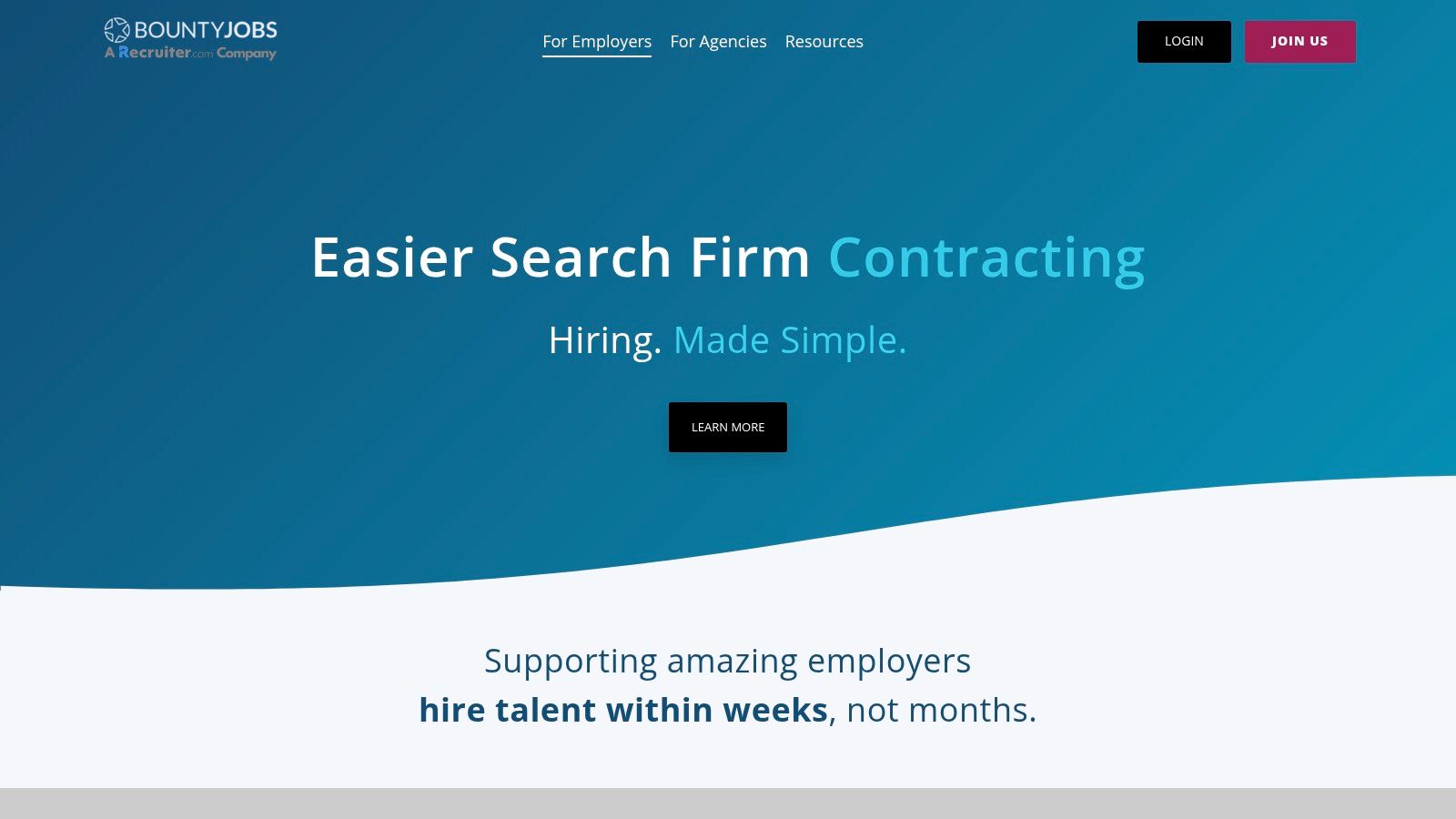
Its core value is simplifying vendor management. The platform handles contracting, compliance, and invoicing, allowing TA teams to focus on evaluating candidates, not paperwork. With features like fee governance and performance analytics, it introduces control and data-driven decision-making to an often-decentralized function.
.tbl-scroll{contain:inline-size;overflow-x:auto;-webkit-overflow-scrolling:touch}.tbl-scroll table{min-width:600px;width:100%;border-collapse:collapse;margin-bottom:20px}.tbl-scroll th{border:1px solid #ddd;padding:8px;text-align:left;background-color:#f2f2f2;white-space:nowrap}.tbl-scroll td{border:1px solid #ddd;padding:8px;text-align:left}ProsConsReduces Administrative Lift: Streamlines contracting, compliance, and invoicing.Best for Volume Hiring: May be overly complex for companies making only one-off hires.Performance Analytics: Offers clear data on agency effectiveness to optimize your supplier list.Platform Fees: Full functionality typically requires an annual platform subscription fee.Marketplace Controls: Provides fee governance and protects against duplicate submissions.Less Direct Relationship: Can mediate the direct partnership-building with agencies.
BountyJobs is an orchestrator of external recruiting agencies, not a direct sourcing tool. It helps you manage the people who find candidates. This differs fundamentally from building an in-house team that uses its own technology stack or leveraging an AI-native platform like Juicebox to source talent directly. While BountyJobs optimizes your agency relationships, modern candidate sourcing tools allow you to bypass agency fees entirely by bringing sourcing intelligence in-house.
Upwork is a massive freelance marketplace that provides direct access to independent recruiters, sourcers, and small agencies. It's ideal for businesses needing fractional or surge recruiting support without the cost of a full-scale agency retainer. Companies can quickly engage talent for specific projects, from building a single candidate pipeline to managing a short-term hiring spike.
The platform's primary strength is its scale and the transparency it provides into a freelancer's work history and client feedback. Hiring managers can browse detailed profiles, review past project success, and see verified client reviews before initiating contact. This on-demand access to a global talent pool allows companies to find specialists quickly.
.tbl-scroll{contain:inline-size;overflow-x:auto;-webkit-overflow-scrolling:touch}.tbl-scroll table{min-width:600px;width:100%;border-collapse:collapse;margin-bottom:20px}.tbl-scroll th{border:1px solid #ddd;padding:8px;text-align:left;background-color:#f2f2f2;white-space:nowrap}.tbl-scroll td{border:1px solid #ddd;padding:8px;text-align:left}ProsConsQuick to add capacity: Scale your recruiting team up or down with minimal commitment.Requires careful vetting: The quality of freelancers varies widely across the marketplace.Transparent reviews and rates: Visible work history and hourly rates simplify selection.Platform fees: Service fees are added for both clients and freelancers, increasing total cost.Secure contractual framework: Built-in payment protection and contracts reduce risk.Best for tactical support: Less suited for high-level, strategic executive search.
Using Upwork gives you on-demand access to human recruiting expertise to execute specific tasks. This differs from building an in-house team, which requires a significant investment in salaries and tools. Upwork provides the freelance talent, whereas an AI-native platform like Juicebox automates the sourcing function itself, allowing a small team to build candidate pipelines with the efficiency of a much larger one. This is a key consideration when evaluating Indeed alternatives for sourcing talent.
Choosing a recruiting partner is less about picking a name from a list and more about designing a process. The most effective talent acquisition functions don't just outsource a problem; they strategically integrate external resources to augment their internal capabilities. Your primary challenge isn't finding a list of the top recruiting companies; it's defining your needs with enough clarity to select the right type of partner.
The rise of powerful AI sourcing tools has fundamentally changed this calculus. The decision is no longer a simple binary of "build vs. buy." It's about creating a hybrid model. Use top recruiting companies for their strategic counsel and exclusive networks for your most critical hires. For everything else, empower your internal team with AI-native tools to build a more efficient, scalable, and cost-effective sourcing engine. This strategic blend unlocks a modern, world-class talent acquisition function that drives sustainable growth.
Compare sourcing workflows inside Juicebox
What is the best type of recruiting company for startups?
Startups often benefit from flexible or specialized partners. Platforms like Upwork provide fractional recruiters for tactical needs, while boutique firms found on Clutch offer deep expertise in specific industries like tech or biotech.
How do recruiting company fees work?
Most firms use a contingency model (20-30% of first-year salary, paid upon hiring) or a retained model (a portion paid upfront) for executive searches. Marketplaces like BountyJobs help standardize these fees across multiple vendors.
When should I use an agency vs. sourcing in-house?
Use an agency for highly specialized, confidential, or executive-level roles where their network is critical. For most other roles, building an in-house sourcing function with AI tools like Juicebox is more cost-effective and scalable.
{{large_cta}}
Run your first search for free. Find and engage top talent across 800M+ profiles. Trusted by 5,000+ customers.
.png)
![The Complete Guide to Employee Reimbursement [2026]](https://cdn.prod.website-files.com/68c2f83ae8165ab45cf529f8/698c5c3c6f51cb7da4cc4641_reimbursement-finance.jpeg)

.png)