Before you can learn how to write a meeting agenda that actually works, you have to understand why most of them fail. It’s not about a missing checklist; it’s about a missing purpose—a clear, outcome-driven goal that moves the needle on business results.
Most guides miss this, but it’s the one thing that separates meetings that drain energy from meetings that create momentum.
Here’s how to create meeting agendas that acually work:
TL;DR: how to write a meeting agenda
Define a single goal: Start with one clear, action-oriented objective (e.g., “Decide on the top 2 candidates”). If you can’t, don’t meet.
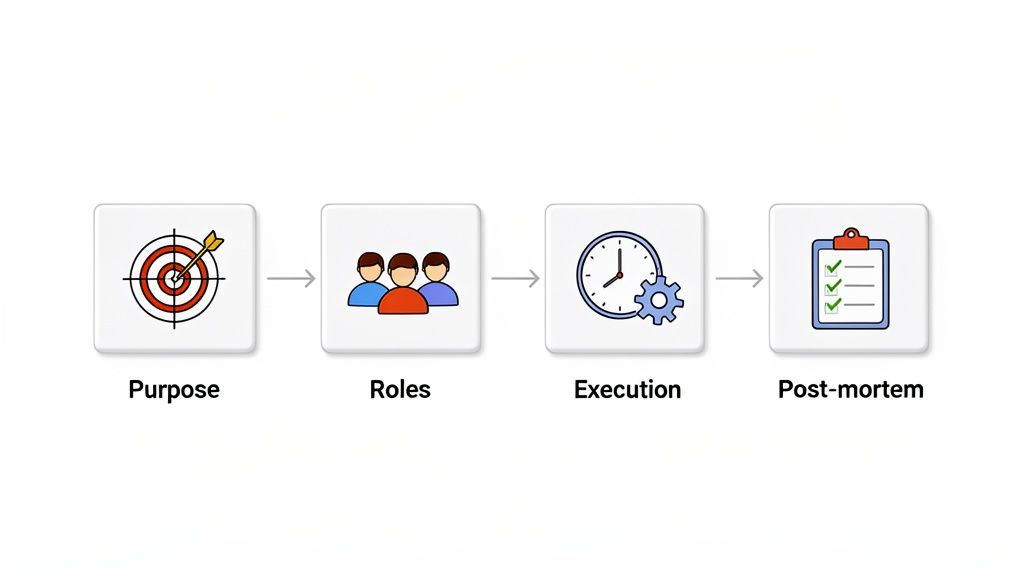
Use the PREP framework: Structure your agenda around Purpose, Roles, Execution (timed topics), and Post-mortem (action items).
Frame topics as questions: Instead of “Discuss feedback,” write “Does Candidate A meet our technical requirements? (Yes/No).” This forces a decision.
Distribute 24 hours in advance: Embed the core goal and agenda link directly in the calendar invite. Don’t send it last minute.
Adapt for remote/hybrid: Use 25-minute meeting slots and build in async-first options to combat Zoom fatigue and respect focus time.
Why most meeting agendas fail (and how to fix it)
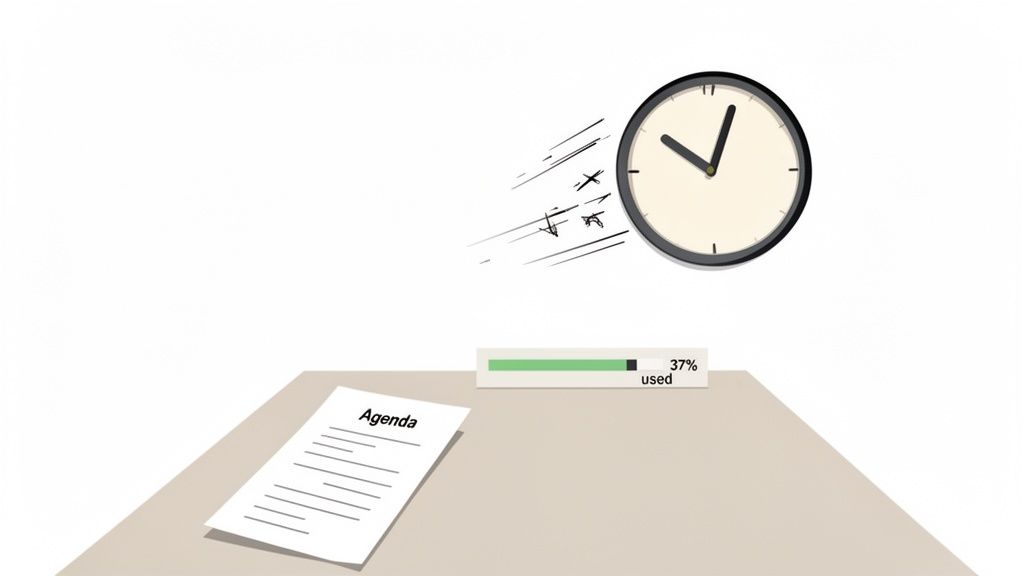
Let’s be real: the vast majority of meetings are a colossal waste of time. This isn’t just a hunch; it’s a costly reality. A 2024 analysis by Flowtrace found that employees waste up to 5 hours per week in unproductive meetings, a tangible loss that stalls decisions and slows down business. For a fast-moving team, a single aimless meeting can delay a critical hire and hand an advantage to competitors.
The problem isn’t usually a lack of effort. Here’s the deal: Most agendas are treated like simple topic lists—a procedural formality instead of the strategic tool they’re meant to be.
Think of it this way: your agenda isn’t just a map. It’s the source code for a productive session. When the code is garbage, the program crashes.
But there’s a problem most guides on how to write a meeting agenda ignore. They give you the obvious tips, like “list your topics” or “add timings.” They completely miss the fundamental point. A great agenda is a commitment device. It forces clarity on the one thing you must accomplish and holds everyone accountable for getting there, a key tactic to combat issues like a 9-80 work schedule that can blur team focus.
This is especially true when you’re navigating complex team dynamics, where foggy expectations can sometimes lead to what some call malicious compliance.
By framing every item as a question to be answered or a decision to be made, you instantly transform the meeting from a passive update into an active work session. This simple shift moves the focus from covering topics to achieving tangible outcomes.
Anatomy of an outcome-driven agenda
So, what transforms a simple topic list into a powerful tool for productivity? It boils down to a few essential components that force clarity and drive action.
Here’s what that looks like in practice:
Component | Purpose | Recruiting Example |
|---|---|---|
Meeting Goal (The “Why”) | A single, clear sentence stating the desired outcome. If you can’t write this, you shouldn’t have the meeting. | “Decide on the top 2 candidates for the Senior Product Manager role to move to the final interview stage.” |
Key Questions / Decisions | Converts vague topics into actionable items. Instead of “Discuss candidate feedback,” you ask decision questions. | “Decision: Finalize the interview panel for the final round. Question: What are the key red flags from the reference checks for Candidate B?” |
Required Attendees & Roles | Lists who needs to be there and why (decision-maker, SME, note-taker). Prevents over-inviting. | “Hiring Manager (Decision-Maker), Lead Engineer (Technical Veto), Recruiter (Process Owner).” |
Time Allocation per Item | Assigns realistic time to each decision/question to keep the conversation on track. | “Review Candidate A feedback (10 mins), Review Candidate B feedback (10 mins), Final Decision & Next Steps (5 mins).” |
Pre-Work / Required Reading | Links to essential documents (resumes, feedback) attendees must review beforehand. | “Pre-read (15 mins): Please review the attached feedback summaries for Candidate A and Candidate B in our ATS.” |
Putting these elements together is what separates a meeting that drains energy from one that creates momentum. It’s not about adding bureaucracy; it’s about being intentional with everyone’s time. Using effective recruitment emails is another great way to respect everyone’s time.
The PREP framework: a repeatable system for great agendas
Frameworks are gold. They turn something you dread into a simple, repeatable system. Instead of staring at a blank page every time you need to figure out how to write a meeting agenda, you can just follow a proven model. For meetings, we swear by the PREP framework.
PREP stands for Purpose, Roles, Execution, and Post-mortem.
You might think a good agenda needs to be incredibly detailed to be effective. Here’s why that often fails: some of the most productive meetings run on agendas that are just a few hundred characters long because they nail these four core components. The power of this framework is its focus on clarity over complexity.
Purpose: define the single goal
First things first: what is the meeting’s Purpose? This isn’t a list of topics. It’s the single, measurable outcome you need to walk away with. If you can’t nail down the purpose in one clear sentence, the meeting should be an email.
Weak purpose: “Discuss Q3 hiring plan.” (Vague, no clear action.)
Strong purpose: “Finalize and approve the engineering headcount for the Q3 hiring plan.” (Specific, decision-oriented.)
A strong purpose is your North Star. It keeps the conversation on track and stops you from getting pulled into detours.
Think of it like this: a clear Purpose is the foundation. Everything else is built right on top of it, creating a repeatable loop for genuinely productive meetings. Finding the right candidates using tools like these Indeed alternatives is just as purpose-driven.
Roles and execution: map the path to get there
Once the purpose is clear, define the Roles. Who absolutely needs to be there to hit that goal? Be ruthless. Invite only essential decision-makers, contributors, and owners.
Then, assign a facilitator and a notetaker. It’s a game-changer. People often think more attendees mean more collaboration, but research shows the opposite: smaller groups make decisions faster. For instance, a candidate debrief at Juicebox only ever includes the hiring manager (decision-maker), an interviewer (contributor), and the recruiter (facilitator).
Next is the Execution—the “how” of your agenda. Break down your purpose into a logical flow of timed topics or specific questions. Link to any pre-read materials, whether it’s a candidate’s profile or a dashboard with your team’s key recruiting metrics.
I see this all the time: people cram ten topics into a 30-minute slot. It’s far better to tackle three important items thoroughly than to rush through ten and accomplish nothing.
Post-mortem: solidify what happens next
Finally, every great meeting agenda plans for a Post-mortem. This isn’t a whole separate meeting. It’s the last five minutes of the one you’re already in.
The goal is simple: review decisions and assign clear action items with owners and deadlines. This is how you ensure the momentum you built translates into real-world progress. Without this step, even the most energetic conversations fizzle out, leaving everyone wondering, “So… what’s next?”
Agenda templates for high-stakes meetings
Theory is great, but actionable templates save you time. You don’t need to reinvent the wheel every time you need to figure out how to write a meeting agenda. What you need are battle-tested starting points you can adapt in seconds.
Most people believe templates are too rigid for the fast-paced world of recruiting. The opposite is true. A strong template isn’t a cage; it’s a launchpad. It handles the structural thinking so you can focus on high-value conversations that lead to great hires. This is especially true for leaders at scaling companies like Ramp and Quora, who live by their ability to standardize excellence. Using the right AI recruiting tools follows the same principle of standardizing excellence.
Here are three annotated templates for the most common high-stakes recruiting meetings.
The candidate debrief session template
The point of a debrief is to make a clear Go / No-Go decision. This agenda forces that outcome and kills the dreaded “let’s circle back” conclusion.
Meeting goal (5 mins): Decide whether to advance [Candidate Name] to the next stage for the [Role Title] position.
Round-robin feedback (15 mins): Each interviewer shares their top 2-3 data points against the role’s core competencies (3 mins max each).
Decision: Is this a “yes,” “no,” or “strong yes”?
Owner: [Recruiter Name]
Next step: Communicate the decision to the candidate by [Date/Time].
The weekly sourcing sync template
This meeting isn’t a status update—it’s a strategic huddle to analyze data, solve roadblocks, and adjust tactics.
What you need to know: A 2024 analysis by Microsoft of over 30,000 workers revealed that inefficient meetings were the #1 productivity disruptor. That means a structured sync isn’t just nice to have; it’s a competitive necessity.
Meeting goal (2 mins): Identify the top sourcing priority for the week and remove one key blocker.
Metrics review (10 mins): Review sourcing channel performance (reply rates, pass-through rates) for P0 roles.
Blocker triage (10 mins): What’s the single biggest thing slowing us down? Brainstorm one tactical solution.
Action items (3 mins): Define one clear action item for each priority role.
The hiring manager intake meeting template
A bad intake means wasted sourcing cycles. This agenda ensures you walk away with an actionable search profile everyone agrees on. Understanding tools and associated costs, like SeekOut pricing, is often part of these strategic discussions.
Meeting goal (5 mins): Finalize the role scorecard and interview process for the [Role Title] position.
Scorecard deep dive (25 mins): Define the 3-5 “must-have” vs. “nice-to-have” qualifications and key outcomes for the first 6 months.
Process mapping (15 mins): Define each interview stage, assign interviewers, and agree on feedback SLOs (e.g., 24 hours).
Sourcing strategy (10 mins): Identify “Top 10” target companies and ideal candidate profiles.
Confirm next steps (5 mins): Recruiter to post the job and start outreach by EOD.
How to ensure your agenda actually gets used
You’ve crafted the perfect agenda. But if it’s buried in an email ten minutes before the meeting, it’s useless. Getting an agenda in front of busy people—and getting them to read it—is the real challenge.
The good news? A few tactical changes can make all the difference.
The secret isn’t sending more reminders. It’s about making the agenda impossible to ignore and easy to act upon, starting with the calendar invitation.
Crafting the perfect calendar invite
Your calendar invite is prime real estate. Use the description field to frame the meeting’s purpose and set expectations.
Here’s a simple structure to embed in your invites:
Meeting goal: A single, sharp sentence. Ex: “Goal: Finalize the Q4 sourcing strategy for the Senior AI Engineer role.”
Key decisions: List the 1-2 critical outcomes. Ex: “We will decide on our top 3 target companies and approve the outreach messaging.”
Agenda & pre-read: A direct link to the full document. Ex: “Full Agenda & Candidate Profiles [link]”
This gives everyone immediate context and signals this isn’t just another casual chat. It respects their time by telling them what’s required before they even open the full agenda. Similar to writing a great resume, clarity is key.
Timing and distribution are everything
Poor timing is the #1 reason agendas go unread.
The golden rule is simple: send your agenda at least 24 hours in advance. This gives everyone a chance to review materials, gather thoughts, and show up ready to contribute—not just react.
Sending it the morning of guarantees few will come prepared. A well-timed agenda is a strategic move that dramatically increases the odds of a productive outcome. It also empowers your team to decline if their input isn’t needed, protecting everyone’s focus time. This is a core principle in how to streamline the recruitment process.
Adapting agendas for remote and hybrid work
The way we work has changed, but our meeting habits haven’t kept up. In a world of remote and hybrid teams, the old-school, back-to-back meeting structure is a fast track to burnout. Learning how to write a meeting agenda for this new reality is critical.
A 2025 report from Atlassian highlighted that 92% of workers multitask during virtual meetings. That massive disconnect is your opportunity to do better.
Building agendas for live virtual meetings
For remote or hybrid teams, an agenda must manage energy and focus.
Here’s how:
Schedule with buffers: Ditch the 30-minute default. Schedule 25-minute meetings. That five-minute buffer lets people reset.
Add a human moment: Add a 3-5 minute item at the start for non-work chat to bridge the physical gap.
Clarify roles per item: Note who needs to be an active participant vs. who can just listen for each topic. This helps people conserve mental energy.
For more on this, check out these insights into the current state of remote and hybrid work.
When a meeting isn’t a meeting
What about asynchronous work? An “async agenda” guides collaboration in tools like Slack or shared docs without a live call.
Here’s a simple example for a Slack channel:
It clearly states the goal, links to context, asks specific questions, and sets a firm deadline. This keeps the conversation focused and productive without blocking everyone’s calendar. Using the right tools, including understanding elements like LinkedIn Recruiter pricing, is part of this modern approach.
FAQs: how to write a meeting agenda (2026)
How long should a meeting agenda be?
Keep it concise. Aim for 3–5 key topics or questions. The most effective agendas are often under 400 characters, focusing on objectives, not exhaustive detail.
What’s the single most critical part of an agenda?
The objective. A clear, single-sentence goal explaining the desired outcome is the rudder for the entire conversation, keeping everyone focused on a tangible result.
Whose job is it to create the agenda?
The meeting organizer owns it, but the best agendas are collaborative. Loop in key attendees for input to ensure all critical topics are covered and build buy-in.
Your agenda is your competitive edge
Mastering how to write a meeting agenda isn’t just about administrative tidiness. It’s about reclaiming your team’s most valuable, non-renewable resource: their time.
This one skill unlocks faster decisions, higher-quality collaboration, and a more focused operation. By treating every agenda as a blueprint for action, you turn meetings from a necessary evil into a genuine competitive advantage that lets you outpace everyone else.
Sign up for Juicebox (it's free!)
Run your first search for free. Find and engage top talent across 800M+ profiles. Trusted by 5,000+ customers.