Tired of sending outreach into a black hole? The average recruiter sends over 50 emails a day but gets barely 5 replies.
This isn’t a volume problem. It’s a strategy problem. Most templates are generic, impersonal, and instantly ignored by the talent you’re trying to reach. Generic outreach fails because it makes the candidate do all the work of connecting their skills to a vague job description.
In this guide, we’ll show you the nine essential recruitment email sample templates used by top sourcers at companies like Ramp and Perplexity to cut through the noise.
This isn’t just another list of copy-paste templates. We’ll analyze the strategic psychology behind each email, showing you how to adapt them for different roles, from cold outreach to engaging passive candidates. You’ll learn replicable methods behind high-performing outreach, see the exact language that compels a response, and discover how to automate this entire workflow to scale your sourcing efforts.
Let’s dive right in:
TL;DR: key recruitment email strategies
Ditch generic templates: Mass-blasted emails get ignored. Success requires a portfolio of specialized templates for different scenarios like cold outreach, referral requests, and re-engagement.
Personalization is non-negotiable: Move beyond
{FirstName}. Effective outreach references a candidate’s specific work, recent achievements, or shared connections to build immediate rapport.Strategy over volume: A well-researched, multi-step sequence for a single high-value candidate will outperform a hundred generic emails. Focus on quality touches over raw quantity.
Leverage sourcing intelligence: Use tools that provide deep insights into a candidate’s background and motivations to craft messages that resonate and prove you’ve done your homework.
1. How do you write a direct outreach email? (Cold Sourcing template)
Direct outreach emails are the cornerstone of a modern talent sourcing strategy, designed to engage high-value passive candidates with a concise, personalized, and role-first message. This template gets straight to the point, leading with the opportunity and a data-backed reason why the specific candidate is a perfect fit. This approach respects the candidate’s time and demonstrates you’ve done your homework, making it one of the most effective recruitment email samples for building a high-quality pipeline.
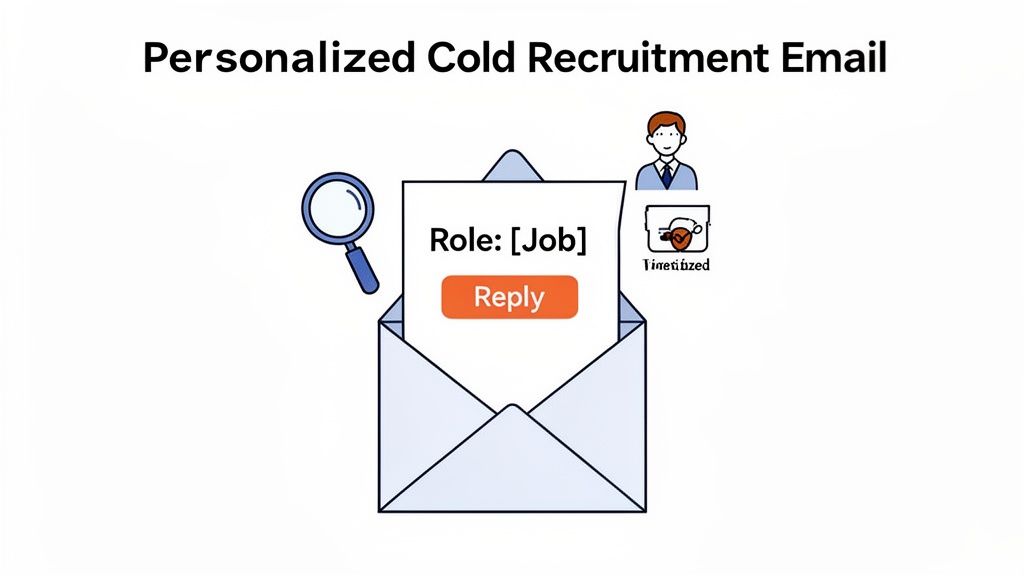
This method thrives on precision. Success hinges on sourcing high-intent signals, like recent promotions or project launches, and weaving them into the opening line. Ramp and Cognition have seen a 3x lift in reply rates by combining hyper-personalized first-touch emails with automated multi-step sequences.
Why this template works
Candidate-centric: It immediately answers the candidate’s primary question: “What’s in it for me?”
Shows genuine interest: Referencing a specific achievement proves you aren’t just spamming a list.
Reduces friction: By linking to a clear job description or a short Loom video from the hiring manager, it makes learning more about the role effortless.
Actionable tips for implementation
Hyper-personalize the opening: Use PeopleGPT, a sourcing feature inside the Juicebox platform, to uncover recent achievements. Start with, “Saw your recent talk on scalable vector databases at QCon…”
Keep subject lines short and sweet: A/B test direct subject lines like “Staff Engineer role at [Your Company]” against more personal ones like “Quick question, [FirstName]”. Keep them under 50 characters for mobile visibility.
Focus on the “Why You”: Include a single sentence that connects their specific background to the role’s challenges. Example: “Your experience scaling data infrastructure at [Their Company] is exactly what we need to build our new ML platform.”
Optimize send times: Data shows the highest engagement occurs Tuesday through Thursday between 9 am and 11 am in the candidate’s local time zone.
For a deeper dive into sourcing and messaging strategies for top-tier talent, explore our guide on how to engage passive candidates.
2. What is a value-first email? (Benefits-Focused template)
The value-first email prioritizes career impact over role mechanics. This template leads with the tangible benefits and growth opportunities the role offers, addressing the candidate’s long-term trajectory before diving into company specifics. It’s designed to answer the crucial “why this role, why now” question for high-caliber passive candidates who are constantly evaluating their opportunity cost. Instead of just selling a job, you’re selling a career milestone.
This approach is particularly effective for competitive roles where top talent has multiple options. Anyscale successfully recruits machine learning engineers by leading its outreach with complex infrastructure challenges and unique learning opportunities, rather than generic company pitches. These recruitment email samples shift the conversation from “what the company needs” to “what the candidate gains,” a critical distinction in a candidate-driven market. This is a powerful strategy when considering a LinkedIn Recruiter alternative.
Why this template works
Appeals to ambition: It directly targets a candidate’s desire for growth, learning, and impact.
Establishes credibility: Leading with high-impact problems and mentioning metrics like user base or funding builds immediate trust.
Differentiates your offer: It highlights unique benefits (e.g., specific tech, mentorship) that competitors may not offer.
Actionable tips for implementation
Lead with impact: Start with the core problem the role solves. Example: “We’re looking for an engineering leader to scale our payment infrastructure from 1M to 10M daily transactions.”
Quantify the opportunity: Use numbers to add weight to your claims. Mention team size, user growth, or scale of the technical challenge.
Personalize the “Why”: Connect their past progression to this future opportunity. Use career progression filters in your sourcing to find candidates on an upward trajectory.
Include a surprising benefit: Mention one unique perk that stands out, such as a dedicated learning budget, a four-day work week, or a significant equity package.
To craft a compelling value-first message, it’s essential to understand your company’s core offerings. For more ideas, explore our guide on building an effective employee value proposition.
Pattern Interrupt: Most recruiters focus on what they need. Elite recruiters focus on what the candidate wants. This simple shift in perspective is the difference between an email that gets deleted and one that gets a reply.
3. How can you leverage employee referrals? (Advocacy template)
The referral incentive email activates your most valuable sourcing channel: your employees. This template encourages team members to tap into their professional networks, turning your entire organization into a distributed recruiting force. This approach leverages trusted relationships to improve candidate quality, reduce time-to-hire, and lower sourcing costs. It’s one of the most cost-effective recruitment email samples for scaling a high-performance team.
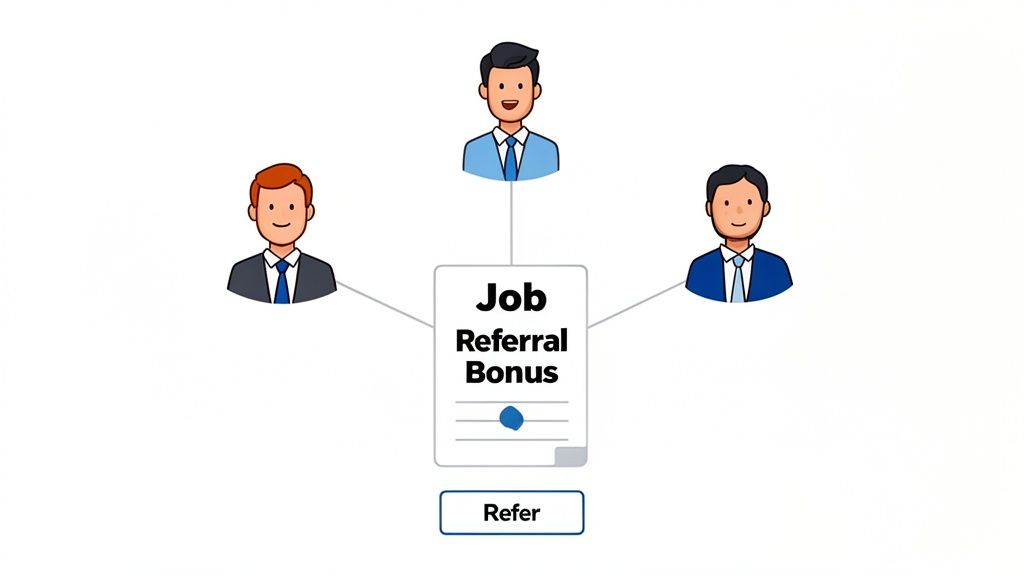
This method’s success is well-documented. YC-backed startups often build their foundational engineering teams this way, with referrals accounting for 30-50% of hires. High-growth tech companies like Stripe and Canva attribute over 40% of their hires to strong referral programs. The strategy works because it’s built on trust; employees pre-vet candidates for both skill and cultural fit, leading to higher engagement and better long-term retention.
Why this template works
Increases candidate quality: Referrals come with a built-in endorsement, significantly increasing the likelihood of a strong match.
Improves efficiency: It drastically reduces sourcing time by tapping into warm, pre-qualified talent pools.
Boosts employee engagement: It gives employees a tangible way to contribute to the company’s growth and success.
Actionable tips for implementation
Make it frictionless: The referral process should take less than 60 seconds. Use one-click apply links or simple forms that don’t require employees to jump through hoops.
Provide clear role profiles: Equip your team with a concise ideal candidate profile for key roles. Define essential skills, experience level, and key attributes to guide their search.
Set market-appropriate incentives: Research and offer competitive referral bonuses, tiered by role seniority or difficulty-to-fill. Publicly celebrate top referrers to foster a culture of advocacy.
Automate the follow-up: Once a referral is submitted, ensure the candidate is immediately entered into a multi-step outreach sequence to maintain momentum and show you value the introduction.
To learn more about setting up a successful program, explore our guide on what is an employee referral program.
4. How do you follow up after an event? (Networking template)
This recruitment email sample bridges the gap between in-person networking and digital outreach. It’s designed for recruiters who meet promising candidates at industry conferences, founder events, or tech meetups. Instead of sending a generic, cold follow-up, this template leverages the recent, shared context of the event to create a warm and memorable touchpoint. The goal is to transform a brief handshake into a meaningful conversation about a potential career move.
A prompt follow-up within 48 hours is crucial. Leading with a specific detail you discussed, like a candidate’s project demo at NeurIPS or a question they asked during a panel at a YC event, immediately establishes rapport and shows you were genuinely listening. It proves your interest is personal, not just transactional, making it a highly effective method for engaging passive talent authentically.
Why this template works
Builds on existing rapport: It references a real-world interaction, instantly making the email feel warmer and less intrusive than a completely cold message.
Demonstrates attentiveness: Mentioning a specific detail from your conversation proves you value the candidate as an individual, not just a name on an attendee list.
High context, high relevance: The outreach is perfectly timed and contextually relevant, increasing the likelihood of a positive response.
Actionable tips for implementation
Take detailed notes: During the event, use a simple system to jot down the candidate’s name, company, and one unique conversation point (e.g., “mentioned pain points with their current data stack”).
Act quickly: Send your follow-up email within 24-48 hours. The longer you wait, the less impact your shared context will have.
Reference a specific detail: Your opening line should be a direct callback. For example: “It was great connecting with you after the keynote at Startup Grind yesterday. I really enjoyed hearing your thoughts on scaling go-to-market teams.”
Offer value first: Before pivoting to a job role, offer something of value. This could be an article related to your discussion, an introduction to another person in your network, or an invitation to a relevant webinar your company is hosting.
Verify and enrich profiles: Before sending, use a tool to verify the contact information you collected and enrich their profile with recent professional achievements to further personalize your outreach.
5. How do you pitch a stretch role? (Growth-Oriented template)
The stretch role email targets high-potential candidates who possess 70-80% of the required qualifications but demonstrate a strong learning velocity. Instead of chasing the perfect candidate, this template frames the position as a compelling growth opportunity. It proactively addresses potential skill gaps by highlighting the company’s commitment to development through mentorship, training, and clear career pathing. This approach attracts ambitious talent in competitive or emerging fields.
This method is powerful when hiring for roles with novel tech stacks. Early-stage AI startups and major tech firms like Google often prioritize a candidate’s ability to learn and adapt over a perfect resume match. By explicitly stating what you will teach versus what they need to know on day one, you build trust and appeal to a candidate’s long-term career ambitions, making this one of the most forward-thinking recruitment email samples. This is a key technique to streamline the recruitment process.
Why this template works
Expands the talent pool: It opens up sourcing to a wider group of high-potential individuals, not just those with a perfect keyword match.
Appeals to ambition: Top performers are motivated by growth and learning. This email speaks directly to that desire.
Builds employer brand: It positions your company as an organization that invests in its people, which is a powerful differentiator.
Actionable tips for implementation
Be explicit about growth: Clearly state the role is a “stretch opportunity” and detail the support system. Example: “You’ll be paired with our Principal Engineer for your first three months to ramp up on our ML pipeline.”
Define the learning path: Mention specific training resources, such as a conference budget, internal courses, or dedicated mentorship, to make the promise of development tangible.
Focus on foundational skills: In your outreach, connect their proven core competencies to the new skills they will learn. For example: “Your deep experience in Python is the perfect foundation for learning the advanced ML frameworks we use.”
Use career progression signals: Use career filters on sourcing platforms to identify candidates who have successfully taken on new responsibilities or learned new skills in previous roles, indicating a high learning velocity.
6. How should you re-engage former employees? (Boomerang template)
The boomerang outreach email targets a high-value, often overlooked talent pool: former employees. This strategy focuses on re-engaging alumni who left on good terms, leveraging their existing institutional knowledge and proven culture fit. Unlike cold outreach, this template builds on a foundation of familiarity, making the conversation warmer and more direct. The goal is to showcase company growth and present a new opportunity that aligns with the alum’s career progression since they departed.
This approach transforms your alumni network into a strategic sourcing channel. Companies like Stripe and Google have formalized boomerang programs because they recognize that these hires ramp up faster, have higher engagement, and often bring back valuable external perspectives. Re-engaging former talent is one of the most cost-effective recruitment email samples you can deploy.
Why this template works
Reduces hiring risk: The candidate is a known quantity in terms of work ethic, skills, and cultural alignment.
Faster onboarding: Boomerang hires already understand the company’s systems, processes, and internal dynamics, significantly cutting down ramp-up time.
Builds a stronger employer brand: Actively recruiting alumni signals a positive company culture where the door is always open for great talent to return.
Actionable tips for implementation
Maintain an alumni CRM: Use a simple spreadsheet or your ATS to track former employees, their reasons for leaving, performance history, and key skills. Note their career movements after leaving.
Lead with empathy and progress: Acknowledge their previous tenure and show genuine interest in their journey. Connect their new skills to a current business need. Example: “Since you worked on our V1 search algorithm, I thought you’d be interested to see how we’re now tackling personalization with LLMs.”
Address past issues head-on: If they left due to a specific concern (e.g., lack of growth opportunities, management), briefly mention how the company has evolved in that area. This builds trust and shows you value their past feedback.
Keep the ask low-pressure: Frame the initial email as a “catch-up” or an exploratory conversation rather than a formal interview request. This lowers the barrier to a reply and opens the door for a casual chat.
Pattern Interrupt: Your best source of hire might be someone who already knows your worst coffee machine. Don’t sleep on your alumni network; they have institutional knowledge and a pre-vetted culture fit. Re-engagement is the ultimate sourcing shortcut.
7. How do you recruit top technical talent? (Skill-Specific template)
Recruiting top-tier technical talent requires speaking their language: code, systems, and complex problems. This skill-specific email template abandons generic corporate speak and leads with technical depth. It’s designed for highly specialized roles where proficiency in a specific framework or language is non-negotiable. The goal is to prove you’ve done your homework by referencing their technical contributions and framing the opportunity as a compelling engineering challenge.
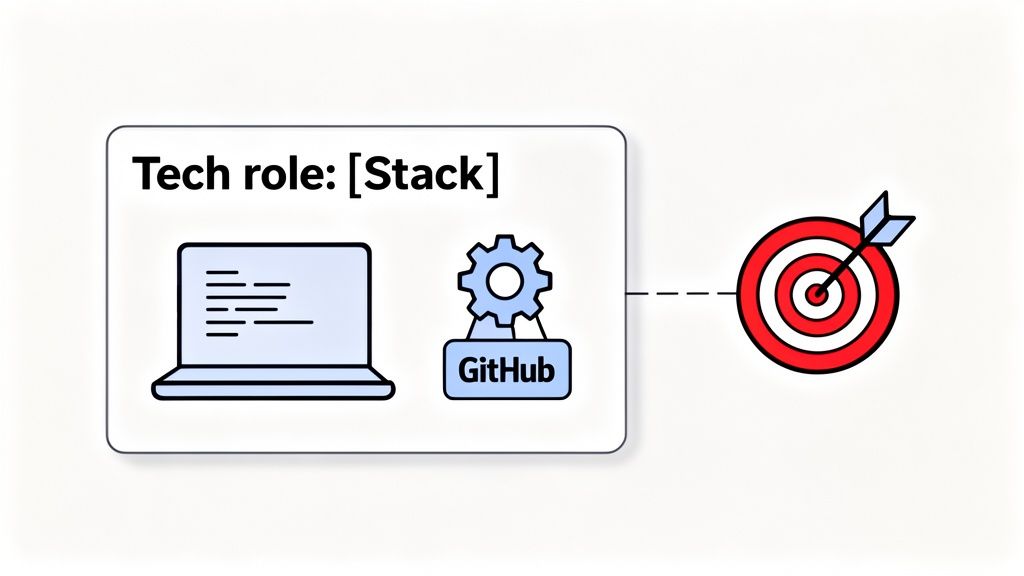
This approach is critical for companies like Cognition, which recruits for advanced AI systems design, or Ramp, which needs fintech infrastructure specialists. By referencing a candidate’s GitHub repository, a conference talk, or a technical blog post, you signal credibility and respect for their craft. This is one of the most effective recruitment email samples for engaging elite engineers who ignore 99% of inbound messages. Leveraging advanced candidate sourcing tools is key here.
Why this template works
Speaks their language: It uses precise technical terms and references, showing you understand the domain.
Problem-first approach: It frames the role around an interesting technical problem to be solved, appealing to an engineer’s core motivation.
Demonstrates credibility: Including links to your own company’s technical blog, whitepapers, or open-source projects proves you’re a serious engineering organization.
Actionable tips for implementation
Lead with the technical hook: Start your email by referencing their work. Example: “Saw your contributions to the Rust compiler on GitHub and was impressed with your work on memory optimization.”
Quantify the challenge: Be specific about the scale and complexity. Instead of “fast-paced environment,” use “we’re scaling our inference service to handle 100M queries/day with <50ms latency.”
Name-drop technical mentors: Mention senior engineers on the team they could learn from. Example: “You’d be working alongside [Lead Engineer’s Name], who authored the whitepaper on our distributed database.”
Provide technical artifacts: Link to a recent engineering blog post, a talk from a team member, or an open-source tool your team built. This provides social proof and deepens their interest.
8. What is a DEI-focused email? (Underrepresented Talent template)
This recruitment email sample is designed to engage talent from underrepresented groups by leading with a genuine commitment to diversity, equity, and inclusion. Instead of a generic outreach, it addresses potential historical barriers and highlights concrete DEI programs, employee resource groups (ERGs), and a culture of belonging. This template is critical for building diverse teams and tapping into talent pools often overlooked by traditional sourcing methods.
The approach requires authenticity. Success depends not on just saying you value diversity, but proving it with specific examples. Mentioning public diversity reports, partnerships with organizations like Women Who Code, or highlighting senior leaders from underrepresented backgrounds shows your commitment is more than words. This method builds trust and signals to candidates that they will be supported and valued.
Why this template works
Builds psychological safety: It explicitly welcomes diverse backgrounds, making candidates feel seen and encouraging them to apply where they might otherwise hesitate.
Demonstrates authenticity: Backing up claims with links to DEI reports, ERG pages, or flexible work policies proves your commitment is genuine.
Taps into overlooked talent: It directly connects with talented professionals who may not be active on mainstream platforms or who prioritize inclusive workplaces in their job search.
Actionable tips for implementation
Lead with commitment, not quotas: Frame the outreach around building an inclusive environment, not just hitting diversity numbers. Subject lines like “Building a diverse eng team at [Your Company]” work well.
Be specific and transparent: Vague statements are a red flag. Mention specific ERGs, mentorship programs, or family-friendly benefits. Example: “Our [ERG Name] provides a strong community for [Group], and we offer 20 weeks of gender-neutral parental leave.”
Earn the right: Only use this email if your company has tangible DEI initiatives. If you don’t have public metrics or active ERGs, focus on building those programs first.
Leverage community partnerships: Mention if your company partners with diversity-focused organizations like Code2040 or Lesbians Who Tech. This adds third-party validation to your claims.
To ensure your outreach is both effective and authentic, explore our guide on building impactful diversity recruiting strategies.
9. How do you create a multi-step nurture sequence? (Warm Lead template)
A multi-step nurture sequence builds relationships with warm leads over time, moving beyond the limitations of a single cold email. This method uses a coordinated series of 3-5 emails, sent over 2-4 weeks, to maintain engagement and guide a candidate toward a conversation. Instead of hoping a single message lands at the perfect moment, a sequence builds familiarity and provides value at multiple touchpoints, dramatically increasing the odds of a reply.
This approach works because persistence pays off, but only when it’s valuable and respectful. Modern recruitment practices show that automated sequences outperform single-send campaigns by a wide margin. Recruiters using platforms like Juicebox to automate these sequences report faster sourcing-to-shortlist cycles because the system handles the follow-ups, allowing them to focus on conversations with candidates who have shown interest.
Why this template works
Builds trust over time: Multiple points of contact create a sense of familiarity and demonstrate genuine, sustained interest in the candidate.
Provides value first: By sharing helpful resources or company insights, you position yourself as a valuable industry contact, not just a recruiter with a job to fill.
Catches candidates at the right time: A single email might arrive on a busy day, but a sequence increases the probability of connecting when the candidate is open to new opportunities.
Actionable tips for implementation
Establish a smart cadence: Follow a proven follow-up schedule like a 3-5-7-10 day cadence between emails. Use engagement data (opens/clicks) to adjust the timing or content for future messages.
Vary your content and CTAs: Start with a personalized compliment and a soft CTA. In the next email, share a valuable resource (like a company engineering blog post) with a lighter ask. Later, introduce proof points (like funding news or team growth) and address potential objections.
Use “Take the Pressure Off” messaging: In the final email, use a gentle closing like, “If the timing isn’t right, no problem at all. Let me know if I should reach out again in a few months.” This often gets a positive response.
Automate and monitor: Use a multi-step sequencer to manage the campaign and automatically pause it when a candidate replies. Monitor unsubscribe rates; if they exceed 2%, your cadence may be too aggressive or your content isn’t relevant enough.
To learn more about fostering long-term connections with top talent, read our guide on effective candidate relationship management.
Conclusion
The true takeaway isn’t memorizing a handful of templates, but internalizing the underlying principles that make them effective: hyper-personalization, value-first communication, and context-aware sequencing. Mastering these frameworks transforms your outreach from a numbers game into a strategic function that drives higher open rates, secures more replies, and ultimately, leads to better hires. This strategic shift unlocks a predictable, high-quality talent pipeline that consistently delivers the talent your organization needs to thrive.
Juicebox allows you to discover ideal candidates with PeopleGPT, verify their contact information, and enroll them in multi-step outreach sequences all from a single platform.
Start sourcing candidates with PeopleGPT:
Sign up for Juicebox (it's free!)
Run your first search for free. Find and engage top talent across 800M+ profiles. Trusted by 5,000+ customers.

FAQs: recruitment email sample (2026)
What is the most critical element of a successful recruitment email?
Personalization is the most critical element. A generic template is easily ignored, but an email that references a candidate’s specific project, recent talk, or unique skill proves you’ve done your research and significantly increases your chance of getting a reply.
How many follow-up emails are appropriate in a recruitment sequence?
A sequence of 2-3 follow-up emails, spaced 3-5 business days apart, is a standard best practice. Each follow-up should offer new value or a different angle, avoiding simple “just checking in” messages that can appear like spam and damage your sender reputation.
How can I A/B test my recruitment email samples effectively?
To A/B test effectively, change only one variable at a time, such as the subject line, the call-to-action, or the opening sentence. Send each version to a statistically significant group of similar candidates and track open rates and reply rates to determine which performs better.